This week Google Maps began using a new symbology on its maps.line features and place names are now outlined/shadowed, making the maps much easier to read. The new maps are more aesthetically pleasing, professional-looking, and sharper at every scale:
View Larger Map
View Larger Map
They actually remind me of the maps put out by Alexandria Drafting Company (ADC), the local standard in road atlases for a good long time.
Saturday, October 24, 2009

Friday, October 23, 2009
Suburbane
Today I stopped in Calverton to fill up on gas. Much to my surprise, the Sunoco station on Cherry Hill Road offered "NBC at the pump", a TV screen with news and entertainment snippets. I had to sort of chuckle at the combination of two uniquely suburban inventions.
I often wonder what of our American toys were popularized or invented because of suburbanization. I've opined in the past that youth sports rose to prominence because of the suburbs. But the popular axiom "it takes a village to raise a child" is virtually lost in isolated, homogenized suburban culture. My mother, who grew up in a Sicilian ghetto in the West Side of Buffalo back when it was a thriving industrial city, used to bemoan the amount of television I watched growing up. As a pre-adolescent, however, I had few other choices for any type of sensory stimulation.
The Northwest Branch ran along the eastern edge of my neighborhood in a steep wooded valley. Despite the hiking path running through it, I was not allowed to play down there because I could get hurt or abducted and there would be no one around to help. Acres of wooded wonder just blocks from my house, and I couldn't utilize it. I was not allowed to walk along or cross University Boulevard for safety reasons. I was allowed to walk home from school along University Boulevard, as well as cross over the Betlway, but that of course was under the watchful eye of a twelve year old wearing an orange patrol belt. These two restrictions confined me to the Franklin Knolls and Montgomery Knolls subdivisions, which included two outdoor community pools, an elementary and a middle school, a synagogue-cum-Baptist church, and a nursing home. Oh, and I almost left out the acres of colonials, ranchers, and cape cods arranged in a hilly, illogical road network.
Newer, shinier suburbs sprouted up in outer Silver Spring and other towns by the late '80's, leaving few children my age in my neighborhood. It was mostly empty-nesters like the holdover Jews from before the synagogue left, the old Greek, Italian, Armenian, and Irish Catholics who moved in at a time when out neighborhood was still connected to a Catholic parish, before the Beltway partitioned it. We might have moved out in the early '90's when the neighborhood really started going down hill. Many of my neighbors did. These were the neighbors that had somewhat prestigious government jobs, like my old next door neighbor the Secret Service Agent. My father fell into this category, but tragically he passed away in 1992, and with three of my siblings in college, my mother decided to stay put.
By that time, I was older. I had slightly more freedom. But any semblance of "community" that existed in the Woodmoor shopping center or the Four Corners area a mile down University Boulevard had long since been replaced by generic strip mall shops. No satisfaction of place there. I also was discouraged from riding the C2 and C4 buses because of "bus people". (My mother eventually convinced me to drop this prejudice that I learned in school, and in high school I became a "bus person"). While most of my friends had a Nintendo or a Sega Genesis, my mother refused to let me and my younger brother partake in video games. Video games are also quite practical in the suburbs. If I could immerse myself in Super Mario Brothers 3 for a couple hours a night, it would fill the void where I should have had a sense of place. Lack of video games led to me talking incessantly on the telephone.
Alexander Graham Bell once said that one day there would be a telephone in every major American city. It's easy to see how he would grossly underestimate his invention before the society was partitioned, isolated, and homogenized into suburban culture. The satisfaction of human interaction could be feigned through talking on the telephone, and later through its successors, the internet and the cell phone. Yes, these inventions have been quite useful and successful across the world. With over four billion subscribers worldwide, cell phones are considered the fastest propagating technology in the history of mankind. But the rise popularity of phones, like television, video games, and the internet, for better or for worse, is likely the product of the suburb induced loneliness that so many Americans suffer, completely unaware of the shortcomings of their environs.
Back in Buffalo, where many of my cousins live, one can still purchase a 4 bedroom single family house for under $7000. My aunts and uncles fled the West Side to McMansions in Williamsville and Amherst. The butcher on the corner of my grandparents' street is currently vacant. And Buffalo continues to spread itself thin. If you haven't recently moved to the most far flung, newly built suburb, you live in an undesirable area.
Meanwhile, Franklin Knolls made a bit of a comeback recently. My older sister now lives there with her family. The neighborhood owes its recovery in no small part to its proximity to Downtown Silver Spring and its revival. Our region has dropped that deleterious paradigm. Georgetown, where my older brother slummed with gutter punks in 1987, is now one of the most desirable and prestigious neighborhoods in the region (to the tune of I'll-never-be-able-to-afford-it). Georgetown was built 250 years ago for beauty and comfort, which back then came from sense of place. over time, it remained a memorable place. It became dignified and urbane, so much so that when the flight from the city occurred, those charms didn't abandon it. And in the flight back into the city, Georgetown immigrants would easily settle in to the timeless, memorable environment. In Franklin Knolls, my nephews will be far less likely to need television, video games, and telecommunications to find sense of place and social satisfaction like I did when I grew up there.
As for those vast mazes of colonials and cape cods in Silver Spring, they're slowly getting sidewalks, crosswalks, mixed use development, and better integration to their surroundings. With urbanization, I believe an area becomes more dignified, more memorable, more urbane. With suburbanization... well, I guess the only word to describe it is suburbane.
I often wonder what of our American toys were popularized or invented because of suburbanization. I've opined in the past that youth sports rose to prominence because of the suburbs. But the popular axiom "it takes a village to raise a child" is virtually lost in isolated, homogenized suburban culture. My mother, who grew up in a Sicilian ghetto in the West Side of Buffalo back when it was a thriving industrial city, used to bemoan the amount of television I watched growing up. As a pre-adolescent, however, I had few other choices for any type of sensory stimulation.
The Northwest Branch ran along the eastern edge of my neighborhood in a steep wooded valley. Despite the hiking path running through it, I was not allowed to play down there because I could get hurt or abducted and there would be no one around to help. Acres of wooded wonder just blocks from my house, and I couldn't utilize it. I was not allowed to walk along or cross University Boulevard for safety reasons. I was allowed to walk home from school along University Boulevard, as well as cross over the Betlway, but that of course was under the watchful eye of a twelve year old wearing an orange patrol belt. These two restrictions confined me to the Franklin Knolls and Montgomery Knolls subdivisions, which included two outdoor community pools, an elementary and a middle school, a synagogue-cum-Baptist church, and a nursing home. Oh, and I almost left out the acres of colonials, ranchers, and cape cods arranged in a hilly, illogical road network.
Newer, shinier suburbs sprouted up in outer Silver Spring and other towns by the late '80's, leaving few children my age in my neighborhood. It was mostly empty-nesters like the holdover Jews from before the synagogue left, the old Greek, Italian, Armenian, and Irish Catholics who moved in at a time when out neighborhood was still connected to a Catholic parish, before the Beltway partitioned it. We might have moved out in the early '90's when the neighborhood really started going down hill. Many of my neighbors did. These were the neighbors that had somewhat prestigious government jobs, like my old next door neighbor the Secret Service Agent. My father fell into this category, but tragically he passed away in 1992, and with three of my siblings in college, my mother decided to stay put.
By that time, I was older. I had slightly more freedom. But any semblance of "community" that existed in the Woodmoor shopping center or the Four Corners area a mile down University Boulevard had long since been replaced by generic strip mall shops. No satisfaction of place there. I also was discouraged from riding the C2 and C4 buses because of "bus people". (My mother eventually convinced me to drop this prejudice that I learned in school, and in high school I became a "bus person"). While most of my friends had a Nintendo or a Sega Genesis, my mother refused to let me and my younger brother partake in video games. Video games are also quite practical in the suburbs. If I could immerse myself in Super Mario Brothers 3 for a couple hours a night, it would fill the void where I should have had a sense of place. Lack of video games led to me talking incessantly on the telephone.
Alexander Graham Bell once said that one day there would be a telephone in every major American city. It's easy to see how he would grossly underestimate his invention before the society was partitioned, isolated, and homogenized into suburban culture. The satisfaction of human interaction could be feigned through talking on the telephone, and later through its successors, the internet and the cell phone. Yes, these inventions have been quite useful and successful across the world. With over four billion subscribers worldwide, cell phones are considered the fastest propagating technology in the history of mankind. But the rise popularity of phones, like television, video games, and the internet, for better or for worse, is likely the product of the suburb induced loneliness that so many Americans suffer, completely unaware of the shortcomings of their environs.
Back in Buffalo, where many of my cousins live, one can still purchase a 4 bedroom single family house for under $7000. My aunts and uncles fled the West Side to McMansions in Williamsville and Amherst. The butcher on the corner of my grandparents' street is currently vacant. And Buffalo continues to spread itself thin. If you haven't recently moved to the most far flung, newly built suburb, you live in an undesirable area.
Meanwhile, Franklin Knolls made a bit of a comeback recently. My older sister now lives there with her family. The neighborhood owes its recovery in no small part to its proximity to Downtown Silver Spring and its revival. Our region has dropped that deleterious paradigm. Georgetown, where my older brother slummed with gutter punks in 1987, is now one of the most desirable and prestigious neighborhoods in the region (to the tune of I'll-never-be-able-to-afford-it). Georgetown was built 250 years ago for beauty and comfort, which back then came from sense of place. over time, it remained a memorable place. It became dignified and urbane, so much so that when the flight from the city occurred, those charms didn't abandon it. And in the flight back into the city, Georgetown immigrants would easily settle in to the timeless, memorable environment. In Franklin Knolls, my nephews will be far less likely to need television, video games, and telecommunications to find sense of place and social satisfaction like I did when I grew up there.
As for those vast mazes of colonials and cape cods in Silver Spring, they're slowly getting sidewalks, crosswalks, mixed use development, and better integration to their surroundings. With urbanization, I believe an area becomes more dignified, more memorable, more urbane. With suburbanization... well, I guess the only word to describe it is suburbane.
Monday, October 19, 2009
Transit Capacity
Last month I criticized the plan to scale back Tysons Corner because of the need for increased freeway capacity. The more I think about it, the more merit I see in the notion that a revamped Tysons Corner will be desperately transit-starved. Freeways, however, are not the panacea. The plan to urbanize the region's most prominent edge city will bring thousands more jobs and residents to the area. Even if the area becomes more self contained, it will require much greater capacity for transportation in and out of the area's densest job center.
 Downtown Silver Spring from the Metro station. Photo by mindgutter
Tysons will have 4 stations, but they will only be able to handle about 40% of the rides of stations at Silver Spring, Bethesda, Rosslyn, and King Street. Matt Johnson at Track Twenty-Nine created an excellent diagram showing how track sharing by Metro lines closer in to the city prevent the same capacities on the outer spokes of the system (except on the Red Line, which does not share tracks with any other line). Even with four stations, the capacity of the line does not stack up to urbanizations in Montgomery County, Arlington, and Alexandria. Can it support an even larger development with less system capacity? Can the already-clogged North Arlington Orange Line corridor support the additional riders with its finite capacity? Optimal success of the Tysons plan would require more Metro capacity such as a separated Blue Line on a new Potomac crossing.
I'm also lead to wonder if this has not contributed to the overall inferior urbanization in Prince George's County. No station in Prince George's has more than 60% capacity because the Green, Blue, and Orange lines all share track inside the District (though the northern section of the Green Line as the potential to do so if the Yellow Line ever runs all the way to Greenbelt regularly). Certainly the County's poor planning policies have contributed to the lack of urban development around virtually all 14 Metro stations, often egregiously, but perhaps lack of capacity has contributed as well.
The stretch of Metro in Prince George's County with the most service, the northern Green(/sometimes Yellow) Line has experienced the most development. Prince George's Plaza Station has probably seen the most. Though not exactly Downtown Silver Spring yet, University Town Center is probably the best example of urban development around a Metro station in Prince George's. Much has been planned for West Hyattsville, College Park, and Greenbelt, though little has come to fruition. New Carrollton, which will have added capacity once the Purple Line comes to town, also has grand plans for development. Stops on the Blue and lower Green Lines, however, are not experiencing as much planning buzz.
I have never heard of any study that implies the impact of station capacity versus development around stations, but it stands to reason that the more capacity, the more successful and robust development can be. The Orange Line corridor might be somewhat of an exception. West of Rosslyn, the Orange line can handle about 60% of the trips Silver Spring or Bethesda can handle. The strip is anchored, however, by Rosslyn, which has the same capacity as Silver Spring and Bethesda.
David Alpert suggested some innovative ways to create more system capacity by separating the Green and Yellow lines and rerouting some of the Silver Line trains. This would help Prince George's County, Tysons Corner, and other locations in Virginia and still be cheaper (in theory) than a separated Blue Line. If Silver Spring, Bethesda, and Rosslyn are models we seek to emulate, station capacity ought to be equivalent of those successful areas.
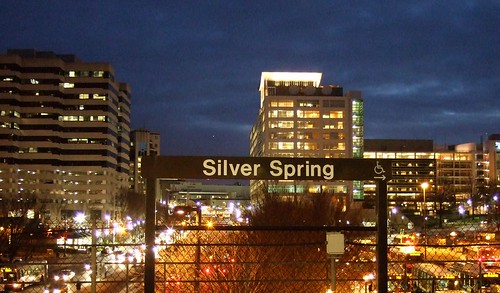 Downtown Silver Spring from the Metro station. Photo by mindgutter
Tysons will have 4 stations, but they will only be able to handle about 40% of the rides of stations at Silver Spring, Bethesda, Rosslyn, and King Street. Matt Johnson at Track Twenty-Nine created an excellent diagram showing how track sharing by Metro lines closer in to the city prevent the same capacities on the outer spokes of the system (except on the Red Line, which does not share tracks with any other line). Even with four stations, the capacity of the line does not stack up to urbanizations in Montgomery County, Arlington, and Alexandria. Can it support an even larger development with less system capacity? Can the already-clogged North Arlington Orange Line corridor support the additional riders with its finite capacity? Optimal success of the Tysons plan would require more Metro capacity such as a separated Blue Line on a new Potomac crossing.
I'm also lead to wonder if this has not contributed to the overall inferior urbanization in Prince George's County. No station in Prince George's has more than 60% capacity because the Green, Blue, and Orange lines all share track inside the District (though the northern section of the Green Line as the potential to do so if the Yellow Line ever runs all the way to Greenbelt regularly). Certainly the County's poor planning policies have contributed to the lack of urban development around virtually all 14 Metro stations, often egregiously, but perhaps lack of capacity has contributed as well.
The stretch of Metro in Prince George's County with the most service, the northern Green(/sometimes Yellow) Line has experienced the most development. Prince George's Plaza Station has probably seen the most. Though not exactly Downtown Silver Spring yet, University Town Center is probably the best example of urban development around a Metro station in Prince George's. Much has been planned for West Hyattsville, College Park, and Greenbelt, though little has come to fruition. New Carrollton, which will have added capacity once the Purple Line comes to town, also has grand plans for development. Stops on the Blue and lower Green Lines, however, are not experiencing as much planning buzz.
I have never heard of any study that implies the impact of station capacity versus development around stations, but it stands to reason that the more capacity, the more successful and robust development can be. The Orange Line corridor might be somewhat of an exception. West of Rosslyn, the Orange line can handle about 60% of the trips Silver Spring or Bethesda can handle. The strip is anchored, however, by Rosslyn, which has the same capacity as Silver Spring and Bethesda.
David Alpert suggested some innovative ways to create more system capacity by separating the Green and Yellow lines and rerouting some of the Silver Line trains. This would help Prince George's County, Tysons Corner, and other locations in Virginia and still be cheaper (in theory) than a separated Blue Line. If Silver Spring, Bethesda, and Rosslyn are models we seek to emulate, station capacity ought to be equivalent of those successful areas.
Wednesday, October 14, 2009
Bolling Air Force Waste
Neil at GGW had a great article about the proposal to narrow the Anacostia River (dubbed the McMillian Two Plan) and bring a bit of Paris to eastern DC. If it works and can be done with environmental prudence, I am absolutely in love with the idea. It strengthens the urban fabric of the city, it extends the grid to an underdeveloped but historic part of the city, and it creates more monumental space in the city.
But my favorite part? The plan appears to redevelop the northern part of Bolling Air Force Base. Bolling AFB is an abominable waste of valuable riverfront real estate. Some might argue that the Nation's Capital ought to play host to military facilities. As a former soldier, this is a no-brainer. Of course it should. But DoD property within the District ought to use the space in a manner that is congruent with the rest of the city. Across the Anacostia River, Fort McNair interacts with its urban environment productively and in keeping with the other infrastructure surrounding it. Bolling AFB looks like it could have been built on an empty greenfield an hours drive from the city:
View Larger Map
Does an Air Force base (especially one without an active air strip since 1962) need to take up this much land? Does the utterly suburban housing stock need to sit atop land above one of the most iconic rivers in the world? I'm sure this is no problem at Minot AFB in North Dakota, but the District of Columbia has only 68 square miles. Should almost 5% of it be devoted to isolated, wasteful suburban style land use? Perhaps its time to consolidate Bolling's facilities into something that works better with the city surrounding it, and redevelop Southwest's Potomac waterfront in a manner more suited to its urban environment.
But my favorite part? The plan appears to redevelop the northern part of Bolling Air Force Base. Bolling AFB is an abominable waste of valuable riverfront real estate. Some might argue that the Nation's Capital ought to play host to military facilities. As a former soldier, this is a no-brainer. Of course it should. But DoD property within the District ought to use the space in a manner that is congruent with the rest of the city. Across the Anacostia River, Fort McNair interacts with its urban environment productively and in keeping with the other infrastructure surrounding it. Bolling AFB looks like it could have been built on an empty greenfield an hours drive from the city:
View Larger Map
Does an Air Force base (especially one without an active air strip since 1962) need to take up this much land? Does the utterly suburban housing stock need to sit atop land above one of the most iconic rivers in the world? I'm sure this is no problem at Minot AFB in North Dakota, but the District of Columbia has only 68 square miles. Should almost 5% of it be devoted to isolated, wasteful suburban style land use? Perhaps its time to consolidate Bolling's facilities into something that works better with the city surrounding it, and redevelop Southwest's Potomac waterfront in a manner more suited to its urban environment.
Tuesday, September 15, 2009
Tysons Should Look North
Montgomery County Maryland has no limited access freeways that lead into DC. There is the Clara Barton Parkway, a limited access 4-lane parkway at the extreme western edge that ferries traffic to Georgetown with few at-grade intersections, but that's it. Nearly one million people live in Montgomery County, but none of them are hopping on a freeway to get to work Downtown in the morning.
I'm not sure if this is a chicken-and-egg issue, but I'm quite sure that this is related to the fact that the Metro's Red Line, which terminates both ends in Montgomery County, has the highest capacity and ridership of any single line. It shares no track with any other lines. Silver Spring and Bethesda have approximately 70,000 residents in each of their downtowns, and yet not a single freeway runs through them. And in each of those downtowns, there is only one Metro station.
Why then, shouldn't Tyson's Corner be able to thrive without freeway widening once it gets its FOUR Silver Line stations? Fairfax County is planning on scaling back its redevelopment because of potential stress on the freeways 40 years from now.
Their rationale is simple: many people will still drive. Well, sure. Especially if you widen the freeways. And especially if the Silver Line is shoehorned through a huge choke point at Rosslyn, where three lines will be sharing one track.
Perhaps Fairfax County should be considering the enhancement of Metro capacity instead of the worrying about freeways. Montgomery County has an assortment of redeveloped edge cities that don't have any freeways connecting their downtowns with DC. If the Beltway is the worry, why not seek to invest in a transit connection between Fairfax and Montgomery Counties?
People drive primarily because driving has been subsidized into being the best option. If Tyson's Corner is looking to progressively remodel the region, perhaps they should think outside the box and reimagine their transit options.
I'm not sure if this is a chicken-and-egg issue, but I'm quite sure that this is related to the fact that the Metro's Red Line, which terminates both ends in Montgomery County, has the highest capacity and ridership of any single line. It shares no track with any other lines. Silver Spring and Bethesda have approximately 70,000 residents in each of their downtowns, and yet not a single freeway runs through them. And in each of those downtowns, there is only one Metro station.
Why then, shouldn't Tyson's Corner be able to thrive without freeway widening once it gets its FOUR Silver Line stations? Fairfax County is planning on scaling back its redevelopment because of potential stress on the freeways 40 years from now.
Their rationale is simple: many people will still drive. Well, sure. Especially if you widen the freeways. And especially if the Silver Line is shoehorned through a huge choke point at Rosslyn, where three lines will be sharing one track.
Perhaps Fairfax County should be considering the enhancement of Metro capacity instead of the worrying about freeways. Montgomery County has an assortment of redeveloped edge cities that don't have any freeways connecting their downtowns with DC. If the Beltway is the worry, why not seek to invest in a transit connection between Fairfax and Montgomery Counties?
People drive primarily because driving has been subsidized into being the best option. If Tyson's Corner is looking to progressively remodel the region, perhaps they should think outside the box and reimagine their transit options.
Monday, September 7, 2009
Labor Day Quick Links
August and September are very busy months for me, so it's difficult to keep up with writing original articles regularly. But please, take a look at some of the links to the right, they are all interesting blogs. Here is a sampling.
DCMUD - More, better housing near a Metro station in a rapidly improving part of the city: Deanwood
GreaterGreaterWashington - Track Twenty-Nine's Matt Johnson has written three spectacular series on freight and passenger rail in DC, station motifs on Metro, and the naming conventions for streets in the District of Columbia
And Now, Anacostia - How soon before Anacostia has streetcars?
Southeast Socialite - Never mincing words, she comments on a critique of Marion Barry, and concern about Eleanor Holmes Norton's lack of responsiveness to public queries.
Bloomingdale (For Now) - Clarifies the location of a section of 7th Street being renamed in honor of the father of go-go
Fairfax Suburbanista - Fairfax City is suburbanizing its Old Town with suburban townhouses. I wonder why they don't just try a traditional plot of townhouses?
WalkLaurel - It's a new website that explains forthcoming pedestrian and traffic improvements in the city of Laurel
Just Up The Pike - Photographs of the ICC construction through an area where several people lost their homes for the sake of the project.
Baltimore Inner Space - Discusses the "low hanging fruit" plan for the Red Line
The Overhead Wire - Discusses the George W. Bush Presidential Library and its ironic proximity to transit
Extraordinary Observations - Are Whole Foods' high prices worth a boycott? Rob argues NO.
DC Sports Bog - While admitting to being on the wrong side of history, Dan Steinberg attempts to douse some of the fire over the Redskins ticket scandal.
Hope you check a few of these articles out. Hope everyone enjoys Labor Day in the seat of the free world.
DCMUD - More, better housing near a Metro station in a rapidly improving part of the city: Deanwood
GreaterGreaterWashington - Track Twenty-Nine's Matt Johnson has written three spectacular series on freight and passenger rail in DC, station motifs on Metro, and the naming conventions for streets in the District of Columbia
And Now, Anacostia - How soon before Anacostia has streetcars?
Southeast Socialite - Never mincing words, she comments on a critique of Marion Barry, and concern about Eleanor Holmes Norton's lack of responsiveness to public queries.
Bloomingdale (For Now) - Clarifies the location of a section of 7th Street being renamed in honor of the father of go-go
Fairfax Suburbanista - Fairfax City is suburbanizing its Old Town with suburban townhouses. I wonder why they don't just try a traditional plot of townhouses?
WalkLaurel - It's a new website that explains forthcoming pedestrian and traffic improvements in the city of Laurel
Just Up The Pike - Photographs of the ICC construction through an area where several people lost their homes for the sake of the project.
Baltimore Inner Space - Discusses the "low hanging fruit" plan for the Red Line
The Overhead Wire - Discusses the George W. Bush Presidential Library and its ironic proximity to transit
Extraordinary Observations - Are Whole Foods' high prices worth a boycott? Rob argues NO.
DC Sports Bog - While admitting to being on the wrong side of history, Dan Steinberg attempts to douse some of the fire over the Redskins ticket scandal.
Hope you check a few of these articles out. Hope everyone enjoys Labor Day in the seat of the free world.
Friday, September 4, 2009
Baltimore Yellow Line Boondoggle
GGW's breakfast links yesterday had a troubling article at the bottom. The Central Maryland Transit Alliance wants to prioritize extending Baltimore's Yellow Line light rail to Columbia over extending the Green Line subway to White Marsh. I can't even begin to express how dumb of an idea this is.
The Green Line extension will hit developed areas in a large city with a burgeoning centralized train system in place. This is smart. The Yellow Line extension will connect Columbia to downtown Baltimore on a very long, very circuitous route that by-passes Fort Meade, the largest employment center in the state of Maryland.
Baltimore City needs transit connections. It needs an expanded system. It needs a centralized system. A Yellow Line extension would bolster businesses in Columbia and Towson. These are decentralized locations. A Green Line extension would bolster more centralized business districts like the Belair Road and Harford Road corridors. These are centralized areas. Baltimore has been decentralizing for fifty years, and it's not working.
From Columbia, the Yellow Line would take 42 minutes to get to BWI Airport, and then another 27 to get to downtown Baltimore. An hour and nine minutes to get from Columbia to Baltimore. The northern section of the Yellow Line is actually a good idea, connecting several colleges along a main thoroughfare through the city proper. But the southern portion is as circuitous and useless as the current plan for the CCT in Gaithersburg.
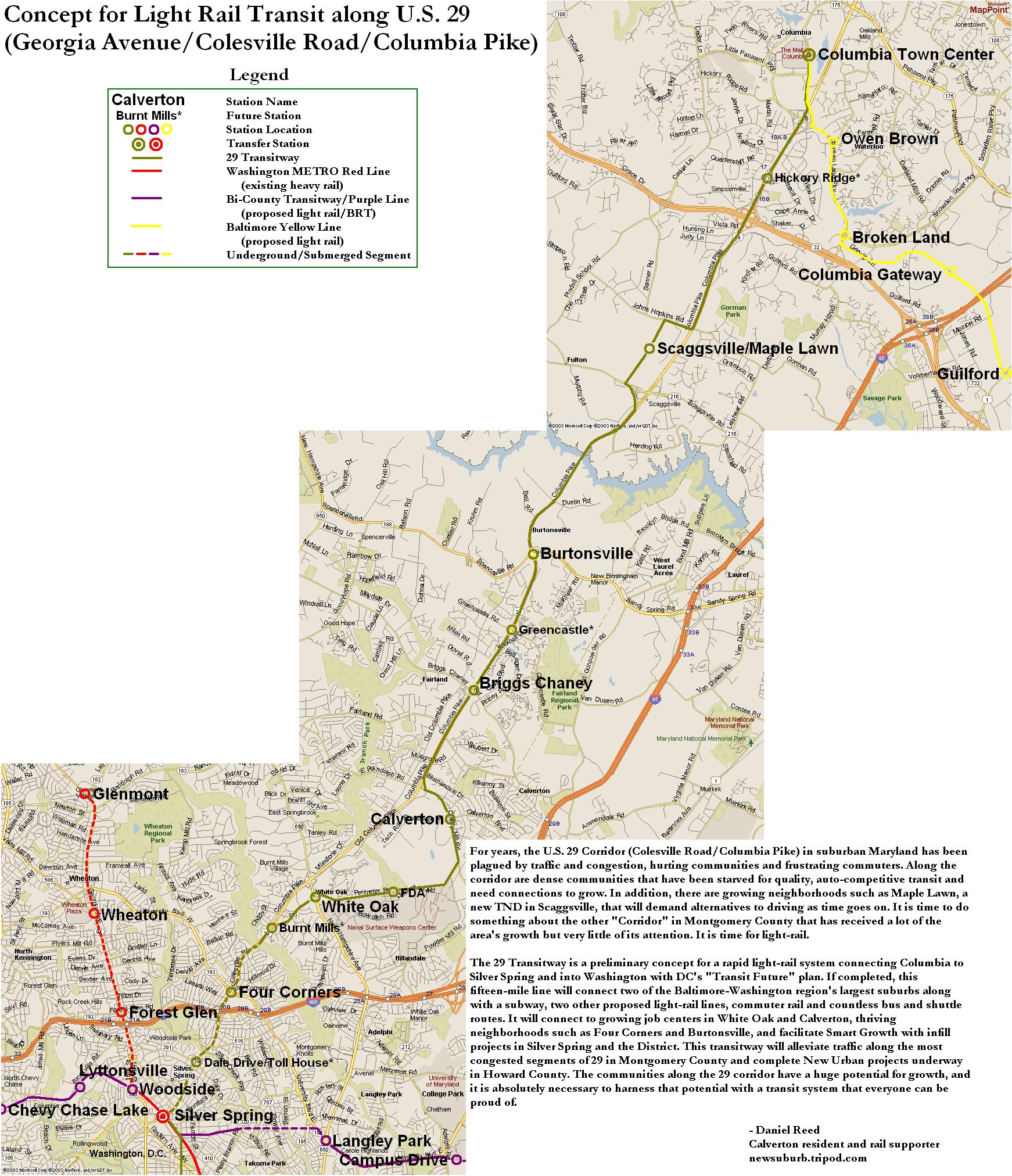
CMTA, if you want light rail connecting Columbia to the city, why not push for the US-29 light rail project that was once promised to run from Silver Spring to Columbia? A direct route to the city, not a circuitous one, that hits several established communities along the way is what Central Maryland Transit Alliance ought to be seeking. I don't know how long Dan Reed's alignment (linked above) would take to get from Columbia to downtown DC, but I bet it's faster than 69 minutes.
And if Maryland does decide to run light rail further away from Baltimore, can you at least make some effort to hit the 50,000+ job center at Fort Meade before it is completely choking the region with traffic? I bet you a rail right-of-way that a lot of those employees live in Columbia.
The Green Line extension will hit developed areas in a large city with a burgeoning centralized train system in place. This is smart. The Yellow Line extension will connect Columbia to downtown Baltimore on a very long, very circuitous route that by-passes Fort Meade, the largest employment center in the state of Maryland.
Baltimore City needs transit connections. It needs an expanded system. It needs a centralized system. A Yellow Line extension would bolster businesses in Columbia and Towson. These are decentralized locations. A Green Line extension would bolster more centralized business districts like the Belair Road and Harford Road corridors. These are centralized areas. Baltimore has been decentralizing for fifty years, and it's not working.
From Columbia, the Yellow Line would take 42 minutes to get to BWI Airport, and then another 27 to get to downtown Baltimore. An hour and nine minutes to get from Columbia to Baltimore. The northern section of the Yellow Line is actually a good idea, connecting several colleges along a main thoroughfare through the city proper. But the southern portion is as circuitous and useless as the current plan for the CCT in Gaithersburg.
CMTA, if you want light rail connecting Columbia to the city, why not push for the US-29 light rail project that was once promised to run from Silver Spring to Columbia? A direct route to the city, not a circuitous one, that hits several established communities along the way is what Central Maryland Transit Alliance ought to be seeking. I don't know how long Dan Reed's alignment (linked above) would take to get from Columbia to downtown DC, but I bet it's faster than 69 minutes.
And if Maryland does decide to run light rail further away from Baltimore, can you at least make some effort to hit the 50,000+ job center at Fort Meade before it is completely choking the region with traffic? I bet you a rail right-of-way that a lot of those employees live in Columbia.
Wednesday, August 12, 2009
You Have To Play To Win
This is a follow-up to last week's post on youth sports.
Silver Spring is a wonderful town by virtue of the dynamic population. I believe it is rare to find a town as diverse. But with the good come the bad.
There are about 300 boys who play football for the Silver Spring Saints. A good portion of them come from single parent households, many others have two working parents. Ironically, since my last post, my team has lost two players who are unable to find transportation to the practices and games. One of those boys played in our program last year, and had been concerned about avoiding gangs in his school. With a single working mother and no extra curricular activity this fall, it raises my concern for him.
I have also been humbled by the immense sacrifices some parents and players make to participate in these programs. Two years ago, a player for my team took two buses to get from school to football practice, and another two to get from football practice back home to Rockville. All in all, every night he had practice was an additional four hours of transportation and walking along unsafe roads. An hour and a half each way between Silver Spring and Rockville on the bus. His single mother had no car, and they relied on coaches to get to and from games. At the time, there was no program in Rockville for which he was eligible to play, and he chose Silver Spring over one other program where he could take the bus to practice from his school.
Many families scrape to come up with the fees to play in a well-organized league. These fees generally run around a couple hundred dollars, and fundraisers and donations are often used to help out families that might not otherwise be able to afford them. When transportation has a negative impact on a child's ability to engage in constructive activities, these children will become isolated and be far more likely to become absorbed into unfavorable activities. No matter how much money is raised, fundraisers and donations will never safely help a young man get to and from our football field. Because of this, how many children will be unable to play youth sports in our region? I know about a handful that had to quit. I'm quite sure there are many more who were never even able to consider it.
Silver Spring is a wonderful town by virtue of the dynamic population. I believe it is rare to find a town as diverse. But with the good come the bad.
There are about 300 boys who play football for the Silver Spring Saints. A good portion of them come from single parent households, many others have two working parents. Ironically, since my last post, my team has lost two players who are unable to find transportation to the practices and games. One of those boys played in our program last year, and had been concerned about avoiding gangs in his school. With a single working mother and no extra curricular activity this fall, it raises my concern for him.
I have also been humbled by the immense sacrifices some parents and players make to participate in these programs. Two years ago, a player for my team took two buses to get from school to football practice, and another two to get from football practice back home to Rockville. All in all, every night he had practice was an additional four hours of transportation and walking along unsafe roads. An hour and a half each way between Silver Spring and Rockville on the bus. His single mother had no car, and they relied on coaches to get to and from games. At the time, there was no program in Rockville for which he was eligible to play, and he chose Silver Spring over one other program where he could take the bus to practice from his school.
Many families scrape to come up with the fees to play in a well-organized league. These fees generally run around a couple hundred dollars, and fundraisers and donations are often used to help out families that might not otherwise be able to afford them. When transportation has a negative impact on a child's ability to engage in constructive activities, these children will become isolated and be far more likely to become absorbed into unfavorable activities. No matter how much money is raised, fundraisers and donations will never safely help a young man get to and from our football field. Because of this, how many children will be unable to play youth sports in our region? I know about a handful that had to quit. I'm quite sure there are many more who were never even able to consider it.
Tuesday, August 4, 2009
Youth Sports and the Automobile
 It's August, the time of year where I return to my favorite volunteer activity coaching youth football in Silver Spring. Youth sports, despite my lack of athletic prowess, were a big part of my childhood and were probably the only thing that kept me reaching the age of 20 with any semblance of physical conditioning. To a suburban child, youth sports will offer exercise and teach social integration in a safe environment.
My 2008 squad.
Exercise is a valuable commodity in the suburbs. You don't burn many calories from the passenger seat of a minivan. The extreme, of course, is Saratoga Springs, where a student was recently punished for riding his bike to school. The policy against biking to school is of course disguised in the name of safety. Social integration is also more valuable in the suburbs. Suburban children grow up cloistered in pods that effectively segregate socio-economic classes from each other. And despite the marketing, the suburbs are not the safest place to be a kid. So a program that offers exercise, social integration, and safety ought not be undervalued, be it football, swimming, ballet, or whatever.
Are youth sports a rare positive side effect of suburbanization? The Mid Maryland Football League has 26 programs spread out over Montgomery, Prince George's, Anne Arundel, Howard, Baltimore, Frederick, and Carroll Counties, and could never survive without the suburban infrastructure. I used to think youth football could not survive without it at all.
***
The Silver Spring Saints, for whom I coach, are one of the oldest youth programs still in existence in the DC area. When I played on this team as a youth, however, it was Saint Bernadette's, a Catholic Youth Organization program. CYO football went under in 1995, however, and the Silver Spring Saints rose from the ashes, playing their home games at Saint Bernadette's field. When It was Saint Bernadette's, however, the program had two teams with about 23 or so players per team. At its peak, the CYO had 40 or 50 such teams in Montgomery, Prince George's, and DC, and they were broken into geographic-based divisions. It was the premier youth football program in Maryland for decades.
When the Silver Spring Saints joined the Capital Beltway League in 1995, the one-time parish-oriented program had to struggle to field teams in six weight classes, effectively tripling the size of the program overnight and drawing in players from a much larger area. As it struggled with finding enough players, the notion of playing games close by started to disappear. Montgomery Village, Clinton, Germantown, and Bowie were now the away games as opposed to other small teams in Silver Spring, Wheaton, and Rockville. This season, the Saints have joined the Mid-Maryland League to escape the poor organization of the CBL. They are now required to field 12 teams. Many of them will only have about 15 or 16 players. (For those of you not familiar with the sport, there are 11 on the field at a time. An NFL team has 53 players. 24 is an ideal number at the youth level)
I love the Saints organization, and what it does for young men between the ages of 6 and 14. Growing up in a single parent household, it gave me male role models, goals, and a sense of belonging that every boy should experience. But in the time between when I played and now that I coach, it has gone from a "mom and pop" program belonging to a community organization to a "big box" program. The parish still has a strong influence on the program, which in my opinion has kept it about the players and not about championships and egos (though we win our share of games).
No, it's hard to imagine youth football now without cars and giant parking lots at each field, where 12 games are played by each program every Saturday and teams drive as many as 80 miles to play each other. But it hasn't been that way throughout the history of the Silver Spring Saints. For their very first game 58 years ago, the first 12 Saints played Saint Micheal's of downtown Silver Spring, two miles away from Saint Bernadette's. To get there, they took a Capitol Transit Bus.
Thursday, July 30, 2009
Imagine the Beltway at New Hampshire Avenue
The Beltway is a dangerous road full of daunting lane shifts and bottlenecks that bring the ire of even the most seasoned drivers. The area around its junction with I-95 receives a lot of attention, but the problems on its northern counterpart often go ignored.
Westbound 495/95 is four lanes until the interchange with US-1. Both ramps from US-1 to The Beltway create additional westbound lanes, making it six lanes wide at the 95/495 split. Four lanes continue westbound. The ramps from Southbound 1-95 swell the roadway back to six westbound lanes. One lane splits off as an exit for northbound New Hampshire Avenue. A flyover ramp replaces it, creating a weave-style merge for cars entering the westbound Beltway from NH northbound and exiting the Beltway southbound. After the interchange, the highway quickly bottlenecks from 6 lanes back to four. Sound confusing? Try diving it.
A driver who wants to exit the Beltway at New Hampshire Avenue northbound must cross two lanes of traffic even if they were in the far right lane before the I-95 merger. For drivers wishing to head southbound on New Hampshire, they must still cross an extra lane of traffic and then contend with merging across the cars entering the Beltway.
View NH Av Interchange in a larger map
My idea would be to remove one westbound lane where northbound 1-95 splits off to the north, making the stretch between northbound I-95 and southbound I-95 three lanes. When the two southbound lanes join the Beltway, it will be five lanes wide.
Next, remove the exit to southbound New Hampshire Avenue, eliminating a dangerous merge area. Instead, direct that traffic down the northbound exit to a left turn, much like the Georgia Avenue, Connecticut Avenue, and University Boulevard exits off the westbound Beltway. The intersection at the end of the northbound exit is already signaled, it would only need provisions for left turning (southbound) vehicles.
In addition to making this interchange safer for Beltway drivers, it creates a safer environment for pedestrians on New Hampshire Avenue. Not by much, but it would be a start. But just for kicks, I threw in a small street grid, in hopes that Hillandale may one day be a little more pedestrian friendly. They already have a LEED Gold building, perhaps more positive change is on the way.
Westbound 495/95 is four lanes until the interchange with US-1. Both ramps from US-1 to The Beltway create additional westbound lanes, making it six lanes wide at the 95/495 split. Four lanes continue westbound. The ramps from Southbound 1-95 swell the roadway back to six westbound lanes. One lane splits off as an exit for northbound New Hampshire Avenue. A flyover ramp replaces it, creating a weave-style merge for cars entering the westbound Beltway from NH northbound and exiting the Beltway southbound. After the interchange, the highway quickly bottlenecks from 6 lanes back to four. Sound confusing? Try diving it.
A driver who wants to exit the Beltway at New Hampshire Avenue northbound must cross two lanes of traffic even if they were in the far right lane before the I-95 merger. For drivers wishing to head southbound on New Hampshire, they must still cross an extra lane of traffic and then contend with merging across the cars entering the Beltway.
View NH Av Interchange in a larger map
My idea would be to remove one westbound lane where northbound 1-95 splits off to the north, making the stretch between northbound I-95 and southbound I-95 three lanes. When the two southbound lanes join the Beltway, it will be five lanes wide.
Next, remove the exit to southbound New Hampshire Avenue, eliminating a dangerous merge area. Instead, direct that traffic down the northbound exit to a left turn, much like the Georgia Avenue, Connecticut Avenue, and University Boulevard exits off the westbound Beltway. The intersection at the end of the northbound exit is already signaled, it would only need provisions for left turning (southbound) vehicles.
In addition to making this interchange safer for Beltway drivers, it creates a safer environment for pedestrians on New Hampshire Avenue. Not by much, but it would be a start. But just for kicks, I threw in a small street grid, in hopes that Hillandale may one day be a little more pedestrian friendly. They already have a LEED Gold building, perhaps more positive change is on the way.
Subscribe to:
Posts (Atom)

 Posts
Posts