Having experienced many of my Christmases as a youth in Buffalo, I'm generally nonplussed by big snow storms. This one has confined me to my house, however, and I've been watching the madness unfold on News Channel 8, where they are warning us not to venture outside our houses if we don't have to do so.
Route 1 in Laurel, taken from the front of the Greene Turtle. Plenty of cars were out despite warnings, making pedestrian conditions hazardous. Photo by the author.
Generally, that's very good advice. However, they were showing footage of pedestrians crossing streets and dismissing it as wildly dangerous behavior because, hey, cars gotta use those streets! Certainly driving conditions merit warnings, but why are we chiding the pedestrians instead of the people driving non-emergency vehicles? How are pedestrians expected to stay out of the streets when public services are focusing efforts on clearing roadways while ignoring sidewalks?
Prince George's County Executive Jack Johnson declared a state of emergency because so many county residents failed to heed warnings not to drive. I saw a few of those obstinate drivers on my walk to the Safeway in my neighborhood... which of course was closed. In fact, the only things open in Laurel Lakes Shopping Center were a nail salon (?) and a liquor store. Eventually I found an open 7-11, but suffice to say there was a lack of healthy diet staples. The proprietor, Pankaj, had walked to his store this morning to make sure Laurel Lakes could at least purchase Hot Pockets and yogurt smoothies if nothing else. This really made me wish my neighborhood had live-work units. Not to mention sidewalks.
Despite my lack of healthy food, open shops, and decent pedestrian facilities, at least I wasn't threatened with a gun during a snowball fight. A public gathering in the public realm at 14th and U NW was broken up because... wait for it... a car was hit by a couple of snowballs. The man brandishing the weapon was an off-duty policeman. The message: People don't matter in a snow emergency. Cars do.
Search This Blog
Showing posts with label Laurel. Show all posts
Saturday, December 19, 2009
Monday, September 7, 2009
Labor Day Quick Links
August and September are very busy months for me, so it's difficult to keep up with writing original articles regularly. But please, take a look at some of the links to the right, they are all interesting blogs. Here is a sampling.
DCMUD - More, better housing near a Metro station in a rapidly improving part of the city: Deanwood
GreaterGreaterWashington - Track Twenty-Nine's Matt Johnson has written three spectacular series on freight and passenger rail in DC, station motifs on Metro, and the naming conventions for streets in the District of Columbia
And Now, Anacostia - How soon before Anacostia has streetcars?
Southeast Socialite - Never mincing words, she comments on a critique of Marion Barry, and concern about Eleanor Holmes Norton's lack of responsiveness to public queries.
Bloomingdale (For Now) - Clarifies the location of a section of 7th Street being renamed in honor of the father of go-go
Fairfax Suburbanista - Fairfax City is suburbanizing its Old Town with suburban townhouses. I wonder why they don't just try a traditional plot of townhouses?
WalkLaurel - It's a new website that explains forthcoming pedestrian and traffic improvements in the city of Laurel
Just Up The Pike - Photographs of the ICC construction through an area where several people lost their homes for the sake of the project.
Baltimore Inner Space - Discusses the "low hanging fruit" plan for the Red Line
The Overhead Wire - Discusses the George W. Bush Presidential Library and its ironic proximity to transit
Extraordinary Observations - Are Whole Foods' high prices worth a boycott? Rob argues NO.
DC Sports Bog - While admitting to being on the wrong side of history, Dan Steinberg attempts to douse some of the fire over the Redskins ticket scandal.
Hope you check a few of these articles out. Hope everyone enjoys Labor Day in the seat of the free world.
DCMUD - More, better housing near a Metro station in a rapidly improving part of the city: Deanwood
GreaterGreaterWashington - Track Twenty-Nine's Matt Johnson has written three spectacular series on freight and passenger rail in DC, station motifs on Metro, and the naming conventions for streets in the District of Columbia
And Now, Anacostia - How soon before Anacostia has streetcars?
Southeast Socialite - Never mincing words, she comments on a critique of Marion Barry, and concern about Eleanor Holmes Norton's lack of responsiveness to public queries.
Bloomingdale (For Now) - Clarifies the location of a section of 7th Street being renamed in honor of the father of go-go
Fairfax Suburbanista - Fairfax City is suburbanizing its Old Town with suburban townhouses. I wonder why they don't just try a traditional plot of townhouses?
WalkLaurel - It's a new website that explains forthcoming pedestrian and traffic improvements in the city of Laurel
Just Up The Pike - Photographs of the ICC construction through an area where several people lost their homes for the sake of the project.
Baltimore Inner Space - Discusses the "low hanging fruit" plan for the Red Line
The Overhead Wire - Discusses the George W. Bush Presidential Library and its ironic proximity to transit
Extraordinary Observations - Are Whole Foods' high prices worth a boycott? Rob argues NO.
DC Sports Bog - While admitting to being on the wrong side of history, Dan Steinberg attempts to douse some of the fire over the Redskins ticket scandal.
Hope you check a few of these articles out. Hope everyone enjoys Labor Day in the seat of the free world.
Labels:
Baltimore,
DC,
ICC,
Laurel,
Redskins,
River East,
Silver Spring
Monday, March 16, 2009
A Big Box Tale
When I moved into Laurel in late 2003, it seemed as if the city's primary industry was furniture sales. I found the jewel of the bunch, Carolina Furniture. I purchased the bulk of the furniture for my hew house at Carolina Furniture, then located on the corner of Main Street and Rt. 1. It was a small business, but had a very helpful staff and one of the best selections I have ever come across, especially impressive considering the modest size of the store. I loved it. I bought a couch and a love seat for half the price of what the Laurel Marlo (prominently located at Rt. 1 and Contee Road) was offering me for just the couch!
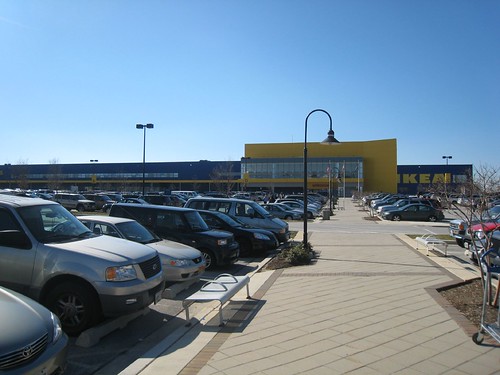
Then came the College Park Ikea. I'll admit, as far as big box stores go, I don't mind Ikea too much. But the College Park location was devastating to local businesses.
Carolina Furniture was the first to go. First it moved to an obviously cheaper site in an industrial park off Bowie Road. By early 2006, it had closed up shop. Galaxy Furniture, located on the site where Burtonsville's Dutch Country Farmers' Market was scheduled to move, fell shortly after. Another mile down Rt. 198 was Regency, a huge warehouse-like store located in a strip mall next to a Target. It closed up shop shortly after. Empire Furniture in Laurel Mall went next, followed by another smaller store that briefly opened in the mall. The tiny family-owned shop across from Galaxy closed just a few months ago. Several others have closed throughout the years in the industrial parks between Rt. 1 and the train tracks. Even the Peir One has closed its doors
Currently, Bargain Furniture is going out of business. This store sold scratched or irregular new furniture at a huge discount, and they offered delivery service only on a few select items. I thought this place would never close. It was always crowded with people looking for a deal on another store's rejected items. But today it is liquidating its stock, as you'll clearly see if you drive through the intersection of 197 and 198.
All in all, at least 9 furniture places have closed in Laurel in the last three years. The only furniture place left in Laurel is mega-chain Marlo, the only store in Laurel I've never recommended because of the poor service I recieved there when purchasing my furniture. All of them were either independent or small chains. I'm sure our recession has played a large part in shutting down these stores, but I can't help but think there were almost a dozen furniture stores before Ikea and now Laurel is down to one or two.
Ikea's iconic 200 foot sign visible from the Beltway for a mile in either direction draws people in to its acres and acres of parking. While the upper level features furniture, the lower level has all kinds of housewares, much like your average Wal-Mart (though of much better quality, generally). The store even features a Swedish cafeteria and a child day-care center. The furniture, however, is do-it-yourself. It is difficult at Ikea to find the country-style furniture I prefer. All the furniture is self-assembled. And no matter how friendly and courteous the staff at the store may be (they tend to be rather hard to pin down), you are one of thousands of shoppers. If you don't buy it, the next person will.
When I bought my living room and dining room sets at Carolina Furniture, everything was delivered and (if needed) assembled at my house at no extra charge. A year later, I took some Army buddies there who had just been stationed at Fort Meade. The sales rep recognized me immediately, even remembering my name and what I had bought. But in Laurel, it appears, those days are long gone. If I want to buy furniture locally, I have to stand in a long line at Ikea or get ripped off by Marlo.
Monday, February 2, 2009
Free Gas at My Grocery Store?
This past Saturday, I was shopping at the Safeway in Laurel Lakes. Upon checkout, I received a surprise: $9 worth of gas at any BP station, a figure based on the amount of money I had spent on groceries over my last few trips. I was completely unaware of this program until the cashier handed me a gift card. The program gives $1.50 in gas for every $100 spent at Safeway. For me, 9 bucks is about a third of a tank, which will get me to and from work for an entire week.
This is a powerful sentiment presented by Safeway. To me, this implies that Safeway's business model assumes that consumers MUST use an automobile (and a gasoline powered one, at that) to use their stores, and therefore ought to subsidize automobiles. Personally, I would prefer imrpved crosswalks on Rt. 1 and better passage through the monstrous parking lot in front of Laurel Lakes Shopping Center. I would never drive to Safeway again. This furthers the notion that large grocery store chains ignore walkable urbanism in their business models despite its success in denser areas. In less dense places like Laurel, I'd like to see the two concepts at least coexist.
This has other implications. Since such grocery stores tend to be far fewer in areas with lower average incomes, this implies that a gas subsidy is the best way to get less fortunate people to the grocery store. In the automobile paradigm, this is somewhat of a charitable act on Safeway's part. However, not owning a car could save working class individuals a very significant percentage of their monthly take-home salary (25% for me!) , a savings that would far supercede the buck and a half I save on gas every time I spend a hundred dollars at Safeway.
I don't want to demonize the automobile. I own one, I use it daily, and I enjoy the freedom that driving provides. However I live 1600 feet from the entrance of the Laurel Lakes Safeway, and the only "safe way" for me to get there is to drive. I don't want to impose any major paradigm shift on anyone, nor do I want to take away their free gas or the parking in front of the store. For this particular shopping trip (which was rather large), I probably would have used a car no matter what the pedestrian facilities were. However, the simple fact that I can't walk 1600 feet from the grocery store to my house without risking my life in the process is inexcusable, and I really wish my local grocery store would acknowledge that this is a problem.
This is a powerful sentiment presented by Safeway. To me, this implies that Safeway's business model assumes that consumers MUST use an automobile (and a gasoline powered one, at that) to use their stores, and therefore ought to subsidize automobiles. Personally, I would prefer imrpved crosswalks on Rt. 1 and better passage through the monstrous parking lot in front of Laurel Lakes Shopping Center. I would never drive to Safeway again. This furthers the notion that large grocery store chains ignore walkable urbanism in their business models despite its success in denser areas. In less dense places like Laurel, I'd like to see the two concepts at least coexist.
This has other implications. Since such grocery stores tend to be far fewer in areas with lower average incomes, this implies that a gas subsidy is the best way to get less fortunate people to the grocery store. In the automobile paradigm, this is somewhat of a charitable act on Safeway's part. However, not owning a car could save working class individuals a very significant percentage of their monthly take-home salary (25% for me!) , a savings that would far supercede the buck and a half I save on gas every time I spend a hundred dollars at Safeway.
I don't want to demonize the automobile. I own one, I use it daily, and I enjoy the freedom that driving provides. However I live 1600 feet from the entrance of the Laurel Lakes Safeway, and the only "safe way" for me to get there is to drive. I don't want to impose any major paradigm shift on anyone, nor do I want to take away their free gas or the parking in front of the store. For this particular shopping trip (which was rather large), I probably would have used a car no matter what the pedestrian facilities were. However, the simple fact that I can't walk 1600 feet from the grocery store to my house without risking my life in the process is inexcusable, and I really wish my local grocery store would acknowledge that this is a problem.
Labels:
gas prices,
grocery stores,
Laurel,
parking,
urban planning
Tuesday, January 27, 2009
Greater Greater Risk to Life and Limb
Tonight I attended a a get together with several of the other writers at Greater Greater Washington, which I really enjoyed. It was my first experience meeting urban planning bloggers face to face, and a lot of thought provoking conversation ensued. Greater Greater Washington has been a great forum, and meeting the other writers it is easy to understand why. I look forward to seeing them again at the 1 Year Anniversary at RFD next week.
The downside to this meeting tonight was that it was in Penn Quarter. No, I have nothing against Penn Quarter (other than the ground-map of the World at the Navy Memorial that has a very outdated rendition of the Aral Sea), but it is quite an ordeal to get down there from Fort Meade in sleet.
On the way home from Greenbelt Metro Station at around 10 pm, I had to call 911 to report a very bad accident 7 car accident on Route 1 that looked like it had just occurred. I think a southbound snow plow side swiped a northbound minivan and a chain reaction ensued. I slowed down, made sure everyone was alright, and called 911 to report it.
Another mile or so up the road (just north of Contee Road), I got a good scare when driving up a hill I saw a Ford Explorer facing sideways and sliding right towards me. I stopped and waited for impact, but fortunately the SUV hit one of the few curbs on that stretch of Rt. 1 and came to a stop. Thank goodness.
Of course, all I could think as that truck was careening towards me was "I can't have anything happen to my car". I wouldn't be able to get to work, or anywhere else for that matter.Car culture has left me putting my property ahead of my health. But hey, I can get to work with a broken arm. I can't get to work without a car. It's too bad, because even trains slowed by the weather would be safer (and probably faster) than driving in this horrible weather.
Fortunately, That was not a problem. But tomorrow when all the tens of thousands of employees of Fort Meade drive to work, how many of them will risk a car accident? For us, we don't have any other choice. For the most part, we don't have any other way to get to work.
The downside to this meeting tonight was that it was in Penn Quarter. No, I have nothing against Penn Quarter (other than the ground-map of the World at the Navy Memorial that has a very outdated rendition of the Aral Sea), but it is quite an ordeal to get down there from Fort Meade in sleet.
On the way home from Greenbelt Metro Station at around 10 pm, I had to call 911 to report a very bad accident 7 car accident on Route 1 that looked like it had just occurred. I think a southbound snow plow side swiped a northbound minivan and a chain reaction ensued. I slowed down, made sure everyone was alright, and called 911 to report it.
Another mile or so up the road (just north of Contee Road), I got a good scare when driving up a hill I saw a Ford Explorer facing sideways and sliding right towards me. I stopped and waited for impact, but fortunately the SUV hit one of the few curbs on that stretch of Rt. 1 and came to a stop. Thank goodness.
Of course, all I could think as that truck was careening towards me was "I can't have anything happen to my car". I wouldn't be able to get to work, or anywhere else for that matter.Car culture has left me putting my property ahead of my health. But hey, I can get to work with a broken arm. I can't get to work without a car. It's too bad, because even trains slowed by the weather would be safer (and probably faster) than driving in this horrible weather.
Fortunately, That was not a problem. But tomorrow when all the tens of thousands of employees of Fort Meade drive to work, how many of them will risk a car accident? For us, we don't have any other choice. For the most part, we don't have any other way to get to work.
Labels:
automobile accidents,
Fort Meade,
Laurel
Tuesday, December 30, 2008
Car Oriented
I chose to live close to my work at Fort Meade thinking I would drive less. I live close to the base on which I work, and since there's bubkes for transit options to the base, I figure it is best to shorten my commute. It will save money. I'll drive less.
But instead I drive more, since I can't go anywhere from my Laurel neighborhood without driving... not even the grocery store two blocks away, as no sane person would attempt to cross Route 1 while carrying something. And considering that I'm a single 29 year old with an active social life, I like to venture out of Laurel as often as possible. I have a part-time night job in Bethesda, volunteer with a youth program in Silver Spring, I have a ton of friends that live in places like Capitol Hill, Rosslyn, and Dupont, my familiy lives mostly in Silver Spring, and I like to attend sporting events in DC and Landover. All of those locations have one distinct advantage over Laurel: Metro stations.
The buses on Route 1 is painfully slow even during off-peak hours. It doesn't run past 8pm, which is generally when I get off work, and is less reliable on the weekends. Greenbelt and Cheverly Metro stations are where I usually hop on the Metro if I'm going into DC or Virginia, but even those are 15 minute drives in light traffic.
I won't shy away from the fact that I enjoy a good glass of scotch or two from time to time, but I have to plan carefully if I want to go meet friends in Bethesda, Old Town, or H Street for a couple of drinks. Fact is, 100% of drunk drivers are driving at the time. I wonder how many DUI's Metro has prevented over the years.
I try to combine trips as often as possible, but walking anywhere from my house is laborious. There are no sidewalks in my neighborhood. Route 1, where every road in my neighborhood empties, has few sidewalks on my stretch and even fewer crosswalks. Most retail near me is hidden behind a sea of paking lots, including the moribund Laurel Mall, where I only shop when I am absolutely desperate (although here's a great secret: the Macy's there is always fully stocked because no one shops there).
For someone who hates paperwork as much as I do, driving is a nightmare. There is insurance, an expensive necessary evil to legally drive in most of the US. If you live anywhere near a city, the price goes up significantly. MVA (which is Marylandese for DMV) registration, tags, and drivers license are relatively cheap, but minor oversights are costly. Should insurance, tags, license, or registration lapse, there are heavy penalties. Then there is the occaisional parking ticket (I have had plenty at work when parking was particularly bad and I chanced it in a reserve space) and if you're really not paying attention, speed camera ($50 for 36 mph on Minnesota Avenue at 3 a.m. last month... I'm not complaining about speed cameras, but ouch).
The real cost of my car oriented lifestyle is huge. I make a decent living on a federal salary. I'm certainly not loaded, but I make a decent wage by most standards. My car is a modest American sedan that gets 30 mpg that I purchased used on a 5 year loan. My car payment, insurance, scheduled maintenance, and gas (to and from work ONLY, assuming $2/gal) eats up over 20% of my take home salary, which includes my federal salary, my VA disability, and my night job. I don't care how much anyone makes. 20% of any living wage is ludicrous. And that 20% doesn't include emergency repairs (like a new set of tires that wasn't covered by my insurance, $600), tickets, MVA fees, or gas to get anywhere besides work. And to add insult to injury, my tax dollars are now going to bail out the automakers. I already gave them my money when I purchased my car. Rest assured that when I purchase another one, it will not be a GM, Ford, or Chrysler.
That's 20% I can't spend on improving my house. If it comes down to it, an emergency repair on my car takes precedence over one for my house, because I can't get to work without my car. The irrational prioritization I am forced to uphold for my automobile is absurd, but it is a simple fact that most Americans take in stride. Supposedly offering the freedom of mobility, many Americans are in my position, and I consider myself a slave to my car.
Why did I take this in stride most of my life? I was raised in a car-oriented suburb in Silver Spring, a quarter mile from a Beltway exit. The only thing I could walk to from my house without a very long trek involving significant distance along a six lane highway was the community swimming pool, which of course was only open three months a year. I attended high school four miles from my house at a private school with no bus service. I would take Metrobus home from school often, however the school has since relocated far away from the a Metro station and I would not have that option today.
Furthermore, as Rob at Extraordinary Observations points out, previous generations (i.e., the parents who raised us) venerate automobiles. Cars were status symbols and not necessary evils. Where our parents dreamt of moving out to the suburbs, today's young adults are flocking back to the cities. To the Cold War generation, riding transit could be compared to people today who use Walkmans instead of iPods... it spurned progress while at the same time it was a sign of weakness. He also points out that young adults enter the work force from college with enormous debt, which most of our parents did not face. Six figure debt at age 23 is not uncommon in our society, as medical costs and especially college tuition increase have greatly outpaced income increases.
After high school I attended Montgomery College in Rockville, to which I drove, and worked at a store in Cleveland Park, to which I took Metro when feasible. After college, I joined the Army. I have repeatedly stated that it is nearly impossible to get by in the US Army without an automobile, an overpowering irony for the service that prides itself on "beating feet". So when I purchased my house five years ago, I thought I was doing the responsible thing living close to work. And perhaps, to a degree, I was. But living far from transit has cost me a great deal, even if I can't take transit to work.
Don't get me wrong, I love driving. I find it cathartic to be on an open road. For liesure, I used to drive out to northwestern Montgomery County and take in the sights. I always offer to drive on road trips. I love that I can hop in the car on a whim and go just about anywhere in America I choose. But there is a distinct difference between chosing to drive and being wholly dependent on an automobile. There is a difference between driving for leisure and driving because you are forced to drive.
Currently, the extra money that goes into driving is ironically prohibiting me from improving my location by moving somewhere more transit accessible. I probably will never give up driving, but I am committed to driving less. More importantly, I will continue to remind myself and those around me how expensive it can be when you lead a car-oriented lifestyle.
But instead I drive more, since I can't go anywhere from my Laurel neighborhood without driving... not even the grocery store two blocks away, as no sane person would attempt to cross Route 1 while carrying something. And considering that I'm a single 29 year old with an active social life, I like to venture out of Laurel as often as possible. I have a part-time night job in Bethesda, volunteer with a youth program in Silver Spring, I have a ton of friends that live in places like Capitol Hill, Rosslyn, and Dupont, my familiy lives mostly in Silver Spring, and I like to attend sporting events in DC and Landover. All of those locations have one distinct advantage over Laurel: Metro stations.
The buses on Route 1 is painfully slow even during off-peak hours. It doesn't run past 8pm, which is generally when I get off work, and is less reliable on the weekends. Greenbelt and Cheverly Metro stations are where I usually hop on the Metro if I'm going into DC or Virginia, but even those are 15 minute drives in light traffic.
I won't shy away from the fact that I enjoy a good glass of scotch or two from time to time, but I have to plan carefully if I want to go meet friends in Bethesda, Old Town, or H Street for a couple of drinks. Fact is, 100% of drunk drivers are driving at the time. I wonder how many DUI's Metro has prevented over the years.
I try to combine trips as often as possible, but walking anywhere from my house is laborious. There are no sidewalks in my neighborhood. Route 1, where every road in my neighborhood empties, has few sidewalks on my stretch and even fewer crosswalks. Most retail near me is hidden behind a sea of paking lots, including the moribund Laurel Mall, where I only shop when I am absolutely desperate (although here's a great secret: the Macy's there is always fully stocked because no one shops there).
For someone who hates paperwork as much as I do, driving is a nightmare. There is insurance, an expensive necessary evil to legally drive in most of the US. If you live anywhere near a city, the price goes up significantly. MVA (which is Marylandese for DMV) registration, tags, and drivers license are relatively cheap, but minor oversights are costly. Should insurance, tags, license, or registration lapse, there are heavy penalties. Then there is the occaisional parking ticket (I have had plenty at work when parking was particularly bad and I chanced it in a reserve space) and if you're really not paying attention, speed camera ($50 for 36 mph on Minnesota Avenue at 3 a.m. last month... I'm not complaining about speed cameras, but ouch).
The real cost of my car oriented lifestyle is huge. I make a decent living on a federal salary. I'm certainly not loaded, but I make a decent wage by most standards. My car is a modest American sedan that gets 30 mpg that I purchased used on a 5 year loan. My car payment, insurance, scheduled maintenance, and gas (to and from work ONLY, assuming $2/gal) eats up over 20% of my take home salary, which includes my federal salary, my VA disability, and my night job. I don't care how much anyone makes. 20% of any living wage is ludicrous. And that 20% doesn't include emergency repairs (like a new set of tires that wasn't covered by my insurance, $600), tickets, MVA fees, or gas to get anywhere besides work. And to add insult to injury, my tax dollars are now going to bail out the automakers. I already gave them my money when I purchased my car. Rest assured that when I purchase another one, it will not be a GM, Ford, or Chrysler.
That's 20% I can't spend on improving my house. If it comes down to it, an emergency repair on my car takes precedence over one for my house, because I can't get to work without my car. The irrational prioritization I am forced to uphold for my automobile is absurd, but it is a simple fact that most Americans take in stride. Supposedly offering the freedom of mobility, many Americans are in my position, and I consider myself a slave to my car.
Why did I take this in stride most of my life? I was raised in a car-oriented suburb in Silver Spring, a quarter mile from a Beltway exit. The only thing I could walk to from my house without a very long trek involving significant distance along a six lane highway was the community swimming pool, which of course was only open three months a year. I attended high school four miles from my house at a private school with no bus service. I would take Metrobus home from school often, however the school has since relocated far away from the a Metro station and I would not have that option today.
Furthermore, as Rob at Extraordinary Observations points out, previous generations (i.e., the parents who raised us) venerate automobiles. Cars were status symbols and not necessary evils. Where our parents dreamt of moving out to the suburbs, today's young adults are flocking back to the cities. To the Cold War generation, riding transit could be compared to people today who use Walkmans instead of iPods... it spurned progress while at the same time it was a sign of weakness. He also points out that young adults enter the work force from college with enormous debt, which most of our parents did not face. Six figure debt at age 23 is not uncommon in our society, as medical costs and especially college tuition increase have greatly outpaced income increases.
After high school I attended Montgomery College in Rockville, to which I drove, and worked at a store in Cleveland Park, to which I took Metro when feasible. After college, I joined the Army. I have repeatedly stated that it is nearly impossible to get by in the US Army without an automobile, an overpowering irony for the service that prides itself on "beating feet". So when I purchased my house five years ago, I thought I was doing the responsible thing living close to work. And perhaps, to a degree, I was. But living far from transit has cost me a great deal, even if I can't take transit to work.
Don't get me wrong, I love driving. I find it cathartic to be on an open road. For liesure, I used to drive out to northwestern Montgomery County and take in the sights. I always offer to drive on road trips. I love that I can hop in the car on a whim and go just about anywhere in America I choose. But there is a distinct difference between chosing to drive and being wholly dependent on an automobile. There is a difference between driving for leisure and driving because you are forced to drive.
Currently, the extra money that goes into driving is ironically prohibiting me from improving my location by moving somewhere more transit accessible. I probably will never give up driving, but I am committed to driving less. More importantly, I will continue to remind myself and those around me how expensive it can be when you lead a car-oriented lifestyle.
Labels:
affordable housing,
buses,
Fort Meade,
freeways,
gas prices,
Laurel,
Metro,
parking
Thursday, December 4, 2008
Banks, Banks, and More Banks
There was another bank robbery in sleepy little Laurel last week. I'm starting to wonder if the rash of crimes at banks around here is due to the overwhelming number drive through bank branches that have been popping up on Route 1 the past few years.
Drive through banks are bad urbanism. They take up a great deal of space, they require curb cuts in addition to parking, and they encourage car-oriented development. Are they attracting crime as well?
Last Week's robbery occurred in the shopping center just north of the mall. A shoot out occurred. This sort of thing is starting to become commonplace.
There are five branches of Chevy Chase bank on or just off Route 1 in Laurel. Five. We're talking about a two and a half mile stretch of one road. Is this entirely necessary? Do they all need to be drive-throughs? Chevy Chase, Sandy Spring, M& T, Citibank, Sun Trust, Wachovia, Wells Fargo, Citizens, Bank of America, Navy Federal, Provident, and PNC all have drive through or strip mall branches (mostly drive through) on the ONE MILE stretch of Route 1 between Contee Road and Cherry Lane. Chevy Chase has three, all of them drive-through.
You know what most of that stretch does not have? SIDEWALKS. CROSSWALKS. I live halfway between Contee and Cherry, and I have to walk a half mile in either direction to get to a crosswalk to access the shopping center accross Route 1. But they have no problems making curb cuts for new drive through bank branches by the dozens... Perhaps because much of route 1 doesn't have curbs on that stretch. Then what happens? People like me are forced to drive a half a mile to get to the Safeway 300 yards away, creating more traffic. Thus begins the cycle, because then we need more parking, more lanes, and more drive through banks, since you can't walk anywhere.
Is this the best use of streeet frontage on the main road through the city of Laurel? Much of the route between Contee and Cherry is not in the corporate limits of the city (yet). But still, this densely populated area is horribly unsafe for the people who live, work, and shop along this route, which is rapidly getting more unsafe with each drive through bank that springs up there. It is becoming a suburban bank ghetto. Don't let this happen in your town!
Drive through banks are bad urbanism. They take up a great deal of space, they require curb cuts in addition to parking, and they encourage car-oriented development. Are they attracting crime as well?
Last Week's robbery occurred in the shopping center just north of the mall. A shoot out occurred. This sort of thing is starting to become commonplace.
There are five branches of Chevy Chase bank on or just off Route 1 in Laurel. Five. We're talking about a two and a half mile stretch of one road. Is this entirely necessary? Do they all need to be drive-throughs? Chevy Chase, Sandy Spring, M& T, Citibank, Sun Trust, Wachovia, Wells Fargo, Citizens, Bank of America, Navy Federal, Provident, and PNC all have drive through or strip mall branches (mostly drive through) on the ONE MILE stretch of Route 1 between Contee Road and Cherry Lane. Chevy Chase has three, all of them drive-through.
You know what most of that stretch does not have? SIDEWALKS. CROSSWALKS. I live halfway between Contee and Cherry, and I have to walk a half mile in either direction to get to a crosswalk to access the shopping center accross Route 1. But they have no problems making curb cuts for new drive through bank branches by the dozens... Perhaps because much of route 1 doesn't have curbs on that stretch. Then what happens? People like me are forced to drive a half a mile to get to the Safeway 300 yards away, creating more traffic. Thus begins the cycle, because then we need more parking, more lanes, and more drive through banks, since you can't walk anywhere.
Is this the best use of streeet frontage on the main road through the city of Laurel? Much of the route between Contee and Cherry is not in the corporate limits of the city (yet). But still, this densely populated area is horribly unsafe for the people who live, work, and shop along this route, which is rapidly getting more unsafe with each drive through bank that springs up there. It is becoming a suburban bank ghetto. Don't let this happen in your town!
Labels:
crime,
drive-through,
Laurel,
parking,
traffic,
urban planning
Thursday, October 30, 2008
Home Sweet Home...
I bought my home in November 2003, at the very beginning of the housing bubble. I consider myself lucky. I had considered moving out and renting for a little while when I got out of the Army in 2005, and I wish I had. My house today is worth less than half what it was worth in when I got out of the Army. Thankfully, still slightly more than I paid for it.
I count my blessings that I wasn't one of the poor souls who got wrangled into a sub-prime mortgage. Considering that I was a naive 23 year old Army specialist when I purchased my house, I very well could have fallen for that. So I'm not on the streets, and I am not totally broke. I count my lucky stars for that.
But now I find myself in a different type of bad situation: one where I want to relocate, but I can't. Sure, it's an excellent time to buy. But even the most motivated seller would have a difficult time selling an old starter home behind the strip malls of Route 1. Tonight I realized just how stuck I really am, and I've all but abandoned my goal of moving by next summer, unless I hit the Powerball or find a much, much more lucrative career field.
I bought this house because of my job on Fort Meade (I'm a civilian now, I was in the Army then). I wasn't thinking that I would be here for a particularly long time, and I was hoping to relocate somewhere more convenient to Metro once I got established in my civilian position. Of course, with the minimal transit capacity on Fort Meade, living near Metro would do me little good, though I might be able to take MARC to work once in a while if I'm in a pinch. The 3 mile shuttle ride from the MARC station to my building is long, infrequent, and inconvenient, and doesn't mesh with my later work schedule, but there are days where anything is better than spending half an hour looking for parking in a lot comparable in size to the lot at FedEx Field for a space that is likely to be virtually inaccessible when I get out of work at 9pm and several of the access gates are long closed.
The parking situation alone leaves me bewildered at people who oppose having Metro come out to Fort Meade, where there are 50,000 jobs plus several thousand more across the B-W Parkway (mostly government contractors, not unlike parts of Tyson's Corner). This massive job center has virtually zero direct transit access (very few shuttles from Savage and Odenton MARC stations), and literally thousands of acres of Fort Meade have been converted to parking lots in order to maintain growth.
Alas, I'm a slave to my car, which soaks up so much of my income that I can't afford to invest the money into the house that I would like in order to sell. Not the worst problem in the world, but just another way the bad economy is hurting an average joe.
I count my blessings that I wasn't one of the poor souls who got wrangled into a sub-prime mortgage. Considering that I was a naive 23 year old Army specialist when I purchased my house, I very well could have fallen for that. So I'm not on the streets, and I am not totally broke. I count my lucky stars for that.
But now I find myself in a different type of bad situation: one where I want to relocate, but I can't. Sure, it's an excellent time to buy. But even the most motivated seller would have a difficult time selling an old starter home behind the strip malls of Route 1. Tonight I realized just how stuck I really am, and I've all but abandoned my goal of moving by next summer, unless I hit the Powerball or find a much, much more lucrative career field.
I bought this house because of my job on Fort Meade (I'm a civilian now, I was in the Army then). I wasn't thinking that I would be here for a particularly long time, and I was hoping to relocate somewhere more convenient to Metro once I got established in my civilian position. Of course, with the minimal transit capacity on Fort Meade, living near Metro would do me little good, though I might be able to take MARC to work once in a while if I'm in a pinch. The 3 mile shuttle ride from the MARC station to my building is long, infrequent, and inconvenient, and doesn't mesh with my later work schedule, but there are days where anything is better than spending half an hour looking for parking in a lot comparable in size to the lot at FedEx Field for a space that is likely to be virtually inaccessible when I get out of work at 9pm and several of the access gates are long closed.
The parking situation alone leaves me bewildered at people who oppose having Metro come out to Fort Meade, where there are 50,000 jobs plus several thousand more across the B-W Parkway (mostly government contractors, not unlike parts of Tyson's Corner). This massive job center has virtually zero direct transit access (very few shuttles from Savage and Odenton MARC stations), and literally thousands of acres of Fort Meade have been converted to parking lots in order to maintain growth.
Alas, I'm a slave to my car, which soaks up so much of my income that I can't afford to invest the money into the house that I would like in order to sell. Not the worst problem in the world, but just another way the bad economy is hurting an average joe.
Labels:
affordable housing,
BRAC,
Laurel
Friday, October 3, 2008
MARC =/= Metro
A lot of people criticize me for not liking MARC. I do like MARC, but I don't think it is a viable service to be integrated with Metro, and I think it only truly serves people who live and work along one of the corridors. Since it is not fully integrated with Metro, switching between the two services is an expensive inter-modal shift that deters people from using the system.
MARC's availability is another problem. Right now the system is wildly overcrowded. It only runs during the work week, during the day. The trains are overcrowded, and the availability to add more daily service is hampered by the fact that much of the system shares tracks with CSX and AMTRAK.
What really bothers me about the system is the fact that in the DC Metro area, MARC does not appear to influence transit-oriented development. Sure, some stations have good development, or at least plans for such development: Rockville, Silver Spring, Greenbelt, New Carrollton... of course, those stations all have Metro stations as well.
An excellent example of this would be the Kensington station. Kensington is on the Brunswick Line between Silver Spring and Rockville. Kensington is an incorporated town with a business district adjacent to the train station, but this station has done little to influence pedestrianism like in Rockville and Silver Spring, which have Metro stations. Kensington is merely a confluence of three rivers of cars, with a few office buildings and restaurants surrounded by parking.
View Larger Map of Kensington Lots of Parking fronting traffic gutters
I live on the Camden Line, perhaps the most useless fixed rail line in the region. I'm about halfway between the Laurel and Muirkirk stations. Muirkirk is a middle-of-nowhere station useful only to commuters who drive there from Beltsville. It serves no one. The Konterra development will be just across Rt 1, but it has seemingly little connectivity to the MARC station. It has been implied that Konterra's town center location along I-95 would support a new Metro station along I-95. Laurel is in the blossoming downtown of Laurel, a city of 30,000 people, but the station has little impact on development plans in the city. It seems that more of the development (such as Laurel Commons) has been more in anticipation for a future Metro station a mile or so south on an expanded Green Line.
View Larger Map of Muirkirk Station Office parks and no sidewalks
To make MARC a more viable system, it would require additional tracks along pretty much the entire system. Why not, then, build Metro tracks along the DC, PG, and MoCo portions of the system and connect those areas to the rest of the system with seamless transfers? Leave MARC as it is, a REGIONAL system that gets people between Baltimore, Washington, and Frederick. Heck, add another MARC line to Annapolis. We need MARC, but we can't treat it like a system that integrates areas into the greater transit system of the DC Metropolitan area.
MARC is not a suitable compliment to Metro. It may connect DC and Baltimore, but it doesn't connect Laurel, Bowie, Kensington, and other DC suburbs to the urban fabric of the metropolitan area.
My thoughts on replacing the stations on the lower portion of MARC with Metro:
Brunswick Line: Use the Yellow Line, build a spur at Ft. Totten and run along the Red Line to Silver Spring (Or better yet, run it under Georgia Avenue from Petworth Station to Silver Spring) and then along the Brunswick Line to Rockville.
Penn Line: Instead of terminating the Silver Line at Stadium-Armory, run the Silver Line along the Orange Line to New Carrollton and then extend it up to the BWI stop on the Penn Line. The Silver Line would then connect two major regional airports.
Camden Line: Bring the Green Line up to Laurel. Route One can support the TOD.
Of course this doesn't appear feasible, but as I have mentioned before, I believe our rail initiatives ought to be at least as ambitious as the Freeway Plan of the 1960's. Leave MARC. It is a great redundancy system for traveling between Baltimore and Washington. But instead of giving MARC more tracks, build tracks for a system that is going to effectively enhance the region's ability to develop more environmentally friendly transit-oriented suburbs with convenient transit access.
MARC's availability is another problem. Right now the system is wildly overcrowded. It only runs during the work week, during the day. The trains are overcrowded, and the availability to add more daily service is hampered by the fact that much of the system shares tracks with CSX and AMTRAK.
What really bothers me about the system is the fact that in the DC Metro area, MARC does not appear to influence transit-oriented development. Sure, some stations have good development, or at least plans for such development: Rockville, Silver Spring, Greenbelt, New Carrollton... of course, those stations all have Metro stations as well.
An excellent example of this would be the Kensington station. Kensington is on the Brunswick Line between Silver Spring and Rockville. Kensington is an incorporated town with a business district adjacent to the train station, but this station has done little to influence pedestrianism like in Rockville and Silver Spring, which have Metro stations. Kensington is merely a confluence of three rivers of cars, with a few office buildings and restaurants surrounded by parking.
View Larger Map of Kensington Lots of Parking fronting traffic gutters
I live on the Camden Line, perhaps the most useless fixed rail line in the region. I'm about halfway between the Laurel and Muirkirk stations. Muirkirk is a middle-of-nowhere station useful only to commuters who drive there from Beltsville. It serves no one. The Konterra development will be just across Rt 1, but it has seemingly little connectivity to the MARC station. It has been implied that Konterra's town center location along I-95 would support a new Metro station along I-95. Laurel is in the blossoming downtown of Laurel, a city of 30,000 people, but the station has little impact on development plans in the city. It seems that more of the development (such as Laurel Commons) has been more in anticipation for a future Metro station a mile or so south on an expanded Green Line.
View Larger Map of Muirkirk Station Office parks and no sidewalks
To make MARC a more viable system, it would require additional tracks along pretty much the entire system. Why not, then, build Metro tracks along the DC, PG, and MoCo portions of the system and connect those areas to the rest of the system with seamless transfers? Leave MARC as it is, a REGIONAL system that gets people between Baltimore, Washington, and Frederick. Heck, add another MARC line to Annapolis. We need MARC, but we can't treat it like a system that integrates areas into the greater transit system of the DC Metropolitan area.
MARC is not a suitable compliment to Metro. It may connect DC and Baltimore, but it doesn't connect Laurel, Bowie, Kensington, and other DC suburbs to the urban fabric of the metropolitan area.
My thoughts on replacing the stations on the lower portion of MARC with Metro:
Brunswick Line: Use the Yellow Line, build a spur at Ft. Totten and run along the Red Line to Silver Spring (Or better yet, run it under Georgia Avenue from Petworth Station to Silver Spring) and then along the Brunswick Line to Rockville.
Penn Line: Instead of terminating the Silver Line at Stadium-Armory, run the Silver Line along the Orange Line to New Carrollton and then extend it up to the BWI stop on the Penn Line. The Silver Line would then connect two major regional airports.
Camden Line: Bring the Green Line up to Laurel. Route One can support the TOD.
Of course this doesn't appear feasible, but as I have mentioned before, I believe our rail initiatives ought to be at least as ambitious as the Freeway Plan of the 1960's. Leave MARC. It is a great redundancy system for traveling between Baltimore and Washington. But instead of giving MARC more tracks, build tracks for a system that is going to effectively enhance the region's ability to develop more environmentally friendly transit-oriented suburbs with convenient transit access.
Labels:
DC,
Kensington,
Konterra,
Laurel,
MARC,
Metro,
New Carrollton,
transit oriented development,
transit planning
Wednesday, July 9, 2008
Truth in Advertising
This is partially in response to the death of a young lady in Dupont on her bicycle the other day. There have been a lot of good threads on bike rights-of-way, and it got me thinking about how a lot of our roads are over engineered for cars and cars alone.
Route 1 in Laurel is called Baltimore Boulevard. I have a small problem with this. Sure, if you follow it, it will take you to Baltimore. But it is not a boulevard, it is a highway. A boulevard, by definition, is a straight, wide urban route with a median and trees, generally designed for parking and slow travel. Perhaps they should reconsider Route 1's odonym.
Baltimore "Boulevard" between Bowie Road and College Park is 4 lanes of high speed driving (when it's not congested) with no parking along the road and nothing but strip malls and a railroad abutting the right of way. Sidewalks, another staple of a boulevard, are a crapshoot on that stretch. Maybe they're there, maybe they aren't. In any event, you don't want to walk there if you can avoid it. Biking is even worse. I'd rather sit shotgun while driving through Sadr City, I'm sure it's slightly safer. Same goes for University "Boulevard" from end to end, College Park to Kensington.
A few weeks ago, Laurel2020 pointed out that improvements are planned for this strip to make it more pedestrian friendly. Nonetheless, developers are still designing roads like this all over the country. Over engineered, wider than they need to be, "traffic gutters" as Andres Duany would say.
What if we held developers and jurisdictions responsible when they named a street? Imagine if every boulevard was indeed a boulevard, wide and straight, low speed, tree lined, with a vista to some kind of a landmark? What if there were a set of regulations governing proper naming of streets based on their real function? Every 'avenue' must have buildings directly fronting the street. Every 'highway' must have shoulders. Every 'court' must come to a dead end or cul de sac. Every 'parkway'... wait for it... ought to run through a park.
These regulations could ostensibly govern a number of traits of a road: pedestrian functionality, lane width and number of lanes, street parking, landscaping, maximum speed limits, availability for interchanges and limited access, zoning allowances, whether or not it can be one-way, transit functionality, street frontage, curbs, storm run-off... anything. I imagine it would force a developer not to over engineer his streets in the new subdivision. If the "Boulevard" leading into the neighborhood has six lanes and no buildings or pedestrian facilities fronting the way, it would have to be renamed a 'highway'. And what potential suburbanite buyer would want to live in a neighborhood where the entrance road is a 'highway'?
Perhaps it's a little shaky. But, if properly implemented and enforced, I think it could ostensibly promote smarter development. At least it would mane I'm not crossing a 'boulevard' with five lanes of speeding traffic and no crosswalks every time I want to wet my whistle at the Greene Turtle.
UPDATE: Route 1 is Baltimore AVENUE, not Boulevard. The two are virtually synonymous, so just replace the word "boulevard with the word "avenue" (except University Boulevard) and ignore the fact that I'm a geographer who doesn't know the streets in his own neighborhood.
Route 1 in Laurel is called Baltimore Boulevard. I have a small problem with this. Sure, if you follow it, it will take you to Baltimore. But it is not a boulevard, it is a highway. A boulevard, by definition, is a straight, wide urban route with a median and trees, generally designed for parking and slow travel. Perhaps they should reconsider Route 1's odonym.
Baltimore "Boulevard" between Bowie Road and College Park is 4 lanes of high speed driving (when it's not congested) with no parking along the road and nothing but strip malls and a railroad abutting the right of way. Sidewalks, another staple of a boulevard, are a crapshoot on that stretch. Maybe they're there, maybe they aren't. In any event, you don't want to walk there if you can avoid it. Biking is even worse. I'd rather sit shotgun while driving through Sadr City, I'm sure it's slightly safer. Same goes for University "Boulevard" from end to end, College Park to Kensington.
A few weeks ago, Laurel2020 pointed out that improvements are planned for this strip to make it more pedestrian friendly. Nonetheless, developers are still designing roads like this all over the country. Over engineered, wider than they need to be, "traffic gutters" as Andres Duany would say.
What if we held developers and jurisdictions responsible when they named a street? Imagine if every boulevard was indeed a boulevard, wide and straight, low speed, tree lined, with a vista to some kind of a landmark? What if there were a set of regulations governing proper naming of streets based on their real function? Every 'avenue' must have buildings directly fronting the street. Every 'highway' must have shoulders. Every 'court' must come to a dead end or cul de sac. Every 'parkway'... wait for it... ought to run through a park.
These regulations could ostensibly govern a number of traits of a road: pedestrian functionality, lane width and number of lanes, street parking, landscaping, maximum speed limits, availability for interchanges and limited access, zoning allowances, whether or not it can be one-way, transit functionality, street frontage, curbs, storm run-off... anything. I imagine it would force a developer not to over engineer his streets in the new subdivision. If the "Boulevard" leading into the neighborhood has six lanes and no buildings or pedestrian facilities fronting the way, it would have to be renamed a 'highway'. And what potential suburbanite buyer would want to live in a neighborhood where the entrance road is a 'highway'?
Perhaps it's a little shaky. But, if properly implemented and enforced, I think it could ostensibly promote smarter development. At least it would mane I'm not crossing a 'boulevard' with five lanes of speeding traffic and no crosswalks every time I want to wet my whistle at the Greene Turtle.
UPDATE: Route 1 is Baltimore AVENUE, not Boulevard. The two are virtually synonymous, so just replace the word "boulevard with the word "avenue" (except University Boulevard) and ignore the fact that I'm a geographer who doesn't know the streets in his own neighborhood.
Labels:
Laurel,
urban planning
Subscribe to:
Posts (Atom)