Today I stopped in Calverton to fill up on gas. Much to my surprise, the Sunoco station on Cherry Hill Road offered "NBC at the pump", a TV screen with news and entertainment snippets. I had to sort of chuckle at the combination of two uniquely suburban inventions.
I often wonder what of our American toys were popularized or invented because of suburbanization. I've opined in the past that youth sports rose to prominence because of the suburbs. But the popular axiom "it takes a village to raise a child" is virtually lost in isolated, homogenized suburban culture. My mother, who grew up in a Sicilian ghetto in the West Side of Buffalo back when it was a thriving industrial city, used to bemoan the amount of television I watched growing up. As a pre-adolescent, however, I had few other choices for any type of sensory stimulation.
The Northwest Branch ran along the eastern edge of my neighborhood in a steep wooded valley. Despite the hiking path running through it, I was not allowed to play down there because I could get hurt or abducted and there would be no one around to help. Acres of wooded wonder just blocks from my house, and I couldn't utilize it. I was not allowed to walk along or cross University Boulevard for safety reasons. I was allowed to walk home from school along University Boulevard, as well as cross over the Betlway, but that of course was under the watchful eye of a twelve year old wearing an orange patrol belt. These two restrictions confined me to the Franklin Knolls and Montgomery Knolls subdivisions, which included two outdoor community pools, an elementary and a middle school, a synagogue-cum-Baptist church, and a nursing home. Oh, and I almost left out the acres of colonials, ranchers, and cape cods arranged in a hilly, illogical road network.
Newer, shinier suburbs sprouted up in outer Silver Spring and other towns by the late '80's, leaving few children my age in my neighborhood. It was mostly empty-nesters like the holdover Jews from before the synagogue left, the old Greek, Italian, Armenian, and Irish Catholics who moved in at a time when out neighborhood was still connected to a Catholic parish, before the Beltway partitioned it. We might have moved out in the early '90's when the neighborhood really started going down hill. Many of my neighbors did. These were the neighbors that had somewhat prestigious government jobs, like my old next door neighbor the Secret Service Agent. My father fell into this category, but tragically he passed away in 1992, and with three of my siblings in college, my mother decided to stay put.
By that time, I was older. I had slightly more freedom. But any semblance of "community" that existed in the Woodmoor shopping center or the Four Corners area a mile down University Boulevard had long since been replaced by generic strip mall shops. No satisfaction of place there. I also was discouraged from riding the C2 and C4 buses because of "bus people". (My mother eventually convinced me to drop this prejudice that I learned in school, and in high school I became a "bus person"). While most of my friends had a Nintendo or a Sega Genesis, my mother refused to let me and my younger brother partake in video games. Video games are also quite practical in the suburbs. If I could immerse myself in Super Mario Brothers 3 for a couple hours a night, it would fill the void where I should have had a sense of place. Lack of video games led to me talking incessantly on the telephone.
Alexander Graham Bell once said that one day there would be a telephone in every major American city. It's easy to see how he would grossly underestimate his invention before the society was partitioned, isolated, and homogenized into suburban culture. The satisfaction of human interaction could be feigned through talking on the telephone, and later through its successors, the internet and the cell phone. Yes, these inventions have been quite useful and successful across the world. With over four billion subscribers worldwide, cell phones are considered the fastest propagating technology in the history of mankind. But the rise popularity of phones, like television, video games, and the internet, for better or for worse, is likely the product of the suburb induced loneliness that so many Americans suffer, completely unaware of the shortcomings of their environs.
Back in Buffalo, where many of my cousins live, one can still purchase a 4 bedroom single family house for under $7000. My aunts and uncles fled the West Side to McMansions in Williamsville and Amherst. The butcher on the corner of my grandparents' street is currently vacant. And Buffalo continues to spread itself thin. If you haven't recently moved to the most far flung, newly built suburb, you live in an undesirable area.
Meanwhile, Franklin Knolls made a bit of a comeback recently. My older sister now lives there with her family. The neighborhood owes its recovery in no small part to its proximity to Downtown Silver Spring and its revival. Our region has dropped that deleterious paradigm. Georgetown, where my older brother slummed with gutter punks in 1987, is now one of the most desirable and prestigious neighborhoods in the region (to the tune of I'll-never-be-able-to-afford-it). Georgetown was built 250 years ago for beauty and comfort, which back then came from sense of place. over time, it remained a memorable place. It became dignified and urbane, so much so that when the flight from the city occurred, those charms didn't abandon it. And in the flight back into the city, Georgetown immigrants would easily settle in to the timeless, memorable environment. In Franklin Knolls, my nephews will be far less likely to need television, video games, and telecommunications to find sense of place and social satisfaction like I did when I grew up there.
As for those vast mazes of colonials and cape cods in Silver Spring, they're slowly getting sidewalks, crosswalks, mixed use development, and better integration to their surroundings. With urbanization, I believe an area becomes more dignified, more memorable, more urbane. With suburbanization... well, I guess the only word to describe it is suburbane.
Showing posts with label Silver Spring. Show all posts
Showing posts with label Silver Spring. Show all posts
Friday, October 23, 2009

Monday, September 7, 2009
Labor Day Quick Links
August and September are very busy months for me, so it's difficult to keep up with writing original articles regularly. But please, take a look at some of the links to the right, they are all interesting blogs. Here is a sampling.
DCMUD - More, better housing near a Metro station in a rapidly improving part of the city: Deanwood
GreaterGreaterWashington - Track Twenty-Nine's Matt Johnson has written three spectacular series on freight and passenger rail in DC, station motifs on Metro, and the naming conventions for streets in the District of Columbia
And Now, Anacostia - How soon before Anacostia has streetcars?
Southeast Socialite - Never mincing words, she comments on a critique of Marion Barry, and concern about Eleanor Holmes Norton's lack of responsiveness to public queries.
Bloomingdale (For Now) - Clarifies the location of a section of 7th Street being renamed in honor of the father of go-go
Fairfax Suburbanista - Fairfax City is suburbanizing its Old Town with suburban townhouses. I wonder why they don't just try a traditional plot of townhouses?
WalkLaurel - It's a new website that explains forthcoming pedestrian and traffic improvements in the city of Laurel
Just Up The Pike - Photographs of the ICC construction through an area where several people lost their homes for the sake of the project.
Baltimore Inner Space - Discusses the "low hanging fruit" plan for the Red Line
The Overhead Wire - Discusses the George W. Bush Presidential Library and its ironic proximity to transit
Extraordinary Observations - Are Whole Foods' high prices worth a boycott? Rob argues NO.
DC Sports Bog - While admitting to being on the wrong side of history, Dan Steinberg attempts to douse some of the fire over the Redskins ticket scandal.
Hope you check a few of these articles out. Hope everyone enjoys Labor Day in the seat of the free world.
DCMUD - More, better housing near a Metro station in a rapidly improving part of the city: Deanwood
GreaterGreaterWashington - Track Twenty-Nine's Matt Johnson has written three spectacular series on freight and passenger rail in DC, station motifs on Metro, and the naming conventions for streets in the District of Columbia
And Now, Anacostia - How soon before Anacostia has streetcars?
Southeast Socialite - Never mincing words, she comments on a critique of Marion Barry, and concern about Eleanor Holmes Norton's lack of responsiveness to public queries.
Bloomingdale (For Now) - Clarifies the location of a section of 7th Street being renamed in honor of the father of go-go
Fairfax Suburbanista - Fairfax City is suburbanizing its Old Town with suburban townhouses. I wonder why they don't just try a traditional plot of townhouses?
WalkLaurel - It's a new website that explains forthcoming pedestrian and traffic improvements in the city of Laurel
Just Up The Pike - Photographs of the ICC construction through an area where several people lost their homes for the sake of the project.
Baltimore Inner Space - Discusses the "low hanging fruit" plan for the Red Line
The Overhead Wire - Discusses the George W. Bush Presidential Library and its ironic proximity to transit
Extraordinary Observations - Are Whole Foods' high prices worth a boycott? Rob argues NO.
DC Sports Bog - While admitting to being on the wrong side of history, Dan Steinberg attempts to douse some of the fire over the Redskins ticket scandal.
Hope you check a few of these articles out. Hope everyone enjoys Labor Day in the seat of the free world.
Friday, September 4, 2009
Baltimore Yellow Line Boondoggle
GGW's breakfast links yesterday had a troubling article at the bottom. The Central Maryland Transit Alliance wants to prioritize extending Baltimore's Yellow Line light rail to Columbia over extending the Green Line subway to White Marsh. I can't even begin to express how dumb of an idea this is.
The Green Line extension will hit developed areas in a large city with a burgeoning centralized train system in place. This is smart. The Yellow Line extension will connect Columbia to downtown Baltimore on a very long, very circuitous route that by-passes Fort Meade, the largest employment center in the state of Maryland.
Baltimore City needs transit connections. It needs an expanded system. It needs a centralized system. A Yellow Line extension would bolster businesses in Columbia and Towson. These are decentralized locations. A Green Line extension would bolster more centralized business districts like the Belair Road and Harford Road corridors. These are centralized areas. Baltimore has been decentralizing for fifty years, and it's not working.
From Columbia, the Yellow Line would take 42 minutes to get to BWI Airport, and then another 27 to get to downtown Baltimore. An hour and nine minutes to get from Columbia to Baltimore. The northern section of the Yellow Line is actually a good idea, connecting several colleges along a main thoroughfare through the city proper. But the southern portion is as circuitous and useless as the current plan for the CCT in Gaithersburg.
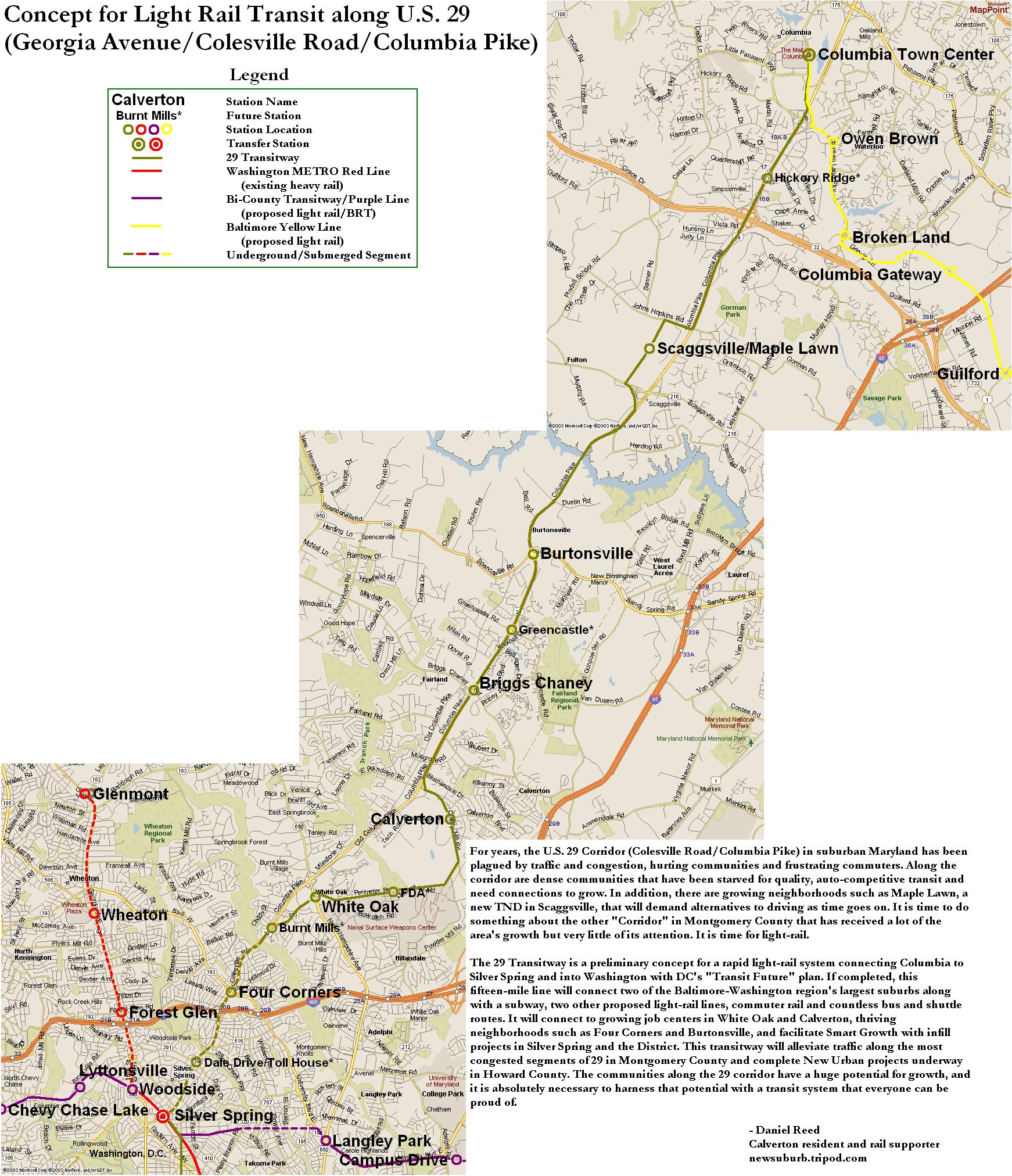
CMTA, if you want light rail connecting Columbia to the city, why not push for the US-29 light rail project that was once promised to run from Silver Spring to Columbia? A direct route to the city, not a circuitous one, that hits several established communities along the way is what Central Maryland Transit Alliance ought to be seeking. I don't know how long Dan Reed's alignment (linked above) would take to get from Columbia to downtown DC, but I bet it's faster than 69 minutes.
And if Maryland does decide to run light rail further away from Baltimore, can you at least make some effort to hit the 50,000+ job center at Fort Meade before it is completely choking the region with traffic? I bet you a rail right-of-way that a lot of those employees live in Columbia.
The Green Line extension will hit developed areas in a large city with a burgeoning centralized train system in place. This is smart. The Yellow Line extension will connect Columbia to downtown Baltimore on a very long, very circuitous route that by-passes Fort Meade, the largest employment center in the state of Maryland.
Baltimore City needs transit connections. It needs an expanded system. It needs a centralized system. A Yellow Line extension would bolster businesses in Columbia and Towson. These are decentralized locations. A Green Line extension would bolster more centralized business districts like the Belair Road and Harford Road corridors. These are centralized areas. Baltimore has been decentralizing for fifty years, and it's not working.
From Columbia, the Yellow Line would take 42 minutes to get to BWI Airport, and then another 27 to get to downtown Baltimore. An hour and nine minutes to get from Columbia to Baltimore. The northern section of the Yellow Line is actually a good idea, connecting several colleges along a main thoroughfare through the city proper. But the southern portion is as circuitous and useless as the current plan for the CCT in Gaithersburg.
CMTA, if you want light rail connecting Columbia to the city, why not push for the US-29 light rail project that was once promised to run from Silver Spring to Columbia? A direct route to the city, not a circuitous one, that hits several established communities along the way is what Central Maryland Transit Alliance ought to be seeking. I don't know how long Dan Reed's alignment (linked above) would take to get from Columbia to downtown DC, but I bet it's faster than 69 minutes.
And if Maryland does decide to run light rail further away from Baltimore, can you at least make some effort to hit the 50,000+ job center at Fort Meade before it is completely choking the region with traffic? I bet you a rail right-of-way that a lot of those employees live in Columbia.
Tuesday, August 4, 2009
Youth Sports and the Automobile
 It's August, the time of year where I return to my favorite volunteer activity coaching youth football in Silver Spring. Youth sports, despite my lack of athletic prowess, were a big part of my childhood and were probably the only thing that kept me reaching the age of 20 with any semblance of physical conditioning. To a suburban child, youth sports will offer exercise and teach social integration in a safe environment.
My 2008 squad.
Exercise is a valuable commodity in the suburbs. You don't burn many calories from the passenger seat of a minivan. The extreme, of course, is Saratoga Springs, where a student was recently punished for riding his bike to school. The policy against biking to school is of course disguised in the name of safety. Social integration is also more valuable in the suburbs. Suburban children grow up cloistered in pods that effectively segregate socio-economic classes from each other. And despite the marketing, the suburbs are not the safest place to be a kid. So a program that offers exercise, social integration, and safety ought not be undervalued, be it football, swimming, ballet, or whatever.
Are youth sports a rare positive side effect of suburbanization? The Mid Maryland Football League has 26 programs spread out over Montgomery, Prince George's, Anne Arundel, Howard, Baltimore, Frederick, and Carroll Counties, and could never survive without the suburban infrastructure. I used to think youth football could not survive without it at all.
***
The Silver Spring Saints, for whom I coach, are one of the oldest youth programs still in existence in the DC area. When I played on this team as a youth, however, it was Saint Bernadette's, a Catholic Youth Organization program. CYO football went under in 1995, however, and the Silver Spring Saints rose from the ashes, playing their home games at Saint Bernadette's field. When It was Saint Bernadette's, however, the program had two teams with about 23 or so players per team. At its peak, the CYO had 40 or 50 such teams in Montgomery, Prince George's, and DC, and they were broken into geographic-based divisions. It was the premier youth football program in Maryland for decades.
When the Silver Spring Saints joined the Capital Beltway League in 1995, the one-time parish-oriented program had to struggle to field teams in six weight classes, effectively tripling the size of the program overnight and drawing in players from a much larger area. As it struggled with finding enough players, the notion of playing games close by started to disappear. Montgomery Village, Clinton, Germantown, and Bowie were now the away games as opposed to other small teams in Silver Spring, Wheaton, and Rockville. This season, the Saints have joined the Mid-Maryland League to escape the poor organization of the CBL. They are now required to field 12 teams. Many of them will only have about 15 or 16 players. (For those of you not familiar with the sport, there are 11 on the field at a time. An NFL team has 53 players. 24 is an ideal number at the youth level)
I love the Saints organization, and what it does for young men between the ages of 6 and 14. Growing up in a single parent household, it gave me male role models, goals, and a sense of belonging that every boy should experience. But in the time between when I played and now that I coach, it has gone from a "mom and pop" program belonging to a community organization to a "big box" program. The parish still has a strong influence on the program, which in my opinion has kept it about the players and not about championships and egos (though we win our share of games).
No, it's hard to imagine youth football now without cars and giant parking lots at each field, where 12 games are played by each program every Saturday and teams drive as many as 80 miles to play each other. But it hasn't been that way throughout the history of the Silver Spring Saints. For their very first game 58 years ago, the first 12 Saints played Saint Micheal's of downtown Silver Spring, two miles away from Saint Bernadette's. To get there, they took a Capitol Transit Bus.
Thursday, June 25, 2009
Imagine A Seperate Green and Yellow Line
Naturally, there has been much written about the terrible Metro crash on the Red Line earlier this week. Had this been a nasty pile-up on the Beltway, we might have heard about it by by this point, we probably would have stopped talking about it by now, and it certainly never would have been international news. It is out of the ordinary, tragic, and was a failure of public infrastructure, unlike traffic accidents, which are usually the failures of individual drivers (we'll forgo the argument that fault may lie in road design). The fact that service disruptions continue on the Red Line is another reminder of this horrible accident. After all, these disruptions have a far greater impact on Metro than a bad traffic accident has on area highways.
If there is an accident on US-29 in Montgomery County, I can drive on Georgia or New Hampshire Avenues. But the stations that were shut down the past couple days isolated eastern Montgomery County from the rest of the Metro System. Originally, I tinkered with a map showing a separated Yellow Line for the sake of greater capacity and more geographic coverage for the Metro System. This week's accident has shown that adding redundancy to the system can be just as valuable as adding capacity.
Realizing the need for more redundancy on the system in the wake of this tragic crash is not an original idea. The Purple Line would obviously create alternate routes throughout the system. The Purple Line is both necessary and long overdue, however separating the Yellow and Green Lines would add capacity to existing track, much like separating the Blue and Orange Lines. In the case of the Yellow Line, it would allow for increased capacity on its Potomac River Bridge. If separated, the entire Green Line and the Yellow Line north of Pentagon would have the same capacity as the Red Line.
Here's what I would do with a separate Yellow Line:
View Separate Yellow Line in a larger map
This alignment is not 100% original either. Bringing Metro to North Capitol Street and Georgia Avenue is in no way a new idea. In these cases, however, people seem to want it for the geographic coverage, and not the additional capacity or system redundancy. Coverage is good, it brings transit to a new area. Capacity and redundancy, however, improve the entire system.
Perhaps I added a few too many stations, but they are just suggestions. While this would add service to the North Capitol Street and Georgia Avenue corridors, it would add redundancy to both the Green and Red Lines via Silver Spring, Georgia Av/Petworth, Union Station, and L'Enfant Plaza.
If this line existed already, the station closures on the Red Line might only have meant an additional transfer for Montgomery County commuters instead of the shuttle services to which Metro resorted after the crash.
If there is an accident on US-29 in Montgomery County, I can drive on Georgia or New Hampshire Avenues. But the stations that were shut down the past couple days isolated eastern Montgomery County from the rest of the Metro System. Originally, I tinkered with a map showing a separated Yellow Line for the sake of greater capacity and more geographic coverage for the Metro System. This week's accident has shown that adding redundancy to the system can be just as valuable as adding capacity.
Realizing the need for more redundancy on the system in the wake of this tragic crash is not an original idea. The Purple Line would obviously create alternate routes throughout the system. The Purple Line is both necessary and long overdue, however separating the Yellow and Green Lines would add capacity to existing track, much like separating the Blue and Orange Lines. In the case of the Yellow Line, it would allow for increased capacity on its Potomac River Bridge. If separated, the entire Green Line and the Yellow Line north of Pentagon would have the same capacity as the Red Line.
Here's what I would do with a separate Yellow Line:
View Separate Yellow Line in a larger map
This alignment is not 100% original either. Bringing Metro to North Capitol Street and Georgia Avenue is in no way a new idea. In these cases, however, people seem to want it for the geographic coverage, and not the additional capacity or system redundancy. Coverage is good, it brings transit to a new area. Capacity and redundancy, however, improve the entire system.
Perhaps I added a few too many stations, but they are just suggestions. While this would add service to the North Capitol Street and Georgia Avenue corridors, it would add redundancy to both the Green and Red Lines via Silver Spring, Georgia Av/Petworth, Union Station, and L'Enfant Plaza.
If this line existed already, the station closures on the Red Line might only have meant an additional transfer for Montgomery County commuters instead of the shuttle services to which Metro resorted after the crash.
Sunday, July 20, 2008
Imagine West Silver Spring
By this point, I think I've made it clear that I'm a fan of Silver Spring. Transit-oriented works there. You've got your Metro, MARC, Metrobus, Ride-On, bike paths, and access to the Beltway. There's a night life, jobs, lots of culture, a fantastic community college, and a very eclectic mix of people, arts, and knowledge. But that doesn't mean I don't think it's under-utilized.
It blows my mind that there are large swaths of land between downtown Silver Spring and downtown Bethesda abutting Rock Creek Park that are veritable industrial dross-scapes. Wasted land along Brookeville Road, secluded by poor road connectivity, in what could be a very high end mixed use heartbeat connecting two of suburban Maryland's most important urban cores. Greater Greater Washington did a nice post on TOD zoning in Montgomery County, and I couldn't resist after I read that.
So I wanted to disrupt the low density feel of those neighborhoods in West Silver Spring; Lyttonsville, Seminary, and Woodside. Create more of an urban gateway between the two central business districts, bringing density down towards the city away from the hinterlands. I imagined West Silver Spring, and this is what I saw:
 Made with Google Maps.
Pink- road network
Red- residential redevelopment
Blue- commercial redevelopment
Orange- transit stations
Purple- deck over rail
For starters, let me talk transit. I envisioned an extension of the Yellow Line that splits from the Green Line at the Petworth station running under Georgia Avenue to Silver Spring, then following the MARC/CSX right-of-way towards Rockville. This led to a station in the Seminary and Woodside neighborhoods as well as the planned Paul Sarbanes Transit Center at Silver Spring Metro. For the Purple Line I assumed the high investment light rail alternative with stations at Lyttonsville, Woodside, and of course the Silver Spring transit center.
These three new stations would be the epicenters of transit-oriented funcsionality with minimum direct impact on the low-density residential infrastructure in existing neighborhoods. Four stations that one could easily walk between, but are far enough apart that are far enough apart to efficiently serve the community. Served by only one line, Lyttonsville and Seminary would not be as dense as Woodside (served by two) or Silver Spring (in my transit vision, served by four lines of Metro plus MARC). Those overwhelmed by the growing density of downtown Silver Spring would have the alternative of moving to a dense-but-not-too-dense TOD not to far away.
And though I'm sure wholesale redevelopment of the Brookville Road corridor and the Walter Reed Annex would garner a great deal of NIMBYism, they are areas that are not exactly pleasant in their current state. The north view from the apartments on Lyttonsville place is a car salvage yard.
Major changes to the road network are mostly in Woodside. I strongly believe that the Summit Hills development at the corner of 16th and East-West Highway ought to be razed and redeveloped from the ground up. Here, I've changed the intersection of Spring and 16th streets so that 16th ends on Spring on a deck over the trains. Spring Street then connects to Porter Road, which runs to Lyttonsville. The northern end of 16th Street could be redesignated Columbia Boulevard. Summit Hills and Rosemary Hills complexes would be redeveloped to compliment the new grid street network, with row houses in the residential areas and condos over retail in the commercial areas. Perhaps the steep grade of this neighborhood might accommodate residential over retail in this manner.
Perhaps my least popular more here: I connected Jones Bridge Road across Rock Creek Park so that Jones Bridge Road, Brookeville Road, and Grubb Road all come together, perhaps in a traffic circle just west of the Lyttonsville station. Though this would mean more traffic through the park, and through those Chevy Chase neighborhoods, the stronger street grid would have a very positive impact on traffic and probably encourage more walking and bike use. I have very little sympathy for Chevy Chase residents, anyway. That town is just going to have to deal with the fact that southern Montgomery County is only going to get denser and denser.
As for the Seminary neighborhood, I imagine the closure of the Walter Reed Annex would lead to some medium-density development on that property. It would compliment the apartments that are now up for rent at National Park Seminary. So here we have a neighborhood with a very eclectic charm in a densely wooded area where existing development is/would be utilized, minimizing the impact on the wealth of mature trees. What a cool place for a transit-based community!
I once again caveat that I am not an urban planner (though I hope to be one day), nor am I an engineer. Please point out any obvious design flaws you might spot. And please, if you have any suggestions for West Silver Spring, I'd love to hear them. I'm not saying this is feasible, but I believe that West Silver Spring could benefit the region heavily if it were developed in such a manner.
It blows my mind that there are large swaths of land between downtown Silver Spring and downtown Bethesda abutting Rock Creek Park that are veritable industrial dross-scapes. Wasted land along Brookeville Road, secluded by poor road connectivity, in what could be a very high end mixed use heartbeat connecting two of suburban Maryland's most important urban cores. Greater Greater Washington did a nice post on TOD zoning in Montgomery County, and I couldn't resist after I read that.
So I wanted to disrupt the low density feel of those neighborhoods in West Silver Spring; Lyttonsville, Seminary, and Woodside. Create more of an urban gateway between the two central business districts, bringing density down towards the city away from the hinterlands. I imagined West Silver Spring, and this is what I saw:
 Made with Google Maps.
Pink- road network
Red- residential redevelopment
Blue- commercial redevelopment
Orange- transit stations
Purple- deck over rail
For starters, let me talk transit. I envisioned an extension of the Yellow Line that splits from the Green Line at the Petworth station running under Georgia Avenue to Silver Spring, then following the MARC/CSX right-of-way towards Rockville. This led to a station in the Seminary and Woodside neighborhoods as well as the planned Paul Sarbanes Transit Center at Silver Spring Metro. For the Purple Line I assumed the high investment light rail alternative with stations at Lyttonsville, Woodside, and of course the Silver Spring transit center.
These three new stations would be the epicenters of transit-oriented funcsionality with minimum direct impact on the low-density residential infrastructure in existing neighborhoods. Four stations that one could easily walk between, but are far enough apart that are far enough apart to efficiently serve the community. Served by only one line, Lyttonsville and Seminary would not be as dense as Woodside (served by two) or Silver Spring (in my transit vision, served by four lines of Metro plus MARC). Those overwhelmed by the growing density of downtown Silver Spring would have the alternative of moving to a dense-but-not-too-dense TOD not to far away.
And though I'm sure wholesale redevelopment of the Brookville Road corridor and the Walter Reed Annex would garner a great deal of NIMBYism, they are areas that are not exactly pleasant in their current state. The north view from the apartments on Lyttonsville place is a car salvage yard.
Major changes to the road network are mostly in Woodside. I strongly believe that the Summit Hills development at the corner of 16th and East-West Highway ought to be razed and redeveloped from the ground up. Here, I've changed the intersection of Spring and 16th streets so that 16th ends on Spring on a deck over the trains. Spring Street then connects to Porter Road, which runs to Lyttonsville. The northern end of 16th Street could be redesignated Columbia Boulevard. Summit Hills and Rosemary Hills complexes would be redeveloped to compliment the new grid street network, with row houses in the residential areas and condos over retail in the commercial areas. Perhaps the steep grade of this neighborhood might accommodate residential over retail in this manner.
Perhaps my least popular more here: I connected Jones Bridge Road across Rock Creek Park so that Jones Bridge Road, Brookeville Road, and Grubb Road all come together, perhaps in a traffic circle just west of the Lyttonsville station. Though this would mean more traffic through the park, and through those Chevy Chase neighborhoods, the stronger street grid would have a very positive impact on traffic and probably encourage more walking and bike use. I have very little sympathy for Chevy Chase residents, anyway. That town is just going to have to deal with the fact that southern Montgomery County is only going to get denser and denser.
As for the Seminary neighborhood, I imagine the closure of the Walter Reed Annex would lead to some medium-density development on that property. It would compliment the apartments that are now up for rent at National Park Seminary. So here we have a neighborhood with a very eclectic charm in a densely wooded area where existing development is/would be utilized, minimizing the impact on the wealth of mature trees. What a cool place for a transit-based community!
I once again caveat that I am not an urban planner (though I hope to be one day), nor am I an engineer. Please point out any obvious design flaws you might spot. And please, if you have any suggestions for West Silver Spring, I'd love to hear them. I'm not saying this is feasible, but I believe that West Silver Spring could benefit the region heavily if it were developed in such a manner.
Tuesday, July 15, 2008
Convince Me To Support the Purple Line
I like the idea of connecting all the Metro Lines in Maryland. I think it's a brilliant idea that will serve smart growth well, greatly reduce automobile reliance, and I think it will economically benefit the city as well as the suburbs.
But are we doing it right?
I haven't heard anyone from Langley Park or Riverdale complain like the whiny NIMBYs of Chevy Chase and Bethesda, who, in my opinion, are doing the entire region a disservice by allowing a Country Club to exist in an area that could be more served with some sort of denser development that serves the larger community and not just a few wealthy people that are accepted by this private club. Move that nonsense out into the country. Or better yet, get rid of Columbia Country Club. We have plenty of golf courses in Montgomery County. At the very least, the club needs to relinquish the 84' of 100' right-of-way that it currently fences off from the general public.
Those whining about the Capital Crescent Trail being harmed are in my opinion selfish. This project will undoubtedly change the character of portions the CCT, but it will extend the path into Silver Spring, connecting it to other hiker biker trails in Montgomery County. Furthermore, this rail right-of-way was purchased to serve the needs of the county, not to serve as a park for the residents of affluent Chevy Chase. I fail to see how the decreased aesthetics of the trail outweigh the increased functionality of the trail.
Then there's the occasional "I won't want a train that close to my house" by people who perhaps aren't familiar with light rail, in which case I can understand their concerns but don't believe their argument has the clout to block the initiative. In my experience, light rail is quieter, cleaner, and safer than buses running up and down the street. The only thing they lose is street parking, which ought not be a birth right in denser areas anyway.
This proposal has a lot of support, and it's generally more organized and informed than the opposition. So I'm not in anyway a NIMBY here. I think this transit link needs to happen. But I want the good people out there who read Imagine, DC to convince me that the current plan is a good idea. I'm leaning that way, but I want more information.
How is this line going to be integrated with the Metro Rail? Sure, it's going to drop people off at Bethesda, Silver Spring, College Park, and New Carrollton... but what's the deal? Is it going to be like a bus route? Or is it going to be fully integrated into Metro with seamless transfers? I've heard that it will be integrated with SmarTrip. That's good, but it's not good enough if it is not treated as part of the existing heavy rail system. It seems to me that would just be a glorified bus route, especially if it winds up as a BRT. Convince me otherwise. Otherwise, change the name, because "Purple Line" implies a seamless integration with Metro that won't exist.
I am not a statistician. But even the most optimistic ridership numbers seem painfully low to me. Gas isn't getting any cheaper. I would use that line 3-4 times a week if it existed, and I don't even commute along that route. 67,000? No way. I think ridership will be much, much higher than that if the line gets built, and that's before the ensuing transit oriented development pops up around Langley Park and wherever else. Is a light rail going to be able to handle those numbers? 5 years after it opens, will it be able to handle double those numbers? Triple?
Considering the large percentage of the route that will be sharing traffic lanes, how do we know it's not going to get stuck in gridlock along Wayne Avenue, University Boulevard, Kenilworth Avenue, or Riverdale Road? Will it have dedicated lanes on those corridors? Will those roads be losing traffic lanes or will additional right-of-way be constructed?
What incentives does the region have to continue this line? I know there have been talks about pushing it further in PG County to Largo. What about Branch Avenue? Will it serve FedEx Field?Andrews Air Force Base? National Harbor? I think a Purple Line ought to be a full loop running all around the city. Eventually, it ought to run through Tyson's Corner, Annandale, Bailey's Crossroads, and Alexandria. Is this feasible with this project?
Trolleys are a great idea. I think they ought to blanket this region by the time I retire, or sooner. But the Purple Line ought to be more than just a simple trolley. Montgomery and Prince George's counties' combined population is pushing two million, mostly concentrated around the regions where this vital transitway will be constructed. Whatever gets build should have been built 10 years ago, and this region has failed us terribly by not providing this transit link.
Again, I WANT fixed rail along this corridor, whatever it takes. I think the only reason I'm not a full fledged Purple Line supporter is because I don't know where to find the answers to these questions. Help me and any passers-by who want more information understand why this proposal should be supported.
I'm asking every pro-transit reader to convince me to come down off the fence onto the side of pro-Purple Line. Don't tell me this is the best idea for the money that has been alotted for this project; tell me this is the best idea for the people of the DC region who want to get around the dense built up (and up-and-coming) towns hugging our Nation's Capital. If there's not enough money for what we ought to have, let's find more. We need the Purple Line, and we need it done right.
But are we doing it right?
I haven't heard anyone from Langley Park or Riverdale complain like the whiny NIMBYs of Chevy Chase and Bethesda, who, in my opinion, are doing the entire region a disservice by allowing a Country Club to exist in an area that could be more served with some sort of denser development that serves the larger community and not just a few wealthy people that are accepted by this private club. Move that nonsense out into the country. Or better yet, get rid of Columbia Country Club. We have plenty of golf courses in Montgomery County. At the very least, the club needs to relinquish the 84' of 100' right-of-way that it currently fences off from the general public.
Those whining about the Capital Crescent Trail being harmed are in my opinion selfish. This project will undoubtedly change the character of portions the CCT, but it will extend the path into Silver Spring, connecting it to other hiker biker trails in Montgomery County. Furthermore, this rail right-of-way was purchased to serve the needs of the county, not to serve as a park for the residents of affluent Chevy Chase. I fail to see how the decreased aesthetics of the trail outweigh the increased functionality of the trail.
Then there's the occasional "I won't want a train that close to my house" by people who perhaps aren't familiar with light rail, in which case I can understand their concerns but don't believe their argument has the clout to block the initiative. In my experience, light rail is quieter, cleaner, and safer than buses running up and down the street. The only thing they lose is street parking, which ought not be a birth right in denser areas anyway.
This proposal has a lot of support, and it's generally more organized and informed than the opposition. So I'm not in anyway a NIMBY here. I think this transit link needs to happen. But I want the good people out there who read Imagine, DC to convince me that the current plan is a good idea. I'm leaning that way, but I want more information.
How is this line going to be integrated with the Metro Rail? Sure, it's going to drop people off at Bethesda, Silver Spring, College Park, and New Carrollton... but what's the deal? Is it going to be like a bus route? Or is it going to be fully integrated into Metro with seamless transfers? I've heard that it will be integrated with SmarTrip. That's good, but it's not good enough if it is not treated as part of the existing heavy rail system. It seems to me that would just be a glorified bus route, especially if it winds up as a BRT. Convince me otherwise. Otherwise, change the name, because "Purple Line" implies a seamless integration with Metro that won't exist.
I am not a statistician. But even the most optimistic ridership numbers seem painfully low to me. Gas isn't getting any cheaper. I would use that line 3-4 times a week if it existed, and I don't even commute along that route. 67,000? No way. I think ridership will be much, much higher than that if the line gets built, and that's before the ensuing transit oriented development pops up around Langley Park and wherever else. Is a light rail going to be able to handle those numbers? 5 years after it opens, will it be able to handle double those numbers? Triple?
Considering the large percentage of the route that will be sharing traffic lanes, how do we know it's not going to get stuck in gridlock along Wayne Avenue, University Boulevard, Kenilworth Avenue, or Riverdale Road? Will it have dedicated lanes on those corridors? Will those roads be losing traffic lanes or will additional right-of-way be constructed?
What incentives does the region have to continue this line? I know there have been talks about pushing it further in PG County to Largo. What about Branch Avenue? Will it serve FedEx Field?Andrews Air Force Base? National Harbor? I think a Purple Line ought to be a full loop running all around the city. Eventually, it ought to run through Tyson's Corner, Annandale, Bailey's Crossroads, and Alexandria. Is this feasible with this project?
Trolleys are a great idea. I think they ought to blanket this region by the time I retire, or sooner. But the Purple Line ought to be more than just a simple trolley. Montgomery and Prince George's counties' combined population is pushing two million, mostly concentrated around the regions where this vital transitway will be constructed. Whatever gets build should have been built 10 years ago, and this region has failed us terribly by not providing this transit link.
Again, I WANT fixed rail along this corridor, whatever it takes. I think the only reason I'm not a full fledged Purple Line supporter is because I don't know where to find the answers to these questions. Help me and any passers-by who want more information understand why this proposal should be supported.
I'm asking every pro-transit reader to convince me to come down off the fence onto the side of pro-Purple Line. Don't tell me this is the best idea for the money that has been alotted for this project; tell me this is the best idea for the people of the DC region who want to get around the dense built up (and up-and-coming) towns hugging our Nation's Capital. If there's not enough money for what we ought to have, let's find more. We need the Purple Line, and we need it done right.
Wednesday, July 2, 2008
Imagine the Purple Line
It's everyone's favorite light rail debate. Few people argue we don't need an east-west transit link through suburban Maryland. Most people just disagree on how and where it ought to be build. I personally think it ought to be a heavy rail. largely underground. I think that once the light rail is built, the immediate need for more capacity will be very apparent, $200 barrels of oil aside.
I'm not opposed to the light rail idea. I think it would be very successful, other than a few NIMBYs sponsored by Columbia Country Club (who is illegally using much of the county's right-of-way) and a couple of crybabies in Silver Spring who don't want the train to run down their street. I can live with the line being light rail. I can't live with the limitations of the current proposal, however.
So long as this train is MTA and not WMATA, it will, of course, stay in Maryland. but what if it went all the way around the Beltway, plenty of others think it should? What if, instead of just being a glorified bus, it was fully integrated with the Metro system? Sure that would require an enclosed station for every stop, but why not? This is fantasy. A fully integrated rail circumnavigating Washington DC!
Ladies and Gentlemen, I give you my Purple Line:
View Larger Map
A quick rundown of the stations, with the path to the next station in parentheses follows. Mind you that these are just what I would name the stations, and the routes I would use.
Bethesda Metro (follows Georgetown Branch Trail)
Chevy Chase Lake: Connecticut Av at Manor Rd (Georgetown Branch Trail)
Lyttonsville: Brookeville Rd at Lyttonsville Pl (Metropolitain Branch ROW)
Woodside: 16th St north of East-West Hwy (Red Line ROW)
Silver Spring Metro (Wayne Av)
Sligo-Manchester: Wayne Av at Manchester Pl (tunnel)
Long Branch: Arliss St at Garland Av (Piney Branch Rd)
Piney Branch: Piney Branch Rd at University Blvd (Univ Blvd)
Takoma-Langley: Univ Blvd at New Hampshire Av (Univ Blvd)
Langley Park: Univ Blvd at Riggs Rd (Univ Blvd)
West Campus/UMUC: Univ Blvd at Adelphi Rd (Campus Dr)
Student Union: Campus Drive near Regents Drive (Campus Dr)
East Campus: Rossborough La at Route 1 (Paint Branch Parkway)
College Park Metro (River Rd)
Calvert Park: River Rd at Rivertech Ct (River Rd and Kenilworth Av)
East Riverdale: Riverdale Rd at Kenilworth Avenue (Riverdale Rd)
Veterans Parkway: Riverdale Rd at Veterans Pkwy (Veterans Pkwy)
Landover Hills: Veterans Pkwy at Annapolis Rd (Annapolis Rd to Harkins Rd)
New Carrollton Metro...
...here's where I start taking some creative liberties...
...(Ardwick-Ardmore Rd)
Glenarden: Ardwick-Ardmore Rd at MLK Highway (Brightseat Rd)
FedEx Field (Arena Drive)
Largo Metro (Harry S Truman Dr)
Kettering/PGCC: Truman Dr at Campus Dr (Truman Dr to at-grade-ROW to Ritchie Rd)
District Heights: Ritchie Rd at Walker Mill Rd (Ritchie Rd)
Forestville: Forestville Rd at Pennsylvania Av (Forestville Rd to Beltway)
Morningside/Andrews AFB: Suitland Rd at Allentown Rd (Beltway)
Temple Hills: Beltway near St Barnabas Rd (Oxon Hill Rd)
Oxon Hill: Livingston Rd at Oxon Hill Rd (Oxon Hill Rd to Harborview Av)
National Harbor: Nat'l Harbor Blvd at Waterfront St (Wilson Bridge)
Alexandria South: Washington St at South St (Washington St)
Old Town Alexandria: Washington St at King St (King St)
King Street Metro (Duke Street)
Landmark: Duke St at Van Dorn St (Duke St)
Lincolnia: Little River Tpk at Beauregard St (Little River Tpk)
Pinecrest: Little River Tpk at Braddock Rd (Little River Tpk)
Annandale: Little River Tpk at Columbia Pike (Beltway to Gallows Rd)
Merrifield: Gallows Rd at Arlington Blvd (Gallows Rd)
Lee Highway: Gallows Rd at Lee Hwy (Gallows Rd)
Dunn Loring Metro (Gallows Rd)
Tyson's South: Gallows Rd at Old Courthouse Rd (Tyson's Corner Center Parking)
Tyson's Central 123 Metro (Tyson's Blvd)
Tyson's North: Westbranch Dr at Jones Branch Dr (Beltway)
Great Falls: Beltway at Georgetown Pike (Beltway to Clara Barton Pkwy)
Cabin John: MacArthur Blvd at 7 Locks Rd (MacArthur Blvd)
Glen Echo: MarArthur Blvd at Goldsboro Rd (Goldsboro to River Rd)
Somerset/Kenwood: River Rd at Dorsey Lane (Little Falls Pkwy to Arlington Rd to Edgemoor Lane to Bethesda Metro
I'm sure there will be plenty of suggestions as to what you folks think the alignment should be. Please share. However, like plenty before me, I have a vision of a vastly expanded Metro system into which this alignment fits perfectly. As soon as I find a suitable manner to illustrate it, I'll share the whole thing with the world. But I'm just starting this blog. I don't want to overwhelm the world quite yet.
I'm not opposed to the light rail idea. I think it would be very successful, other than a few NIMBYs sponsored by Columbia Country Club (who is illegally using much of the county's right-of-way) and a couple of crybabies in Silver Spring who don't want the train to run down their street. I can live with the line being light rail. I can't live with the limitations of the current proposal, however.
So long as this train is MTA and not WMATA, it will, of course, stay in Maryland. but what if it went all the way around the Beltway, plenty of others think it should? What if, instead of just being a glorified bus, it was fully integrated with the Metro system? Sure that would require an enclosed station for every stop, but why not? This is fantasy. A fully integrated rail circumnavigating Washington DC!
Ladies and Gentlemen, I give you my Purple Line:
View Larger Map
A quick rundown of the stations, with the path to the next station in parentheses follows. Mind you that these are just what I would name the stations, and the routes I would use.
Bethesda Metro (follows Georgetown Branch Trail)
Chevy Chase Lake: Connecticut Av at Manor Rd (Georgetown Branch Trail)
Lyttonsville: Brookeville Rd at Lyttonsville Pl (Metropolitain Branch ROW)
Woodside: 16th St north of East-West Hwy (Red Line ROW)
Silver Spring Metro (Wayne Av)
Sligo-Manchester: Wayne Av at Manchester Pl (tunnel)
Long Branch: Arliss St at Garland Av (Piney Branch Rd)
Piney Branch: Piney Branch Rd at University Blvd (Univ Blvd)
Takoma-Langley: Univ Blvd at New Hampshire Av (Univ Blvd)
Langley Park: Univ Blvd at Riggs Rd (Univ Blvd)
West Campus/UMUC: Univ Blvd at Adelphi Rd (Campus Dr)
Student Union: Campus Drive near Regents Drive (Campus Dr)
East Campus: Rossborough La at Route 1 (Paint Branch Parkway)
College Park Metro (River Rd)
Calvert Park: River Rd at Rivertech Ct (River Rd and Kenilworth Av)
East Riverdale: Riverdale Rd at Kenilworth Avenue (Riverdale Rd)
Veterans Parkway: Riverdale Rd at Veterans Pkwy (Veterans Pkwy)
Landover Hills: Veterans Pkwy at Annapolis Rd (Annapolis Rd to Harkins Rd)
New Carrollton Metro...
...here's where I start taking some creative liberties...
...(Ardwick-Ardmore Rd)
Glenarden: Ardwick-Ardmore Rd at MLK Highway (Brightseat Rd)
FedEx Field (Arena Drive)
Largo Metro (Harry S Truman Dr)
Kettering/PGCC: Truman Dr at Campus Dr (Truman Dr to at-grade-ROW to Ritchie Rd)
District Heights: Ritchie Rd at Walker Mill Rd (Ritchie Rd)
Forestville: Forestville Rd at Pennsylvania Av (Forestville Rd to Beltway)
Morningside/Andrews AFB: Suitland Rd at Allentown Rd (Beltway)
Temple Hills: Beltway near St Barnabas Rd (Oxon Hill Rd)
Oxon Hill: Livingston Rd at Oxon Hill Rd (Oxon Hill Rd to Harborview Av)
National Harbor: Nat'l Harbor Blvd at Waterfront St (Wilson Bridge)
Alexandria South: Washington St at South St (Washington St)
Old Town Alexandria: Washington St at King St (King St)
King Street Metro (Duke Street)
Landmark: Duke St at Van Dorn St (Duke St)
Lincolnia: Little River Tpk at Beauregard St (Little River Tpk)
Pinecrest: Little River Tpk at Braddock Rd (Little River Tpk)
Annandale: Little River Tpk at Columbia Pike (Beltway to Gallows Rd)
Merrifield: Gallows Rd at Arlington Blvd (Gallows Rd)
Lee Highway: Gallows Rd at Lee Hwy (Gallows Rd)
Dunn Loring Metro (Gallows Rd)
Tyson's South: Gallows Rd at Old Courthouse Rd (Tyson's Corner Center Parking)
Tyson's Central 123 Metro (Tyson's Blvd)
Tyson's North: Westbranch Dr at Jones Branch Dr (Beltway)
Great Falls: Beltway at Georgetown Pike (Beltway to Clara Barton Pkwy)
Cabin John: MacArthur Blvd at 7 Locks Rd (MacArthur Blvd)
Glen Echo: MarArthur Blvd at Goldsboro Rd (Goldsboro to River Rd)
Somerset/Kenwood: River Rd at Dorsey Lane (Little Falls Pkwy to Arlington Rd to Edgemoor Lane to Bethesda Metro
I'm sure there will be plenty of suggestions as to what you folks think the alignment should be. Please share. However, like plenty before me, I have a vision of a vastly expanded Metro system into which this alignment fits perfectly. As soon as I find a suitable manner to illustrate it, I'll share the whole thing with the world. But I'm just starting this blog. I don't want to overwhelm the world quite yet.
Saturday, June 28, 2008
Imagined: Downtown Silver Spring
There are certainly a lot of controversies in downtown Silver Spring. There's the historical landmarking of the Falkland Chase apartments, which I am avidly against. There is the Purple Line, which I cautiously support. The Paul Sarbanes Transit Center is often the source of debate as well.
And Silver Spring has it's foibles as well. Forest Glen Metro station, separated by the Beltway, is markedly less useful than it would be if it were built about a quarter mile south of it's current location. The Georgetown Branch trail has failed to make it's way into Silver Spring. Colesville Road is a traffic disaster.
But for all its issues and controversies, something very good was done there.
I grew up in Silver Spring, near University and the Beltway, about 2 miles from the downtown. in the '80's, it was a blighted area. it was ugly, unsafe, unfriendly, uninviting, and downright scary. Ellsworth Avenue, now home to the famed Silver Plaza (aka Silver Sprung) was boarded up building well into my post-college Army days.
But yesterday, I had the luxury of experiencing how a little urban planning can create a truely cultural experience. I was killing time after work at the Borders in the plaza area, purchasing a few books (including Suburban Nation by Andres Duany et al, which I am halfway through already!) and I decided to sit at the Lebanese Taverna cafe and do a little reading... something I'm rarely compelled to do in my behind-the-strip-malls Laurel neighborhood where I currently reside. It was a sunny pleasant setting, with kids of all types happily playing in the fountain.
But out of nowhere, a torrential storm came through. All that we were missing was the wicked witch on a bicycle. So much for that. Guess I'll head out, this place is dead. I'll just wait for the rain to pass... And pass it did, but with the sun out came even more people than were in the plaza before. A rock band from Blake High School prepared to play on the stage in the center of the plaza.
Then it got really interesting. A fire alarm (which would later turn out to be a dumpster fire at the Wayne Av garage) cleared out the entire east side of the plaza. All the buildings were vacated, including the movie theater. With half the shops closed, a bunch of teenagers playing loud rock music in the middle of it all, and hundreds of probably annoyed movie goers, I was sure a riot was on the horizon.
Instead, crowds formed around the stage, and around a street performer banging on a set of drums made of kitchen utensils. Another small crowd gathered to watch few skater kids doing tricks near the Chik-Fil-A. despite the horribly inconveniece of being locked out of their stores and movies, everyone there seemed to be having a good time doing something.
And what really impressed me was the overall diversity of the crowd. Young dreadlocked hippies in long flowing skirts, amputee war veterans from Walter Reed, yarmulke-clad group of young men, men in business attire, families with young children, old couples, average joes. It was a tapestry that spanned racial, cultural, socio-economic, and religious boundaries. And the shops at the plaza encourage it. Lebanese, Tex-Mex, Persian, Vientamese, Irish, Thai, Mexican, and Western cuisine as informal as Potbelly's and as first-datey as Red Rock Canyon Grille. And that's just in the plaza area.
Everyone was making the best of an inconvenient situation, all getting along beside each other. The only reality check was when a police car that had responded to the fire was driving down Ellsworth, which was otherwise closed to vehicles, and slammed on the brakes when a young girl ran in front of it. Simultaneous boos from several people in the crowd ensued.
The sight was not lost on me. I know what would have happened if the theater at any isolate location (even a mall) had been evacuated and movie goers were forced to wait in the parking lot. Shouting, complaining, frustration, fights. Hopefully a cop or two might show up. Hopefully there were no little kids that would start crying and create more of a scene.
This was a project borne of wise urban planning, giving Ellsworth Drive back to the people, not the car. This is why the plaza as a centerpiece for a town is such a community asset. In Silver Spring, it is a great unifier, a great equalizer, and a haven from beltway traffic life. I imagine that one day, every town will have a plaza where all types can interact in such a positive cultural experience.
Well done, Silver Spring.
Update 6-29: Sligo of Silver Spring, Singular was also present that day, and he had a decidedly different experience than I did. Of course, he was trying to see a movie when the fire occurred.
And Silver Spring has it's foibles as well. Forest Glen Metro station, separated by the Beltway, is markedly less useful than it would be if it were built about a quarter mile south of it's current location. The Georgetown Branch trail has failed to make it's way into Silver Spring. Colesville Road is a traffic disaster.
But for all its issues and controversies, something very good was done there.
I grew up in Silver Spring, near University and the Beltway, about 2 miles from the downtown. in the '80's, it was a blighted area. it was ugly, unsafe, unfriendly, uninviting, and downright scary. Ellsworth Avenue, now home to the famed Silver Plaza (aka Silver Sprung) was boarded up building well into my post-college Army days.
But yesterday, I had the luxury of experiencing how a little urban planning can create a truely cultural experience. I was killing time after work at the Borders in the plaza area, purchasing a few books (including Suburban Nation by Andres Duany et al, which I am halfway through already!) and I decided to sit at the Lebanese Taverna cafe and do a little reading... something I'm rarely compelled to do in my behind-the-strip-malls Laurel neighborhood where I currently reside. It was a sunny pleasant setting, with kids of all types happily playing in the fountain.
But out of nowhere, a torrential storm came through. All that we were missing was the wicked witch on a bicycle. So much for that. Guess I'll head out, this place is dead. I'll just wait for the rain to pass... And pass it did, but with the sun out came even more people than were in the plaza before. A rock band from Blake High School prepared to play on the stage in the center of the plaza.
Then it got really interesting. A fire alarm (which would later turn out to be a dumpster fire at the Wayne Av garage) cleared out the entire east side of the plaza. All the buildings were vacated, including the movie theater. With half the shops closed, a bunch of teenagers playing loud rock music in the middle of it all, and hundreds of probably annoyed movie goers, I was sure a riot was on the horizon.
Instead, crowds formed around the stage, and around a street performer banging on a set of drums made of kitchen utensils. Another small crowd gathered to watch few skater kids doing tricks near the Chik-Fil-A. despite the horribly inconveniece of being locked out of their stores and movies, everyone there seemed to be having a good time doing something.
And what really impressed me was the overall diversity of the crowd. Young dreadlocked hippies in long flowing skirts, amputee war veterans from Walter Reed, yarmulke-clad group of young men, men in business attire, families with young children, old couples, average joes. It was a tapestry that spanned racial, cultural, socio-economic, and religious boundaries. And the shops at the plaza encourage it. Lebanese, Tex-Mex, Persian, Vientamese, Irish, Thai, Mexican, and Western cuisine as informal as Potbelly's and as first-datey as Red Rock Canyon Grille. And that's just in the plaza area.
Everyone was making the best of an inconvenient situation, all getting along beside each other. The only reality check was when a police car that had responded to the fire was driving down Ellsworth, which was otherwise closed to vehicles, and slammed on the brakes when a young girl ran in front of it. Simultaneous boos from several people in the crowd ensued.
The sight was not lost on me. I know what would have happened if the theater at any isolate location (even a mall) had been evacuated and movie goers were forced to wait in the parking lot. Shouting, complaining, frustration, fights. Hopefully a cop or two might show up. Hopefully there were no little kids that would start crying and create more of a scene.
This was a project borne of wise urban planning, giving Ellsworth Drive back to the people, not the car. This is why the plaza as a centerpiece for a town is such a community asset. In Silver Spring, it is a great unifier, a great equalizer, and a haven from beltway traffic life. I imagine that one day, every town will have a plaza where all types can interact in such a positive cultural experience.
Well done, Silver Spring.
Update 6-29: Sligo of Silver Spring, Singular was also present that day, and he had a decidedly different experience than I did. Of course, he was trying to see a movie when the fire occurred.
Subscribe to:
Posts (Atom)

 Posts
Posts