August and September are very busy months for me, so it's difficult to keep up with writing original articles regularly. But please, take a look at some of the links to the right, they are all interesting blogs. Here is a sampling.
DCMUD - More, better housing near a Metro station in a rapidly improving part of the city: Deanwood
GreaterGreaterWashington - Track Twenty-Nine's Matt Johnson has written three spectacular series on freight and passenger rail in DC, station motifs on Metro, and the naming conventions for streets in the District of Columbia
And Now, Anacostia - How soon before Anacostia has streetcars?
Southeast Socialite - Never mincing words, she comments on a critique of Marion Barry, and concern about Eleanor Holmes Norton's lack of responsiveness to public queries.
Bloomingdale (For Now) - Clarifies the location of a section of 7th Street being renamed in honor of the father of go-go
Fairfax Suburbanista - Fairfax City is suburbanizing its Old Town with suburban townhouses. I wonder why they don't just try a traditional plot of townhouses?
WalkLaurel - It's a new website that explains forthcoming pedestrian and traffic improvements in the city of Laurel
Just Up The Pike - Photographs of the ICC construction through an area where several people lost their homes for the sake of the project.
Baltimore Inner Space - Discusses the "low hanging fruit" plan for the Red Line
The Overhead Wire - Discusses the George W. Bush Presidential Library and its ironic proximity to transit
Extraordinary Observations - Are Whole Foods' high prices worth a boycott? Rob argues NO.
DC Sports Bog - While admitting to being on the wrong side of history, Dan Steinberg attempts to douse some of the fire over the Redskins ticket scandal.
Hope you check a few of these articles out. Hope everyone enjoys Labor Day in the seat of the free world.
Showing posts with label Baltimore. Show all posts
Showing posts with label Baltimore. Show all posts
Monday, September 7, 2009

Friday, September 4, 2009
Baltimore Yellow Line Boondoggle
GGW's breakfast links yesterday had a troubling article at the bottom. The Central Maryland Transit Alliance wants to prioritize extending Baltimore's Yellow Line light rail to Columbia over extending the Green Line subway to White Marsh. I can't even begin to express how dumb of an idea this is.
The Green Line extension will hit developed areas in a large city with a burgeoning centralized train system in place. This is smart. The Yellow Line extension will connect Columbia to downtown Baltimore on a very long, very circuitous route that by-passes Fort Meade, the largest employment center in the state of Maryland.
Baltimore City needs transit connections. It needs an expanded system. It needs a centralized system. A Yellow Line extension would bolster businesses in Columbia and Towson. These are decentralized locations. A Green Line extension would bolster more centralized business districts like the Belair Road and Harford Road corridors. These are centralized areas. Baltimore has been decentralizing for fifty years, and it's not working.
From Columbia, the Yellow Line would take 42 minutes to get to BWI Airport, and then another 27 to get to downtown Baltimore. An hour and nine minutes to get from Columbia to Baltimore. The northern section of the Yellow Line is actually a good idea, connecting several colleges along a main thoroughfare through the city proper. But the southern portion is as circuitous and useless as the current plan for the CCT in Gaithersburg.
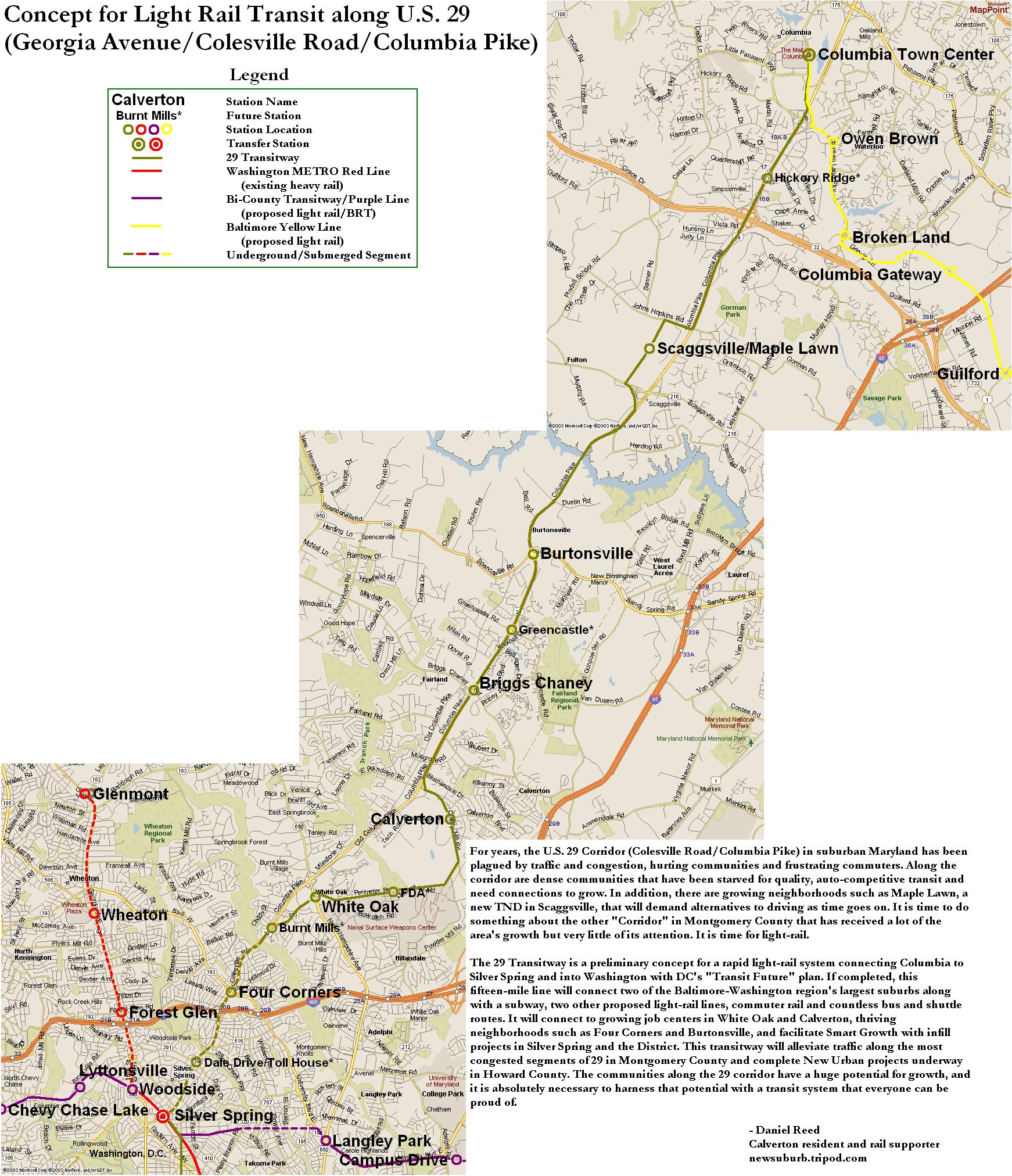
CMTA, if you want light rail connecting Columbia to the city, why not push for the US-29 light rail project that was once promised to run from Silver Spring to Columbia? A direct route to the city, not a circuitous one, that hits several established communities along the way is what Central Maryland Transit Alliance ought to be seeking. I don't know how long Dan Reed's alignment (linked above) would take to get from Columbia to downtown DC, but I bet it's faster than 69 minutes.
And if Maryland does decide to run light rail further away from Baltimore, can you at least make some effort to hit the 50,000+ job center at Fort Meade before it is completely choking the region with traffic? I bet you a rail right-of-way that a lot of those employees live in Columbia.
The Green Line extension will hit developed areas in a large city with a burgeoning centralized train system in place. This is smart. The Yellow Line extension will connect Columbia to downtown Baltimore on a very long, very circuitous route that by-passes Fort Meade, the largest employment center in the state of Maryland.
Baltimore City needs transit connections. It needs an expanded system. It needs a centralized system. A Yellow Line extension would bolster businesses in Columbia and Towson. These are decentralized locations. A Green Line extension would bolster more centralized business districts like the Belair Road and Harford Road corridors. These are centralized areas. Baltimore has been decentralizing for fifty years, and it's not working.
From Columbia, the Yellow Line would take 42 minutes to get to BWI Airport, and then another 27 to get to downtown Baltimore. An hour and nine minutes to get from Columbia to Baltimore. The northern section of the Yellow Line is actually a good idea, connecting several colleges along a main thoroughfare through the city proper. But the southern portion is as circuitous and useless as the current plan for the CCT in Gaithersburg.
CMTA, if you want light rail connecting Columbia to the city, why not push for the US-29 light rail project that was once promised to run from Silver Spring to Columbia? A direct route to the city, not a circuitous one, that hits several established communities along the way is what Central Maryland Transit Alliance ought to be seeking. I don't know how long Dan Reed's alignment (linked above) would take to get from Columbia to downtown DC, but I bet it's faster than 69 minutes.
And if Maryland does decide to run light rail further away from Baltimore, can you at least make some effort to hit the 50,000+ job center at Fort Meade before it is completely choking the region with traffic? I bet you a rail right-of-way that a lot of those employees live in Columbia.
Monday, December 29, 2008
More Freeways = Worse Urbanism
An ironic fact about freeways is that while they are designed to connect towns, they effectively partition them as well. A look at the south suburbs of Baltimore tell the story. The area between I-95, MD-100, and the Chesapeake Bay is criss-crossed with eight interstate-standard freeways. Interstates 95, 195, 695, 895, and 97, along with Maryland routes 10, 100, and 295.
View Larger Map
The area is served by MARC and the MTA Light Rail, however the stations in this area are predominantly park-and-ride. Home prices in these neighborhoods are significantly lower than in other parts of Howard and Anne Arundel Counties. And crime is not uncommon in these suburbs.
Further south, 95 and 295 cut through DC suburbs in Prince George's, but are currently only crossed by the Capital Beltway. Though this area is of similar size and similar geography, the population is much higher than northern Anne Arundel and eastern Howard counties. House prices are comparable, but they have been rising lately, particularly around the Metro stations.
I blame much of this on street connectivity. When the landscape is drawn and quartered like it has been in Baltimore's southern suburbs, it naturally has a negative effect on street connectivity. Lack of street connectivity can lead to higher incidence of traffic accidents, longer response times for emergency vehicles, and greater traffic jams.
Of course, this is a very unscientific and opinion based overview of how lots of highways can ruin an area. I'm sure there are lots of people who think Glen Burnie is a much better town than Hyattsville, so I encourage comments here.
View Larger Map
The area is served by MARC and the MTA Light Rail, however the stations in this area are predominantly park-and-ride. Home prices in these neighborhoods are significantly lower than in other parts of Howard and Anne Arundel Counties. And crime is not uncommon in these suburbs.
Further south, 95 and 295 cut through DC suburbs in Prince George's, but are currently only crossed by the Capital Beltway. Though this area is of similar size and similar geography, the population is much higher than northern Anne Arundel and eastern Howard counties. House prices are comparable, but they have been rising lately, particularly around the Metro stations.
I blame much of this on street connectivity. When the landscape is drawn and quartered like it has been in Baltimore's southern suburbs, it naturally has a negative effect on street connectivity. Lack of street connectivity can lead to higher incidence of traffic accidents, longer response times for emergency vehicles, and greater traffic jams.
Of course, this is a very unscientific and opinion based overview of how lots of highways can ruin an area. I'm sure there are lots of people who think Glen Burnie is a much better town than Hyattsville, so I encourage comments here.
Friday, October 10, 2008
Incorporated
As a Prince George's County resident, I tend to focus my posts more on this area not only because it directly affects me, but also because I feel that it is widely overlooked on issues of urban development and sprawl prevention. This is all too common in Prince George's County... Someone gets struck by a car going at a high speed while crossing a street designed to serve cars and not pedestrians. My last post alarmed me when I saw how many roads are becoming freeways thanks to superfluous interchanges here in my home of Prince George's County. It is horrifying.
I have noted that incorporated towns in Prince George's County seem to be significantly more immune to this "freewayification". Unincorporated areas like Largo, Beltsville, and Greater Upper Marlboro seem to get the brunt of the poorly implemented car-oriented development. Certainly there are may be other factors, but perhaps an incorporated town with direct, small scale representation is less likely to be tolerant of a lack of a sense of place in the town.
Baltimore Inner Space posted this piece (via GGW) on Owings Mills, and its egregious display of poor urbanism, highlighted by a fence and 'No Trespassing' signs that keep mall patrons from accessing the Metro station even though the two are adjacent. Owings Mills, like every other town in Baltimore and Howard counties, is unincorporated. There is no mayor or council to petition against such poor urbanism. residents of the Owings Mills area are at the mercy of developers and a larger government that oversees the entire county of three quarters of a million people. Perhaps this is why Largo looks like this and downtown Hyattsville does not, even though Largo is centrally served by Metro and Hyattsville is not. Even when Hyattsville fell into blight, its primary artery, US-1 remained a four lane road with a speed limit of 30, plentiful cross streets and traffic signals.
Beyond DC writes about Prince William County's future plans to upgrade transit and create more walkable town centers. Beyond DC is skeptical of the plan's ability to succeed, but applauds the idea of improving one of the most populous counties in Virginia. There are only four incorporated areas in Prince William; Occoquan, Quantico, Dumfries, and Haymarket (Manassas and Manassas Park are both independent cities but are completely encompassed by Prince William County). I would be interested to see the success of this plan in those areas versus unincorporated areas like Dale City and Gainesville.
Not to say unincorporated towns can't thrive with good urbanism. Silver Spring and Bethesda are prime examples of unincorporated areas that have exercised a very intelligent master plan. Both those areas are among the most popular walkable areas outside the District. Of course, those two areas are atop Metro stations and they are both adjacent to the DC line situated on prominent corridors into the city. Wheaton, while not enjoying the same level renaissance, might be a good example of an unincorporated exception. It too has a Red Line station (home to the western hemisphere's longest escalator), and has been improving steadily for about the last twenty years. I ought to know, I went to high school there.
If the Tysons Corner plan gets off the ground, that will be another unincorporated area that enjoys smart redevelopment. Of course, the sector plan for the area seems to treat the area like an incorporated town (strict boundaries and districts, guidelines and regulations specific to the area, a council to govern the plan, etc). Obviously the existing density and planned metro stations have a great deal to do with this overhaul as well.
My Prince George's County seems to have a clear dichotomy between smartly designed incorporated towns working to improve their walkability and livability and unincorporated areas that are draped with high speed roads, poor pedestrian facilities, big box stores, and a depressing lack of a sense of place. Even my neighborhood, technically outside the corporate limits of the City of Laurel, lacks the sidewalks and curbs present in the neighborhoods to the east, north, and west. Does that mean it would be smarter to incorporate more towns? Beltsville, Chillum, Langley Park, Lanham, Clinton, Suitland, Largo, Oxon Hill, and Camp Springs, should we look into incorporating them?
The mayor of (incorporated) Kensington commented on my MARC post informing me that Kensington too will be making improvements to the downtown. Does a government directly serving a smaller group of people help an area create, grow, and preserve their sense of place? Perhaps the incorporation provides more organization for the residents to vocalize their desire to improve the state of their surroundings. Whatever it is, it will likely ensure that my next house will be in an incorporated town.

I have noted that incorporated towns in Prince George's County seem to be significantly more immune to this "freewayification". Unincorporated areas like Largo, Beltsville, and Greater Upper Marlboro seem to get the brunt of the poorly implemented car-oriented development. Certainly there are may be other factors, but perhaps an incorporated town with direct, small scale representation is less likely to be tolerant of a lack of a sense of place in the town.
Baltimore Inner Space posted this piece (via GGW) on Owings Mills, and its egregious display of poor urbanism, highlighted by a fence and 'No Trespassing' signs that keep mall patrons from accessing the Metro station even though the two are adjacent. Owings Mills, like every other town in Baltimore and Howard counties, is unincorporated. There is no mayor or council to petition against such poor urbanism. residents of the Owings Mills area are at the mercy of developers and a larger government that oversees the entire county of three quarters of a million people. Perhaps this is why Largo looks like this and downtown Hyattsville does not, even though Largo is centrally served by Metro and Hyattsville is not. Even when Hyattsville fell into blight, its primary artery, US-1 remained a four lane road with a speed limit of 30, plentiful cross streets and traffic signals.
Beyond DC writes about Prince William County's future plans to upgrade transit and create more walkable town centers. Beyond DC is skeptical of the plan's ability to succeed, but applauds the idea of improving one of the most populous counties in Virginia. There are only four incorporated areas in Prince William; Occoquan, Quantico, Dumfries, and Haymarket (Manassas and Manassas Park are both independent cities but are completely encompassed by Prince William County). I would be interested to see the success of this plan in those areas versus unincorporated areas like Dale City and Gainesville.
Not to say unincorporated towns can't thrive with good urbanism. Silver Spring and Bethesda are prime examples of unincorporated areas that have exercised a very intelligent master plan. Both those areas are among the most popular walkable areas outside the District. Of course, those two areas are atop Metro stations and they are both adjacent to the DC line situated on prominent corridors into the city. Wheaton, while not enjoying the same level renaissance, might be a good example of an unincorporated exception. It too has a Red Line station (home to the western hemisphere's longest escalator), and has been improving steadily for about the last twenty years. I ought to know, I went to high school there.
If the Tysons Corner plan gets off the ground, that will be another unincorporated area that enjoys smart redevelopment. Of course, the sector plan for the area seems to treat the area like an incorporated town (strict boundaries and districts, guidelines and regulations specific to the area, a council to govern the plan, etc). Obviously the existing density and planned metro stations have a great deal to do with this overhaul as well.
My Prince George's County seems to have a clear dichotomy between smartly designed incorporated towns working to improve their walkability and livability and unincorporated areas that are draped with high speed roads, poor pedestrian facilities, big box stores, and a depressing lack of a sense of place. Even my neighborhood, technically outside the corporate limits of the City of Laurel, lacks the sidewalks and curbs present in the neighborhoods to the east, north, and west. Does that mean it would be smarter to incorporate more towns? Beltsville, Chillum, Langley Park, Lanham, Clinton, Suitland, Largo, Oxon Hill, and Camp Springs, should we look into incorporating them?
The mayor of (incorporated) Kensington commented on my MARC post informing me that Kensington too will be making improvements to the downtown. Does a government directly serving a smaller group of people help an area create, grow, and preserve their sense of place? Perhaps the incorporation provides more organization for the residents to vocalize their desire to improve the state of their surroundings. Whatever it is, it will likely ensure that my next house will be in an incorporated town.
Subscribe to:
Posts (Atom)

 Posts
Posts