Search This Blog

Showing posts with label Hyattsville. Show all posts

Saturday, December 5, 2009

PG Stands for Poor Growth

Now, I like to stick up for my county. I believe that in many ways, Prince George's County has been dealt the short end of the smart growth stick. But the fact is that the county government isn't even trying, and it seems that any smart, transit oriented growth that does occur happens by accident or coincidence.


What puts me over the edge was this Washington Post article in Greater Greater Washington's Breakfast Links. A concrete plant has been approved near Sheriff and Cabin Branch Roads near Fairmount Heights.The Post article points out the multitude of other industrial plants near this site, surrounded on all sides by middle class residential zoning. GGW highlights this concentration, pointing out that the region in majority black. Pushing around non-wealthy minorities is not a new thing Prince George's County.

Cheverly Metro Station. Photo by Genista from Flickr

But what the Post doesn't point out is that the site where this concrete plant has been approved is less than a mile from Cheverly Metro station, one of the most underused stations on Metro. And it's on the same side of US-50 as the Metro station, meaning that useful growth could potentially occur in that area if Prince George's County wasn't treating it as a dumping ground for undesirable industry. It's a location inside the Beltway with easy access to the city and multiple forms of transit, including two Metrobuses that directly serve the site, five Metro stations within two miles (Cheverly, Landover, Deanwood, and Capitol Heights, and Addison Road-Seat Pleasant), and an Amtrak and MARC station at New Carrollton under three miles from the site. This is not the first, but only the latest controversy where PG County has throw its citizens under the bus and tried to drop an industrial plant in residential areas near Metro stations.

This site could be used for transit-oriented development at Cheverly station. It could be a crossroads between Cheverly and Capitol Heights. Instead it is home to an asphalt plant, a recycling transfer station, and a clay mine. And now, coming soon, a concrete plant. These uses would be far more suitably placed along US 50 outside the Beltway just a few short miles away, alas those areas have been blanketed with very low density McMansion developments. Byzantine laws promoting sprawl in PG will continue to force industrial growth in inappropriate places, including Fairmount Heights, one of the oldest black settlements in Maryland.

Prince George's County will not continue to prosper as it runs out of agricultural land while continuing to neglect its valuable inner ring suburbs. Transit investment will continue to be difficult to justify, making it more difficult to fund. And PG will continue to mean poor growth until the county's planning begins to take a look towards the future with regard to land use economy.

Monday, October 19, 2009

Transit Capacity

Last month I criticized the plan to scale back Tysons Corner because of the need for increased freeway capacity. The more I think about it, the more merit I see in the notion that a revamped Tysons Corner will be desperately transit-starved. Freeways, however, are not the panacea. The plan to urbanize the region's most prominent edge city will bring thousands more jobs and residents to the area. Even if the area becomes more self contained, it will require much greater capacity for transportation in and out of the area's densest job center.

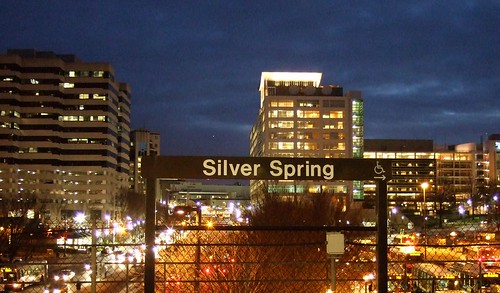
Downtown Silver Spring from the Metro station. Photo by mindgutter

Tysons will have 4 stations, but they will only be able to handle about 40% of the rides of stations at Silver Spring, Bethesda, Rosslyn, and King Street. Matt Johnson at Track Twenty-Nine created an excellent diagram showing how track sharing by Metro lines closer in to the city prevent the same capacities on the outer spokes of the system (except on the Red Line, which does not share tracks with any other line). Even with four stations, the capacity of the line does not stack up to urbanizations in Montgomery County, Arlington, and Alexandria. Can it support an even larger development with less system capacity? Can the already-clogged North Arlington Orange Line corridor support the additional riders with its finite capacity? Optimal success of the Tysons plan would require more Metro capacity such as a separated Blue Line on a new Potomac crossing.

I'm also lead to wonder if this has not contributed to the overall inferior urbanization in Prince George's County. No station in Prince George's has more than 60% capacity because the Green, Blue, and Orange lines all share track inside the District (though the northern section of the Green Line as the potential to do so if the Yellow Line ever runs all the way to Greenbelt regularly). Certainly the County's poor planning policies have contributed to the lack of urban development around virtually all 14 Metro stations, often egregiously, but perhaps lack of capacity has contributed as well.

The stretch of Metro in Prince George's County with the most service, the northern Green(/sometimes Yellow) Line has experienced the most development. Prince George's Plaza Station has probably seen the most. Though not exactly Downtown Silver Spring yet, University Town Center is probably the best example of urban development around a Metro station in Prince George's. Much has been planned for West Hyattsville, College Park, and Greenbelt, though little has come to fruition. New Carrollton, which will have added capacity once the Purple Line comes to town, also has grand plans for development. Stops on the Blue and lower Green Lines, however, are not experiencing as much planning buzz.

I have never heard of any study that implies the impact of station capacity versus development around stations, but it stands to reason that the more capacity, the more successful and robust development can be. The Orange Line corridor might be somewhat of an exception. West of Rosslyn, the Orange line can handle about 60% of the trips Silver Spring or Bethesda can handle. The strip is anchored, however, by Rosslyn, which has the same capacity as Silver Spring and Bethesda.

David Alpert suggested some innovative ways to create more system capacity by separating the Green and Yellow lines and rerouting some of the Silver Line trains. This would help Prince George's County, Tysons Corner, and other locations in Virginia and still be cheaper (in theory) than a separated Blue Line. If Silver Spring, Bethesda, and Rosslyn are models we seek to emulate, station capacity ought to be equivalent of those successful areas.

Thursday, February 26, 2009

Imagine Prince George's Plaza

Though nowhere near up to par with Arlington's Rosslyn-Ballston Corridor, Old Town Alexandria, or the central business districts of Bethesda and Silver Spring, Prince George's Plaza might be the best example of transit-oriented development in Prince George's County. It combines a Metro station with heavy retail, medium density housing, and a walkable street grid. Unfortunately, those things are not integrated with each other.

I love the City of Hyattsville. As soon as I can afford to do so, I plan on moving there. It has a ton of potential. Potential, however, means room for improvement.

Anecdotally, I was told by a Hyattsville Police officer that the city plans to annex and redevelop the suburban style medium-density apartment complexes north and west of the mall. In this same conversation, the officer, who was advising me on where the city experienced most crime, cited garden style apartment complexes like these (like Kirkwood near West Hyattsville station or the apartments on the southwest corner of University and Adelphi) as the worst offenders. I can only assume the isolation of the buildings behind PG Plaza makes them ideal places to engage in criminal activity.

Generally, I don't like the idea of putting heavy transit near a mall. Malls are inherently car-oriented, and over the past decade they have experienced severe decline in image and practicality. The Mall at Prince George's (which I will forever call PG Plaza despite its new name and this newfangled civic movement against saying "PG" in favor of "Prince George's") might be able to take advantage of the Metro station across the street.

Many of the larger development projects in Prince George's County have been greenfield developments outside the Beltway and far from transit taking on a semi-new urbanist format, but are far from transit and isolated from the better urban design closer in. Bowie Town Center and National Harbor are good yardsticks for what we can expect out of planned developments at Brandywine, Westphalia(pdf), Konterra, and Woodmore Town Center (pdf): far from existing transit, isolated pockets of walkable mixed use surrounded by parking. PG Plaza, if redeveloped, can present a retail design similar to that of Bowie Town Center with the added advantage of being across the street from a Metro station in an area that can easily be reticulated into the surrounding street grid.

Remove the roof, which PG Plaza didn't always have anyway, and lay down the grid. I give you new Hyattsville:


View Larger Map

With this, perhaps more pedestrian friendly changes will occur as well. East-West Highway has three shockingly bad design flaws on that stretch. First, the median fences. Anytime a street has a fenced median to discourage jaywalking, it's a sure sign of poor design. Pedestrian traffic is like water flow. It will find the path of least resistance from origin to destination, and will creatively by-pass obstacles. Instead of trying to force pedestrians to go out of their way to cross East-West, embrace the foot traffic with more crossings, traffic signals, and a parallel street to spread out the traffic.

Next, the pedestrian bridge from the Metro station to the mall parking lot has to go. Parking ought to be consolidated into a garage, and the street frontage should be developed. pedestrian bridges over suburban arteries like this are not functional, they encourage speeding on the road, they kills street life, and they are unbearably tacky. Perhaps if the street frontage has an arcade with an upper level of shops and whatnot, it could stay, but generally it looks horrible and it proves to be cumbersome for access to the Metro station.

Third, rename the damn road. East-West Highway (MD route 410) is a title unbecoming for a road passing through the CBD's of Bethesda, Silver Spring, Takoma Park, and Hyattsville. In Takoma Park, 410 is actually called Ethan Allen Avenue. Perhaps Hyattsville could follow suit and rename it something like "John Clark Hyatt Avenue" after the town's founder. Apt, historical, and far less generic.

Hyattsville is evolving as a city. It has come a very, very long way in the last decade, and it continues to grow and improve. PG Plaza will undoubtedly emerge as a hot spot for good urbanism. Eyesores like the pedestrian bridge will be replaced by more of what we're seeing in the nearby Hyattsville Arts District, and instead of an island of good urbanism, it will grow into the fabric of the surrounding areas.

Thursday, February 12, 2009

Imagine West Hyattsville

West Hyattsville Metro Station is one of the most underutilized stations on the Metro system, standing out even in TOD-beleaguered Prince George's County. It stands seemingly in a large field, discouraging the station's use as anything but a commuter stop. The County has plans (pdf) for vitalizing the area around the station, but I thought I might take a crack at it myself with some street connectivity.


View Larger Map

Queens Chapel Town Center has a great deal of potential to anchor a strong retail district. The area, at the intersection of Chillum, Mount Rainier, and Hyattsville, has the population to support retail progress. The success of the nearby Hyattsville Arts District has changed the image of the area. West Hyattsville, connected to the Arts District by a traditional suburban street grid, is poised to parlay the success of one of Prince George's County's most popular real estate ventures into success of its own. Only the presence of a Metro station,

The Northwest Branch runs just to the south of the station, but instead of serving as a barrier, I believe this watercourse can be embraced by development with small waterside paths. I included several new bridges over it, connecting potential new developments to the Metro station. The key element, in this case, is adding parallel roads. As I have stated time and time again (as with many before me), a street grid reduces traffic, lessens vehicle miles traffic, and eliminates car trips as the area becomes more walkable. Hopefully a developer with the vision will take advantage of the opportunity, and hopefully the County won't block any progressive efforts. Hyattsville could become the new Bethesda, it just takes some progressive leadership to make it happen.