
My New Years resolution was to eat at more independently owned food joints. Originally, I opted to do this to get a better taste for DC cuisine, but there is a reason that benefits everyone to seek local fare from locally owned restaurants. That money comes flowing back to you by keeping the money in the place where you live. And this goes for everything, not just food.
I purchase some pork tenderloin at the Wal-Mart in Maryland City, the money goes a lot of places. New York investors, Chinese suppliers, various distributors, and of course the fat cats in Benton, AR where Wal-Mart started. But where doesn't it go? Laurel. Prince George's County. And for the most part, the State of Maryland. My hard earned cash is going to support gated communities like Hot Springs Village, AR, the largest gated community in the United States and not surprisingly convenient to Benton.
If I purchase the same pork tenderloin at the Laurel meat market on Main Street, my money is not going through all the corporate filters of a Wal-Mart. The product is more likely to come from the state of Maryland and will probably be fresher. A larger percentage of the taxed monies will go to the city of Laurel, Prince George's County, and Maryland. And a retailer that depends on the community. Those taxes will go towards investment in my city, not a segregated community halfway across the country with a disproportionate lack of minority population.
River East Idealist had a great article last week on how River East residents can keep their money in River East and break the debt cycle in which many less fortunate River East residents are mired. Her first point was to stop attending colleges you can't afford. I like to think I'm living proof that this works. I have an Associates of Applied Science from Montgomery College. I educated myself where I lived, and I now have what could be considered a decent paying job and a rather prestigious position in Federal Government. Of course, if you can find a way afford a degree from a better more expensive school, go for it. But educating yourself outside your means is not necessary. I believe I am doing much better than most of my friends with bachelors degrees from more prestigious institutions because I do not have six figure student loan debt. My six figure debt is a mortgage on the house I own.
Another observation she made: stop financing cars. If the money Americans spent on the interest alone of financed cars were instead spent on public transportation infrastructure, I wonder how much better our systems would be. If that were the case, I speculate many Americans would not even bother to own a car. At the very least, I bet Metro would not be facing such a tremendous budget gap.
There are a plethora of ways we can keep our money in the community continuing to benefit us. But it is important that those methods be accessible to everyone, regardless of their socio-economic status. Policy ought to be enacted promoting locally owned businesses over chains, mass transit over car ownership, and better investment in local schools to create sharp minds and keep them nearby. The status quo will continue to send money to out of touch corporations and Wall Street investors while siphoning investment away from our own communities.
Showing posts with label Big Box. Show all posts
Showing posts with label Big Box. Show all posts
Sunday, February 7, 2010

Tuesday, August 4, 2009
Youth Sports and the Automobile
 It's August, the time of year where I return to my favorite volunteer activity coaching youth football in Silver Spring. Youth sports, despite my lack of athletic prowess, were a big part of my childhood and were probably the only thing that kept me reaching the age of 20 with any semblance of physical conditioning. To a suburban child, youth sports will offer exercise and teach social integration in a safe environment.
My 2008 squad.
Exercise is a valuable commodity in the suburbs. You don't burn many calories from the passenger seat of a minivan. The extreme, of course, is Saratoga Springs, where a student was recently punished for riding his bike to school. The policy against biking to school is of course disguised in the name of safety. Social integration is also more valuable in the suburbs. Suburban children grow up cloistered in pods that effectively segregate socio-economic classes from each other. And despite the marketing, the suburbs are not the safest place to be a kid. So a program that offers exercise, social integration, and safety ought not be undervalued, be it football, swimming, ballet, or whatever.
Are youth sports a rare positive side effect of suburbanization? The Mid Maryland Football League has 26 programs spread out over Montgomery, Prince George's, Anne Arundel, Howard, Baltimore, Frederick, and Carroll Counties, and could never survive without the suburban infrastructure. I used to think youth football could not survive without it at all.
***
The Silver Spring Saints, for whom I coach, are one of the oldest youth programs still in existence in the DC area. When I played on this team as a youth, however, it was Saint Bernadette's, a Catholic Youth Organization program. CYO football went under in 1995, however, and the Silver Spring Saints rose from the ashes, playing their home games at Saint Bernadette's field. When It was Saint Bernadette's, however, the program had two teams with about 23 or so players per team. At its peak, the CYO had 40 or 50 such teams in Montgomery, Prince George's, and DC, and they were broken into geographic-based divisions. It was the premier youth football program in Maryland for decades.
When the Silver Spring Saints joined the Capital Beltway League in 1995, the one-time parish-oriented program had to struggle to field teams in six weight classes, effectively tripling the size of the program overnight and drawing in players from a much larger area. As it struggled with finding enough players, the notion of playing games close by started to disappear. Montgomery Village, Clinton, Germantown, and Bowie were now the away games as opposed to other small teams in Silver Spring, Wheaton, and Rockville. This season, the Saints have joined the Mid-Maryland League to escape the poor organization of the CBL. They are now required to field 12 teams. Many of them will only have about 15 or 16 players. (For those of you not familiar with the sport, there are 11 on the field at a time. An NFL team has 53 players. 24 is an ideal number at the youth level)
I love the Saints organization, and what it does for young men between the ages of 6 and 14. Growing up in a single parent household, it gave me male role models, goals, and a sense of belonging that every boy should experience. But in the time between when I played and now that I coach, it has gone from a "mom and pop" program belonging to a community organization to a "big box" program. The parish still has a strong influence on the program, which in my opinion has kept it about the players and not about championships and egos (though we win our share of games).
No, it's hard to imagine youth football now without cars and giant parking lots at each field, where 12 games are played by each program every Saturday and teams drive as many as 80 miles to play each other. But it hasn't been that way throughout the history of the Silver Spring Saints. For their very first game 58 years ago, the first 12 Saints played Saint Micheal's of downtown Silver Spring, two miles away from Saint Bernadette's. To get there, they took a Capitol Transit Bus.
Monday, March 16, 2009
A Big Box Tale
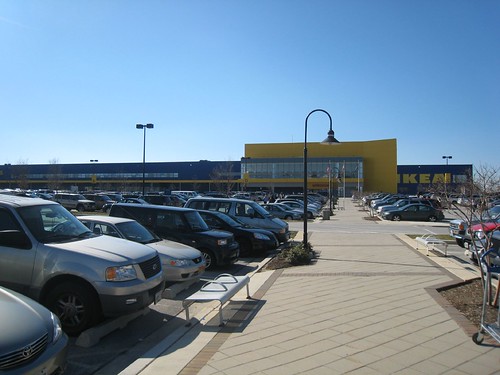 The massive parking lot of the College Park Ikea. Photo from Flickr by technotheory
When I moved into Laurel in late 2003, it seemed as if the city's primary industry was furniture sales. I found the jewel of the bunch, Carolina Furniture. I purchased the bulk of the furniture for my hew house at Carolina Furniture, then located on the corner of Main Street and Rt. 1. It was a small business, but had a very helpful staff and one of the best selections I have ever come across, especially impressive considering the modest size of the store. I loved it. I bought a couch and a love seat for half the price of what the Laurel Marlo (prominently located at Rt. 1 and Contee Road) was offering me for just the couch!
Then came the College Park Ikea. I'll admit, as far as big box stores go, I don't mind Ikea too much. But the College Park location was devastating to local businesses.
Carolina Furniture was the first to go. First it moved to an obviously cheaper site in an industrial park off Bowie Road. By early 2006, it had closed up shop. Galaxy Furniture, located on the site where Burtonsville's Dutch Country Farmers' Market was scheduled to move, fell shortly after. Another mile down Rt. 198 was Regency, a huge warehouse-like store located in a strip mall next to a Target. It closed up shop shortly after. Empire Furniture in Laurel Mall went next, followed by another smaller store that briefly opened in the mall. The tiny family-owned shop across from Galaxy closed just a few months ago. Several others have closed throughout the years in the industrial parks between Rt. 1 and the train tracks. Even the Peir One has closed its doors
Currently, Bargain Furniture is going out of business. This store sold scratched or irregular new furniture at a huge discount, and they offered delivery service only on a few select items. I thought this place would never close. It was always crowded with people looking for a deal on another store's rejected items. But today it is liquidating its stock, as you'll clearly see if you drive through the intersection of 197 and 198.
All in all, at least 9 furniture places have closed in Laurel in the last three years. The only furniture place left in Laurel is mega-chain Marlo, the only store in Laurel I've never recommended because of the poor service I recieved there when purchasing my furniture. All of them were either independent or small chains. I'm sure our recession has played a large part in shutting down these stores, but I can't help but think there were almost a dozen furniture stores before Ikea and now Laurel is down to one or two.
Ikea's iconic 200 foot sign visible from the Beltway for a mile in either direction draws people in to its acres and acres of parking. While the upper level features furniture, the lower level has all kinds of housewares, much like your average Wal-Mart (though of much better quality, generally). The store even features a Swedish cafeteria and a child day-care center. The furniture, however, is do-it-yourself. It is difficult at Ikea to find the country-style furniture I prefer. All the furniture is self-assembled. And no matter how friendly and courteous the staff at the store may be (they tend to be rather hard to pin down), you are one of thousands of shoppers. If you don't buy it, the next person will.
When I bought my living room and dining room sets at Carolina Furniture, everything was delivered and (if needed) assembled at my house at no extra charge. A year later, I took some Army buddies there who had just been stationed at Fort Meade. The sales rep recognized me immediately, even remembering my name and what I had bought. But in Laurel, it appears, those days are long gone. If I want to buy furniture locally, I have to stand in a long line at Ikea or get ripped off by Marlo.
Subscribe to:
Posts (Atom)

 Posts
Posts


