
A historic campus. An idyllic untouched corner of real estate in close proximity to the seat of federal government for a great nation. The headquarters of an esteemed branch of the military and an a department headquarters for a government agency. No nation on earth could improve on a venture like that. But in the United States, we throw in a 1900 space garage.
The United States Coast Guard Headquarters design has been approved. I'm not an architect nor am I capable of eloquently stating my disgust at a coast guard headquarters that looks like a spa retreat off in the woods despite the nearby convergence of two navigable rivers, but I will openly take issue with the 1,973 space garage. It is definitely better than surface parking, but this is a historic site, virgin land with views of the convergence of the rivers, the Capitol, and the monuments. Real estate in America doesn't get more prime than this. And DHS is dropping a greenified Tyson's Corner transplant with a huge garage in the middle of it, complete with a sexed up drainage pond and ample parking.
I've advocated that a campus like this ought to house an institution of higher learning, particularly UDC. To me, that would be the ideal way to dignify that site (Although I don't know what your average UDC student would think about moving into dorms that formerly housed mental patients... but one would think the good people hat DHS and the Coast Guard would have similar concerns!)
I'll admit my reaction is perhaps a bit pessimistic considering that I have not seen an illustration or elevation that contextualizes the complex amongst the St. E's buildings, but with streetcars imminent, location near two Metro stations, and traffic congestion already problematic, a huge parking garage has me worried that this is just going to be another office park like those in Columbia, Gaithersburg, or Tyson's Corner.
The garage is built into a slope visible from Haines Point. Several measures were put in place to minimize the visual impact of the structure, such as putting more of it underground and a green wall system on the northern facade, however on an important site like this with available transit alternatives, I would expect better planning and land use than a green-guilt version of the same disposable crap office box we have all come to know and hate.
Students of architecture, I beg your input on this one. I am at a loss for words. If the Army built something that ugly, I would be even more embarrassed as a veteran than I am when West Point gets annihilated by the Naval Academy in football every December.
Showing posts with label parking. Show all posts
Showing posts with label parking. Show all posts
Thursday, January 7, 2010

Monday, February 2, 2009
Free Gas at My Grocery Store?
This past Saturday, I was shopping at the Safeway in Laurel Lakes. Upon checkout, I received a surprise: $9 worth of gas at any BP station, a figure based on the amount of money I had spent on groceries over my last few trips. I was completely unaware of this program until the cashier handed me a gift card. The program gives $1.50 in gas for every $100 spent at Safeway. For me, 9 bucks is about a third of a tank, which will get me to and from work for an entire week.
This is a powerful sentiment presented by Safeway. To me, this implies that Safeway's business model assumes that consumers MUST use an automobile (and a gasoline powered one, at that) to use their stores, and therefore ought to subsidize automobiles. Personally, I would prefer imrpved crosswalks on Rt. 1 and better passage through the monstrous parking lot in front of Laurel Lakes Shopping Center. I would never drive to Safeway again. This furthers the notion that large grocery store chains ignore walkable urbanism in their business models despite its success in denser areas. In less dense places like Laurel, I'd like to see the two concepts at least coexist.
This has other implications. Since such grocery stores tend to be far fewer in areas with lower average incomes, this implies that a gas subsidy is the best way to get less fortunate people to the grocery store. In the automobile paradigm, this is somewhat of a charitable act on Safeway's part. However, not owning a car could save working class individuals a very significant percentage of their monthly take-home salary (25% for me!) , a savings that would far supercede the buck and a half I save on gas every time I spend a hundred dollars at Safeway.
I don't want to demonize the automobile. I own one, I use it daily, and I enjoy the freedom that driving provides. However I live 1600 feet from the entrance of the Laurel Lakes Safeway, and the only "safe way" for me to get there is to drive. I don't want to impose any major paradigm shift on anyone, nor do I want to take away their free gas or the parking in front of the store. For this particular shopping trip (which was rather large), I probably would have used a car no matter what the pedestrian facilities were. However, the simple fact that I can't walk 1600 feet from the grocery store to my house without risking my life in the process is inexcusable, and I really wish my local grocery store would acknowledge that this is a problem.
This is a powerful sentiment presented by Safeway. To me, this implies that Safeway's business model assumes that consumers MUST use an automobile (and a gasoline powered one, at that) to use their stores, and therefore ought to subsidize automobiles. Personally, I would prefer imrpved crosswalks on Rt. 1 and better passage through the monstrous parking lot in front of Laurel Lakes Shopping Center. I would never drive to Safeway again. This furthers the notion that large grocery store chains ignore walkable urbanism in their business models despite its success in denser areas. In less dense places like Laurel, I'd like to see the two concepts at least coexist.
This has other implications. Since such grocery stores tend to be far fewer in areas with lower average incomes, this implies that a gas subsidy is the best way to get less fortunate people to the grocery store. In the automobile paradigm, this is somewhat of a charitable act on Safeway's part. However, not owning a car could save working class individuals a very significant percentage of their monthly take-home salary (25% for me!) , a savings that would far supercede the buck and a half I save on gas every time I spend a hundred dollars at Safeway.
I don't want to demonize the automobile. I own one, I use it daily, and I enjoy the freedom that driving provides. However I live 1600 feet from the entrance of the Laurel Lakes Safeway, and the only "safe way" for me to get there is to drive. I don't want to impose any major paradigm shift on anyone, nor do I want to take away their free gas or the parking in front of the store. For this particular shopping trip (which was rather large), I probably would have used a car no matter what the pedestrian facilities were. However, the simple fact that I can't walk 1600 feet from the grocery store to my house without risking my life in the process is inexcusable, and I really wish my local grocery store would acknowledge that this is a problem.
Tuesday, January 13, 2009
How I'm Getting to the Inauguration
Hopefully I'll be over my cold by then, but I do plan on attending the Inauguration, which is now only a week away. But with massive transportation issues that day and estimates as high as 5 million people coming to town, getting there seems to be a scary proposition.
I'll have two out of town visitors that I'm putting up at my home in Laurel. My usual stations of choice are Greenbelt, College Park, Cheverly, and New Carrollton. But considering that the Green and Orange Lines are located on the Beltway, I think I'm going to try a different approach.
I'll be heading to Silver Spring Metro station. Here's why: first of all, the other stations on that end of the Red Line (Forest Glen, Wheaton, and Glenmont) will certainly see a great deal of volume, but I do not believe that the gobs of out-of-towners will be flooding them the way they will at Shady Grove, New Carrollton, and Greenbelt, considering the much more "ideal" locations of those stations being at major highway junctions. Forest Glen is right off the Beltway, but it is a tiny station, and it is not marked on the Beltway the way other stations are.
Second, Silver Spring has plenty of stuff to do. If for some reason I make it down there and there is good reason not to go into the city, there are dozens of places to go and watch history unfold on TV. I plan on catching dinner there after the festivities, and showing the area off to my cousin and his friend.
Third, ample parking. As a car-oriented person, I have to take this into account. Hopefully you won't have to do so. Silver Spring has ample garages, and there ought to be enough folks getting off work to make parking there a viable option. Also, I don't believe that tour buses will be flooding this station in the same manner that they will be flooding other outer stations.
My the first reason is my primary reason. I figure people coming from points south will flood the VA stations. From the northeast, they'll all head towards Greenbelt. From the northwest, Shady Grove, and from the east, New Carrollton. Perhaps Huntington and Branch Avenue might be decent options by that logic. Does anyone else have any good plan for getting down there? Are there major flaws in my logic? How are you getting down there?
I'll have two out of town visitors that I'm putting up at my home in Laurel. My usual stations of choice are Greenbelt, College Park, Cheverly, and New Carrollton. But considering that the Green and Orange Lines are located on the Beltway, I think I'm going to try a different approach.
I'll be heading to Silver Spring Metro station. Here's why: first of all, the other stations on that end of the Red Line (Forest Glen, Wheaton, and Glenmont) will certainly see a great deal of volume, but I do not believe that the gobs of out-of-towners will be flooding them the way they will at Shady Grove, New Carrollton, and Greenbelt, considering the much more "ideal" locations of those stations being at major highway junctions. Forest Glen is right off the Beltway, but it is a tiny station, and it is not marked on the Beltway the way other stations are.
Second, Silver Spring has plenty of stuff to do. If for some reason I make it down there and there is good reason not to go into the city, there are dozens of places to go and watch history unfold on TV. I plan on catching dinner there after the festivities, and showing the area off to my cousin and his friend.
Third, ample parking. As a car-oriented person, I have to take this into account. Hopefully you won't have to do so. Silver Spring has ample garages, and there ought to be enough folks getting off work to make parking there a viable option. Also, I don't believe that tour buses will be flooding this station in the same manner that they will be flooding other outer stations.
My the first reason is my primary reason. I figure people coming from points south will flood the VA stations. From the northeast, they'll all head towards Greenbelt. From the northwest, Shady Grove, and from the east, New Carrollton. Perhaps Huntington and Branch Avenue might be decent options by that logic. Does anyone else have any good plan for getting down there? Are there major flaws in my logic? How are you getting down there?
Monday, January 12, 2009
Stupid Growth: St. Elizabeths
What does this look like to you:
View Larger Map
Does it remind you of this?
View Larger Map
Or this?
View Larger Map
Using St. Elizabeths Hospital to house the new Department of Homeland Security headquarters is a bad idea when the land would be much better suited to house a new UDC Campus.
View Larger Map
Does it remind you of this?
View Larger Map
Or this?
View Larger Map
Using St. Elizabeths Hospital to house the new Department of Homeland Security headquarters is a bad idea when the land would be much better suited to house a new UDC Campus.
Tuesday, December 30, 2008
Car Oriented
I chose to live close to my work at Fort Meade thinking I would drive less. I live close to the base on which I work, and since there's bubkes for transit options to the base, I figure it is best to shorten my commute. It will save money. I'll drive less.
But instead I drive more, since I can't go anywhere from my Laurel neighborhood without driving... not even the grocery store two blocks away, as no sane person would attempt to cross Route 1 while carrying something. And considering that I'm a single 29 year old with an active social life, I like to venture out of Laurel as often as possible. I have a part-time night job in Bethesda, volunteer with a youth program in Silver Spring, I have a ton of friends that live in places like Capitol Hill, Rosslyn, and Dupont, my familiy lives mostly in Silver Spring, and I like to attend sporting events in DC and Landover. All of those locations have one distinct advantage over Laurel: Metro stations.
The buses on Route 1 is painfully slow even during off-peak hours. It doesn't run past 8pm, which is generally when I get off work, and is less reliable on the weekends. Greenbelt and Cheverly Metro stations are where I usually hop on the Metro if I'm going into DC or Virginia, but even those are 15 minute drives in light traffic.
I won't shy away from the fact that I enjoy a good glass of scotch or two from time to time, but I have to plan carefully if I want to go meet friends in Bethesda, Old Town, or H Street for a couple of drinks. Fact is, 100% of drunk drivers are driving at the time. I wonder how many DUI's Metro has prevented over the years.
I try to combine trips as often as possible, but walking anywhere from my house is laborious. There are no sidewalks in my neighborhood. Route 1, where every road in my neighborhood empties, has few sidewalks on my stretch and even fewer crosswalks. Most retail near me is hidden behind a sea of paking lots, including the moribund Laurel Mall, where I only shop when I am absolutely desperate (although here's a great secret: the Macy's there is always fully stocked because no one shops there).
For someone who hates paperwork as much as I do, driving is a nightmare. There is insurance, an expensive necessary evil to legally drive in most of the US. If you live anywhere near a city, the price goes up significantly. MVA (which is Marylandese for DMV) registration, tags, and drivers license are relatively cheap, but minor oversights are costly. Should insurance, tags, license, or registration lapse, there are heavy penalties. Then there is the occaisional parking ticket (I have had plenty at work when parking was particularly bad and I chanced it in a reserve space) and if you're really not paying attention, speed camera ($50 for 36 mph on Minnesota Avenue at 3 a.m. last month... I'm not complaining about speed cameras, but ouch).
The real cost of my car oriented lifestyle is huge. I make a decent living on a federal salary. I'm certainly not loaded, but I make a decent wage by most standards. My car is a modest American sedan that gets 30 mpg that I purchased used on a 5 year loan. My car payment, insurance, scheduled maintenance, and gas (to and from work ONLY, assuming $2/gal) eats up over 20% of my take home salary, which includes my federal salary, my VA disability, and my night job. I don't care how much anyone makes. 20% of any living wage is ludicrous. And that 20% doesn't include emergency repairs (like a new set of tires that wasn't covered by my insurance, $600), tickets, MVA fees, or gas to get anywhere besides work. And to add insult to injury, my tax dollars are now going to bail out the automakers. I already gave them my money when I purchased my car. Rest assured that when I purchase another one, it will not be a GM, Ford, or Chrysler.
That's 20% I can't spend on improving my house. If it comes down to it, an emergency repair on my car takes precedence over one for my house, because I can't get to work without my car. The irrational prioritization I am forced to uphold for my automobile is absurd, but it is a simple fact that most Americans take in stride. Supposedly offering the freedom of mobility, many Americans are in my position, and I consider myself a slave to my car.
Why did I take this in stride most of my life? I was raised in a car-oriented suburb in Silver Spring, a quarter mile from a Beltway exit. The only thing I could walk to from my house without a very long trek involving significant distance along a six lane highway was the community swimming pool, which of course was only open three months a year. I attended high school four miles from my house at a private school with no bus service. I would take Metrobus home from school often, however the school has since relocated far away from the a Metro station and I would not have that option today.
Furthermore, as Rob at Extraordinary Observations points out, previous generations (i.e., the parents who raised us) venerate automobiles. Cars were status symbols and not necessary evils. Where our parents dreamt of moving out to the suburbs, today's young adults are flocking back to the cities. To the Cold War generation, riding transit could be compared to people today who use Walkmans instead of iPods... it spurned progress while at the same time it was a sign of weakness. He also points out that young adults enter the work force from college with enormous debt, which most of our parents did not face. Six figure debt at age 23 is not uncommon in our society, as medical costs and especially college tuition increase have greatly outpaced income increases.
After high school I attended Montgomery College in Rockville, to which I drove, and worked at a store in Cleveland Park, to which I took Metro when feasible. After college, I joined the Army. I have repeatedly stated that it is nearly impossible to get by in the US Army without an automobile, an overpowering irony for the service that prides itself on "beating feet". So when I purchased my house five years ago, I thought I was doing the responsible thing living close to work. And perhaps, to a degree, I was. But living far from transit has cost me a great deal, even if I can't take transit to work.
Don't get me wrong, I love driving. I find it cathartic to be on an open road. For liesure, I used to drive out to northwestern Montgomery County and take in the sights. I always offer to drive on road trips. I love that I can hop in the car on a whim and go just about anywhere in America I choose. But there is a distinct difference between chosing to drive and being wholly dependent on an automobile. There is a difference between driving for leisure and driving because you are forced to drive.
Currently, the extra money that goes into driving is ironically prohibiting me from improving my location by moving somewhere more transit accessible. I probably will never give up driving, but I am committed to driving less. More importantly, I will continue to remind myself and those around me how expensive it can be when you lead a car-oriented lifestyle.
But instead I drive more, since I can't go anywhere from my Laurel neighborhood without driving... not even the grocery store two blocks away, as no sane person would attempt to cross Route 1 while carrying something. And considering that I'm a single 29 year old with an active social life, I like to venture out of Laurel as often as possible. I have a part-time night job in Bethesda, volunteer with a youth program in Silver Spring, I have a ton of friends that live in places like Capitol Hill, Rosslyn, and Dupont, my familiy lives mostly in Silver Spring, and I like to attend sporting events in DC and Landover. All of those locations have one distinct advantage over Laurel: Metro stations.
The buses on Route 1 is painfully slow even during off-peak hours. It doesn't run past 8pm, which is generally when I get off work, and is less reliable on the weekends. Greenbelt and Cheverly Metro stations are where I usually hop on the Metro if I'm going into DC or Virginia, but even those are 15 minute drives in light traffic.
I won't shy away from the fact that I enjoy a good glass of scotch or two from time to time, but I have to plan carefully if I want to go meet friends in Bethesda, Old Town, or H Street for a couple of drinks. Fact is, 100% of drunk drivers are driving at the time. I wonder how many DUI's Metro has prevented over the years.
I try to combine trips as often as possible, but walking anywhere from my house is laborious. There are no sidewalks in my neighborhood. Route 1, where every road in my neighborhood empties, has few sidewalks on my stretch and even fewer crosswalks. Most retail near me is hidden behind a sea of paking lots, including the moribund Laurel Mall, where I only shop when I am absolutely desperate (although here's a great secret: the Macy's there is always fully stocked because no one shops there).
For someone who hates paperwork as much as I do, driving is a nightmare. There is insurance, an expensive necessary evil to legally drive in most of the US. If you live anywhere near a city, the price goes up significantly. MVA (which is Marylandese for DMV) registration, tags, and drivers license are relatively cheap, but minor oversights are costly. Should insurance, tags, license, or registration lapse, there are heavy penalties. Then there is the occaisional parking ticket (I have had plenty at work when parking was particularly bad and I chanced it in a reserve space) and if you're really not paying attention, speed camera ($50 for 36 mph on Minnesota Avenue at 3 a.m. last month... I'm not complaining about speed cameras, but ouch).
The real cost of my car oriented lifestyle is huge. I make a decent living on a federal salary. I'm certainly not loaded, but I make a decent wage by most standards. My car is a modest American sedan that gets 30 mpg that I purchased used on a 5 year loan. My car payment, insurance, scheduled maintenance, and gas (to and from work ONLY, assuming $2/gal) eats up over 20% of my take home salary, which includes my federal salary, my VA disability, and my night job. I don't care how much anyone makes. 20% of any living wage is ludicrous. And that 20% doesn't include emergency repairs (like a new set of tires that wasn't covered by my insurance, $600), tickets, MVA fees, or gas to get anywhere besides work. And to add insult to injury, my tax dollars are now going to bail out the automakers. I already gave them my money when I purchased my car. Rest assured that when I purchase another one, it will not be a GM, Ford, or Chrysler.
That's 20% I can't spend on improving my house. If it comes down to it, an emergency repair on my car takes precedence over one for my house, because I can't get to work without my car. The irrational prioritization I am forced to uphold for my automobile is absurd, but it is a simple fact that most Americans take in stride. Supposedly offering the freedom of mobility, many Americans are in my position, and I consider myself a slave to my car.
Why did I take this in stride most of my life? I was raised in a car-oriented suburb in Silver Spring, a quarter mile from a Beltway exit. The only thing I could walk to from my house without a very long trek involving significant distance along a six lane highway was the community swimming pool, which of course was only open three months a year. I attended high school four miles from my house at a private school with no bus service. I would take Metrobus home from school often, however the school has since relocated far away from the a Metro station and I would not have that option today.
Furthermore, as Rob at Extraordinary Observations points out, previous generations (i.e., the parents who raised us) venerate automobiles. Cars were status symbols and not necessary evils. Where our parents dreamt of moving out to the suburbs, today's young adults are flocking back to the cities. To the Cold War generation, riding transit could be compared to people today who use Walkmans instead of iPods... it spurned progress while at the same time it was a sign of weakness. He also points out that young adults enter the work force from college with enormous debt, which most of our parents did not face. Six figure debt at age 23 is not uncommon in our society, as medical costs and especially college tuition increase have greatly outpaced income increases.
After high school I attended Montgomery College in Rockville, to which I drove, and worked at a store in Cleveland Park, to which I took Metro when feasible. After college, I joined the Army. I have repeatedly stated that it is nearly impossible to get by in the US Army without an automobile, an overpowering irony for the service that prides itself on "beating feet". So when I purchased my house five years ago, I thought I was doing the responsible thing living close to work. And perhaps, to a degree, I was. But living far from transit has cost me a great deal, even if I can't take transit to work.
Don't get me wrong, I love driving. I find it cathartic to be on an open road. For liesure, I used to drive out to northwestern Montgomery County and take in the sights. I always offer to drive on road trips. I love that I can hop in the car on a whim and go just about anywhere in America I choose. But there is a distinct difference between chosing to drive and being wholly dependent on an automobile. There is a difference between driving for leisure and driving because you are forced to drive.
Currently, the extra money that goes into driving is ironically prohibiting me from improving my location by moving somewhere more transit accessible. I probably will never give up driving, but I am committed to driving less. More importantly, I will continue to remind myself and those around me how expensive it can be when you lead a car-oriented lifestyle.
Friday, December 26, 2008
Bus Parking for the Inauguration
The Washington Post put out a map of the charter bus parking plan for Inauguration Day. 10,000 buses are expected to flood the city with tourists, and it's a good idea to have a plan to deal with them. The map states that cars parked on the designated bus parking routes will be towed after midnight on the 20th. It also indicated that no buses will be parked on residential blocks.
The plan, however, is a little vague... according to the map, the neighborhoods between P, K, 12th and 21st Streets NW appear to be fair game. Same with NoMa, Near Southeast, and all of Southwest. Are these buses just going to park on the street? Did the area residents and businesses have any chance to chime in on this? Who exactly created this plan? (The Post's graphic is sourced to D.C. Homeland Security and Emergency Management Agency)
It appears that RFK's lots and perhaps the garage at Nationals Stadium will be used. This makes a lot of sense to me. But 10,000 is a lot of buses. I think if the city plans to park them on residential streets like the WaPo map suggests, the people who live and work in those neighborhoods ought to have a say.
The plan, however, is a little vague... according to the map, the neighborhoods between P, K, 12th and 21st Streets NW appear to be fair game. Same with NoMa, Near Southeast, and all of Southwest. Are these buses just going to park on the street? Did the area residents and businesses have any chance to chime in on this? Who exactly created this plan? (The Post's graphic is sourced to D.C. Homeland Security and Emergency Management Agency)
It appears that RFK's lots and perhaps the garage at Nationals Stadium will be used. This makes a lot of sense to me. But 10,000 is a lot of buses. I think if the city plans to park them on residential streets like the WaPo map suggests, the people who live and work in those neighborhoods ought to have a say.
Wednesday, December 24, 2008
Imagine Wheaton
GGW's Cavan has written a couple of posts about Wheaton, a bustling suburb with an unfairly negative reputation in the heart of MoCo. Wheaton is near and dear to my heart, as I spent a lot of time there in high school. My old high school (since relocated to Olney to keep "transit people" from applying) was a quarter mile from the Metro station and the Wheaton CBD.
It's a gritty area with significant Central American cultural ties, lots of unique little shops, and, as Cavan will tell you, a schizofrenic approach to good urbanism. But I like the potential of Wheaton, it has something many inner suburbs don't enjoy when seeking to grow smarter: the framework of a good street grid. A few roadway connections here and there, and Wheaton could be the very model of transit oriented development. Okay, so maybe there are a few other things before that could be the case... but here's my vision of what Wheaton would look like if its streets were better connected:
View Larger Map
Blue lines are new street connections. Blue place marks are new traffic signals. Zoom in and see how my lines mesh with the road network.
Wheaton has a few other issues. It's one of the only places I've ever been where there is street parking with meters fronting free parking at a strip mall (Ennals Avenue between Grandview and Viers Mill). Crosswalks are often poorly marked. The three main roads through Wheaton (University Boulevard, Viers Mill Road, and Georgia Avenue) are 6 lane traffic nightmares with little street parking and no bus lanes. There are curb cuts for strip mall parking all over the place. And of course, there's a giant freakin' mall.
Though Wheaton has plenty of interesting and quirky independently owned shops, Just Up the Pike points out the failure of the Montgomery Cinema 'n' Drafthouse, blaming some of the above examples of bad urbanism. JUTP also points out a shooting that occured at the mall this week as being the fourth major crime at the mall since its renovation. Would removing the mall and replacing it with mixed use high density transit oriented development (and less surface parking) lower crime? I like to think so.
In the mean time, Wheaton is a guinea pig for inner suburb redevelopment. It slowly gets more walkable as it fights new fights and teaches the rest of the region the lessons we must learn to develop a better sense of place around the Beltway.
It's a gritty area with significant Central American cultural ties, lots of unique little shops, and, as Cavan will tell you, a schizofrenic approach to good urbanism. But I like the potential of Wheaton, it has something many inner suburbs don't enjoy when seeking to grow smarter: the framework of a good street grid. A few roadway connections here and there, and Wheaton could be the very model of transit oriented development. Okay, so maybe there are a few other things before that could be the case... but here's my vision of what Wheaton would look like if its streets were better connected:
View Larger Map
Blue lines are new street connections. Blue place marks are new traffic signals. Zoom in and see how my lines mesh with the road network.
Wheaton has a few other issues. It's one of the only places I've ever been where there is street parking with meters fronting free parking at a strip mall (Ennals Avenue between Grandview and Viers Mill). Crosswalks are often poorly marked. The three main roads through Wheaton (University Boulevard, Viers Mill Road, and Georgia Avenue) are 6 lane traffic nightmares with little street parking and no bus lanes. There are curb cuts for strip mall parking all over the place. And of course, there's a giant freakin' mall.
Though Wheaton has plenty of interesting and quirky independently owned shops, Just Up the Pike points out the failure of the Montgomery Cinema 'n' Drafthouse, blaming some of the above examples of bad urbanism. JUTP also points out a shooting that occured at the mall this week as being the fourth major crime at the mall since its renovation. Would removing the mall and replacing it with mixed use high density transit oriented development (and less surface parking) lower crime? I like to think so.
In the mean time, Wheaton is a guinea pig for inner suburb redevelopment. It slowly gets more walkable as it fights new fights and teaches the rest of the region the lessons we must learn to develop a better sense of place around the Beltway.
Thursday, December 4, 2008
Banks, Banks, and More Banks
There was another bank robbery in sleepy little Laurel last week. I'm starting to wonder if the rash of crimes at banks around here is due to the overwhelming number drive through bank branches that have been popping up on Route 1 the past few years.
Drive through banks are bad urbanism. They take up a great deal of space, they require curb cuts in addition to parking, and they encourage car-oriented development. Are they attracting crime as well?
Last Week's robbery occurred in the shopping center just north of the mall. A shoot out occurred. This sort of thing is starting to become commonplace.
There are five branches of Chevy Chase bank on or just off Route 1 in Laurel. Five. We're talking about a two and a half mile stretch of one road. Is this entirely necessary? Do they all need to be drive-throughs? Chevy Chase, Sandy Spring, M& T, Citibank, Sun Trust, Wachovia, Wells Fargo, Citizens, Bank of America, Navy Federal, Provident, and PNC all have drive through or strip mall branches (mostly drive through) on the ONE MILE stretch of Route 1 between Contee Road and Cherry Lane. Chevy Chase has three, all of them drive-through.
You know what most of that stretch does not have? SIDEWALKS. CROSSWALKS. I live halfway between Contee and Cherry, and I have to walk a half mile in either direction to get to a crosswalk to access the shopping center accross Route 1. But they have no problems making curb cuts for new drive through bank branches by the dozens... Perhaps because much of route 1 doesn't have curbs on that stretch. Then what happens? People like me are forced to drive a half a mile to get to the Safeway 300 yards away, creating more traffic. Thus begins the cycle, because then we need more parking, more lanes, and more drive through banks, since you can't walk anywhere.
Is this the best use of streeet frontage on the main road through the city of Laurel? Much of the route between Contee and Cherry is not in the corporate limits of the city (yet). But still, this densely populated area is horribly unsafe for the people who live, work, and shop along this route, which is rapidly getting more unsafe with each drive through bank that springs up there. It is becoming a suburban bank ghetto. Don't let this happen in your town!
Drive through banks are bad urbanism. They take up a great deal of space, they require curb cuts in addition to parking, and they encourage car-oriented development. Are they attracting crime as well?
Last Week's robbery occurred in the shopping center just north of the mall. A shoot out occurred. This sort of thing is starting to become commonplace.
There are five branches of Chevy Chase bank on or just off Route 1 in Laurel. Five. We're talking about a two and a half mile stretch of one road. Is this entirely necessary? Do they all need to be drive-throughs? Chevy Chase, Sandy Spring, M& T, Citibank, Sun Trust, Wachovia, Wells Fargo, Citizens, Bank of America, Navy Federal, Provident, and PNC all have drive through or strip mall branches (mostly drive through) on the ONE MILE stretch of Route 1 between Contee Road and Cherry Lane. Chevy Chase has three, all of them drive-through.
You know what most of that stretch does not have? SIDEWALKS. CROSSWALKS. I live halfway between Contee and Cherry, and I have to walk a half mile in either direction to get to a crosswalk to access the shopping center accross Route 1. But they have no problems making curb cuts for new drive through bank branches by the dozens... Perhaps because much of route 1 doesn't have curbs on that stretch. Then what happens? People like me are forced to drive a half a mile to get to the Safeway 300 yards away, creating more traffic. Thus begins the cycle, because then we need more parking, more lanes, and more drive through banks, since you can't walk anywhere.
Is this the best use of streeet frontage on the main road through the city of Laurel? Much of the route between Contee and Cherry is not in the corporate limits of the city (yet). But still, this densely populated area is horribly unsafe for the people who live, work, and shop along this route, which is rapidly getting more unsafe with each drive through bank that springs up there. It is becoming a suburban bank ghetto. Don't let this happen in your town!
Monday, November 3, 2008
Are You Ready For Some Metro
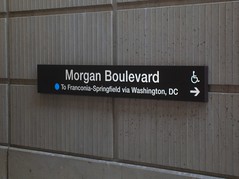 Monday Night Football, the NFL's major prime time network(-cum-basic-cable) broadcast has come to FedEx Field once again. Even more exciting than the normal hyperbole of MNF game is the fact that the 6-2 Redskins are playing the 5-2 Pittsburgh Steelers, a game that lots of people are actually going to care about for a change. Redskins Nation is buzzing.
If you commute on the eastern half of the Beltway, however, your afternoon drive will probably be much slower, as FedEx Field opens the lots four hours before the 9 pm kickoff and tailgaters will likely be jamming exits 15, 16, and 17 during the evening rush, as happens for every weeknight home game at FedEx Field. But Metro is pulling their weight, just like they did for the last Monday Night game at FedEx, the 2006 season opener. The system will be staying open until 1 a.m., with additional personnel at Morgan Boulevard and Largo stations.
Considering that FedEx Field opened in 1997 but Morgan Boulevard and Largo stations did not open until 2004, Metro use during mega-events at the stadium does not make headlines like Nationals Park did when it opened atop a Green Line station this spring. People took notice that Nationals games were not choking the Metro system, even when Nationals games were getting high attendance at the beginning of the season (interest naturally waned by the middle of their dismal 59-102 season).
Of course, FedEx Field has over twice the capacity of Nationals Park. Then again, FedEx Field is suburban, fed by highways, and surrounded by acres of surface parking. Where Navy Yard station is a block from Nats Park, FedEx Field lies almost a mile from Morgan Boulevard. Even if one were to envision a future Purple Line station at FedEx Field, it wouldn't be much closer, and would likely augment rather than replace Morgan Boulevard as the primary stop for the venue. In any event, an awful lot of people would have to give up driving before Metro started to have major issues on game day, even when games impacted the weekday rush hour. For now, the Blue Line is a viable alternative to driving. I'll take walking a four fifths of a mile for free from the Metro over walking two fifths of a mile from a $30 parking space. And it never hurts to take a car off the Beltway, while you're at it.
Friday, October 31, 2008
cArmy Base: Fort Meade
Military bases dot the landscape all around the Capital region. This is a unique presence, as many cities in America are largely defined by the one or two military bases near their boundaries, cities like Fayetteville, NC; Pensacola, FL; Kileen, TX; Norfolk, VA; and even San Diego, CA. Washington, DC, however, is home to the entire Federal Government, so the fact of a few military bases is pocket change in comparison. among the more prominent is a WWI-era base halfway between DC and Baltimore called Fort George G. Meade.
Nestled at the northeast corner of the junction of the Baltimore-Washington Parkway and MD-32, Fort Meade is by far the largest single job center in the state of Maryland and, after Downtown and Tysons Corner, the third largest in the metro area, and this does not account for National Business Park, a huge complex of government contractor buildings right across the B-W Parkway. Fort Meade is home to tens of thousands of military personnel from all five branches, plus retirees. It houses several major Army units, including the Defense Information School, Defense Courier Service, and the US Army Field Band. The Environmental Protection Agency has a large facility, and let's not forget about the National Security Agency, which housed over 30,000 jobs according to James Bamford's 2000 book Body of Secrets. No doubt that number has increased in recent years. Additionally, 5,700 jobs are being relocated to Fort Meade in the Base Relocation and Closure.
The continued growth of the base is of great concern, considering the institutional problems within the defense department when it comes to planning policy. The Pentagon, for example, sits atop two lines of Metro, yet it still has the largest surface parking lot in Arlington County. Fort Meade's total surface parking rivals (if not overtakes) FedEx Field's. This is particularly alarming considering the surface parking's negative effects on storm water runoff into the adjacent Patuxent Research Refuge (to the point where the NSA has an entire section devoted to it on its website). But the base's planning priority? Two 18 hole golf courses to "maintain soldiers' quality of life".
Surely with all these jobs, thousands of residents, and an explosion of growth in the near future, there must be some kind of transit node on the base, right? Not really.
The base is served by a single bus, a 24-seater that runs only twice in the morning and twice in the evening and serves only portions of the city of Laurel to the NSA's main gate. Various agencies on the base offer shuttles that run a few times a day from the Odenton and Savage MARC stations, which are two and five miles from the NSA main gate, respectively, and each three miles from the nearest regular base gate. It is literally illegal to walk any of those routes, as they are largely along MD-32, a freeway of interstate standards. Even servicemen living on base are likely to commute by car, as the base is so spread out that it is a long walk from any of the housing to any of the jobs on post, including almost all of the shopping and recreation amenities.
The first thing I did when I got stationed at Fort Meade? Buy a car. Sure, I wanted a car to go home and visit my family regularly. But I would not have been able to attend my morning physical training without a car. And this was when I lived in the battalion barracks!
So what do you care about a base 20 miles outside of DC?
Consider that a traffic nightmare reaching the base would have a major impact on transportation between Baltimore and Washington. The economic impacts of the resulting disconnect between the two cities could be drastic. Ryan Avent considered the positive impacts that a high speed rail between DC and Baltimore would provide. clogging the highways between the two cities would likely have the opposite effect.
I have often considered Fort Meade an ideal place for the Baltimore and Washington rail systems to meet. I know many detractors consider it wasteful to run the system all the way out to Fort Meade. But smaller jobs centers in Chantilly and Reston, similarly unserved by transit currently will be getting Silver Line service within a decade. And transportation implications in northwestern Fairfax County do not affect passage between two major cities. Other bases involved in the BRAC, such as Andrews AFB, Bolling AFB, Fort Belvoir, and Bethesda Naval Medical Center, have all had plenty of proposals thrown around to improve transit access to the bases (in some cases, like Bolling and Bethesda Naval, increasing existing transit efficiency). Fort Meade has not, despite the unique opportunity of potentially being able to serve the base by two major cities' transit systems. To alleviate traffic at enormous (50,000+) job centers, connector shuttles from commuter rails (i.e. a necessary modal shift) just won't do the trick. Perhaps for a Metro station, the NSA could donate some of it's 900+ acres of parking.
But today, long before ground will ever be broken on any kind of rail connections, wouldn't it at LEAST be appropriate for Fort Meade to receive some sort of express bus service from Greenbelt Metro? Perhaps more regular service from towns like Columbia, Laurel, Odenton and Annapolis? A bus system for the base itself so that a young GI doesn't have to waste his first few paychecks on a new car?
It blows my mind that 18 year old privates are not allowed to drink alcohol, but they are expected to be mature enough to finance, purchase, insure, and properly operate their own heavy machinery, which they may legally store on base free of charge. Shame on Army bases across the country, but particularly Fort Meade, which has the resources nearby to outgrow ridiculous and deleterious planning policies. For a service known for moving on foot, the Army's bases certainly don't embrace any mode of transportation beyond the car.
Nestled at the northeast corner of the junction of the Baltimore-Washington Parkway and MD-32, Fort Meade is by far the largest single job center in the state of Maryland and, after Downtown and Tysons Corner, the third largest in the metro area, and this does not account for National Business Park, a huge complex of government contractor buildings right across the B-W Parkway. Fort Meade is home to tens of thousands of military personnel from all five branches, plus retirees. It houses several major Army units, including the Defense Information School, Defense Courier Service, and the US Army Field Band. The Environmental Protection Agency has a large facility, and let's not forget about the National Security Agency, which housed over 30,000 jobs according to James Bamford's 2000 book Body of Secrets. No doubt that number has increased in recent years. Additionally, 5,700 jobs are being relocated to Fort Meade in the Base Relocation and Closure.
The continued growth of the base is of great concern, considering the institutional problems within the defense department when it comes to planning policy. The Pentagon, for example, sits atop two lines of Metro, yet it still has the largest surface parking lot in Arlington County. Fort Meade's total surface parking rivals (if not overtakes) FedEx Field's. This is particularly alarming considering the surface parking's negative effects on storm water runoff into the adjacent Patuxent Research Refuge (to the point where the NSA has an entire section devoted to it on its website). But the base's planning priority? Two 18 hole golf courses to "maintain soldiers' quality of life".
Surely with all these jobs, thousands of residents, and an explosion of growth in the near future, there must be some kind of transit node on the base, right? Not really.
The base is served by a single bus, a 24-seater that runs only twice in the morning and twice in the evening and serves only portions of the city of Laurel to the NSA's main gate. Various agencies on the base offer shuttles that run a few times a day from the Odenton and Savage MARC stations, which are two and five miles from the NSA main gate, respectively, and each three miles from the nearest regular base gate. It is literally illegal to walk any of those routes, as they are largely along MD-32, a freeway of interstate standards. Even servicemen living on base are likely to commute by car, as the base is so spread out that it is a long walk from any of the housing to any of the jobs on post, including almost all of the shopping and recreation amenities.
The first thing I did when I got stationed at Fort Meade? Buy a car. Sure, I wanted a car to go home and visit my family regularly. But I would not have been able to attend my morning physical training without a car. And this was when I lived in the battalion barracks!
So what do you care about a base 20 miles outside of DC?
Consider that a traffic nightmare reaching the base would have a major impact on transportation between Baltimore and Washington. The economic impacts of the resulting disconnect between the two cities could be drastic. Ryan Avent considered the positive impacts that a high speed rail between DC and Baltimore would provide. clogging the highways between the two cities would likely have the opposite effect.
I have often considered Fort Meade an ideal place for the Baltimore and Washington rail systems to meet. I know many detractors consider it wasteful to run the system all the way out to Fort Meade. But smaller jobs centers in Chantilly and Reston, similarly unserved by transit currently will be getting Silver Line service within a decade. And transportation implications in northwestern Fairfax County do not affect passage between two major cities. Other bases involved in the BRAC, such as Andrews AFB, Bolling AFB, Fort Belvoir, and Bethesda Naval Medical Center, have all had plenty of proposals thrown around to improve transit access to the bases (in some cases, like Bolling and Bethesda Naval, increasing existing transit efficiency). Fort Meade has not, despite the unique opportunity of potentially being able to serve the base by two major cities' transit systems. To alleviate traffic at enormous (50,000+) job centers, connector shuttles from commuter rails (i.e. a necessary modal shift) just won't do the trick. Perhaps for a Metro station, the NSA could donate some of it's 900+ acres of parking.
But today, long before ground will ever be broken on any kind of rail connections, wouldn't it at LEAST be appropriate for Fort Meade to receive some sort of express bus service from Greenbelt Metro? Perhaps more regular service from towns like Columbia, Laurel, Odenton and Annapolis? A bus system for the base itself so that a young GI doesn't have to waste his first few paychecks on a new car?
It blows my mind that 18 year old privates are not allowed to drink alcohol, but they are expected to be mature enough to finance, purchase, insure, and properly operate their own heavy machinery, which they may legally store on base free of charge. Shame on Army bases across the country, but particularly Fort Meade, which has the resources nearby to outgrow ridiculous and deleterious planning policies. For a service known for moving on foot, the Army's bases certainly don't embrace any mode of transportation beyond the car.
Wednesday, October 15, 2008
...Fight For Ol' DC
 Talk of bringing the Redskins back inside District lines is abound lately. Cost estimates for a domed stadium are roughly in the $1 billion range. The stadium would be designed to host all the Redskins' home games with hopes of bringing the Super Bowl or the NCAA final four to Washington, DC in the future.
Let me start off by saying that I am the biggest Redskins fan around. Apart from military a few obligations, I haven't missed watching a Redskins game since the 80's. One of my goals in life is to be well-off enough to get season tickets. I have accumulated a very extensive memorabilia collection. You get the idea.
It is important to point out that the Washington Redskins have been a part of this city since 1937. The team has set NFL attendance records eight years in a row, and it is the third most valuable sports franchise in the world. The team has sold out every home game since 1967. The NFL is by far the most prominent professional sports league today, and the Redskins are the second most valuable franchise in the league.
Which was why I was a little troubled by something I read on Richard Layman's blog regarding the notion of relocating the Redskins' stadium back into the District:
"SPENDING MONEY ON SPORTS STADIUMS IS A WASTE OF TIME....There are an endless stream of reasons that building a new Redskins stadium in the District would be a bad idea, but I must strongly object to this language when approaching this topic. Professional sports are a very, very important cultural institutions for the cities where they exist. Sports institutions are just as large a part of the culture of a city as its cuisine, art, music, and theater. Spending money on sports venues is just as important as spending money on other cultural venues like the Kennedy Center or the Corcoran Galleries.
...NOW IS THE TIME FOR LEADERSHIP.
NOT PANDERING ON RIDICULOUS STUPID THINGS LIKE GUYS RUNNING AROUND IN COLORED UNDERWEAR AND SIMILAR STUFF."
(Emphasis was in the original text)
I was for the Verizon Center. I was for Nationals Park. and I am for DC United Stadium. But as much as I love the Redskins, I cannot foresee any parcel of land where a new Redskins stadium would be a good thing for the city. For starters, this new stadium is going to be larger than FedEx Field, the Redskins current home, a 92,000-seat stadium in Landover. It will also likely be larger than the new Dallas Cowboys Stadium, a 100,000+ monstrosity. Even the most casual football fan knows that the Redskins and the Cowboys are constantly one-upping each other.
So now we are talking about a stadium with almost DOUBLE the capacity of RFK's 57,000. RFK didn't have too much more capacity than National's Park, and Metro could handle the game day rush. I'm not so sure that this would be true if the numbers were doubled. Assuming three quarters of ticket holders (75,000) live outside the District (which I feel may be conservative, but I don't know where to get the numbers on that), that means that on game day, the population of the city swells by about one eighth. This project has absolutely no chance of getting rid of the surface parking that plagues the area, especially considering the significantly larger footprint of the stadium structure.
Football fans are going to drive because football fans are going to tailgate before and probably after the game. This is why they open up parking five hours before kickoff. When I go to a Redskins game, it usually winds up being a 10 hour ordeal. Most of the folks I know have rather elaborate tailgating set-ups. This phenomenon certainly is not unique to the Redskins. Any team, any city, any weather, there will be tailgating. And why not? At $8 a beer and $5 for a bratwurst, may as well have a party outside the stadium in the parking lot. I imagine this also has to do with the fact that venues as large as football stadiums would flood local businesses on gamedays, and therefore you don't see too many NFL stadiums surrounded by commerce like the Verizon Center. The difference between 17,000 fans and 91,000 fans is... well, do the math. Then imagine five or six times as many people cramming into RFD and Fido in Chinatown on game night.
I poked around, and I can't seem to find an inner-city NFL stadium that appears to have a positive impact on the surrounding area. Soldier Field in Chicago appeared to be among the best:
View Larger Map
Lambeau Field in Green Bay didn't appear to have any surface parking around the stadium, but Green Bay is the smallest American city with a major pro sports team. However, if it were possible to build a stadium with that small of a relative footprint, I'm all for it. Unfortunately, the majority of NFL stadiums wind up looking more like Detroit's Ford Field, vast expanses of surface parking in the downtown. Just like FedEx Field, only FedEx Field's parking is effectively in the middle of nowhere.
This raises the question, is the payoff from the stadium worth the bad urbanism? Well, Ryan Avent doesn't think it's such a good deal to begin with. This enormous chunk of land will host 10 football games a year, eight regular season and two preseason. Best case scenario, another two if my Skins suddenly make a run at the Super Bowl. There may be a Super Bowl or two held there, plus a couple of NCAA tournament games every couple of years. Let's also throw in a major concert, like the HFStival once a year. Maybe another major event or two a year that I'm not considering. My most generous estimation gives fifteen events at this venue in one year. Nationals Park hosts 81 Nats games alone every year. As for the Phone Booth, I've seen the Capitals, Wizards, Georgetown Hoyas, multiple concerts, and a three ring circus there. every other day there is a major event at that place.
GreaterGreaterWashington argues that if all this venue will bring is civic pride, $1 billion is too too costly. This place is going to be sitting vacant for 350+ days a year, occupying riverfront property and containing surface parking that will no doubt contribute to pollution in the Anacostia River. GGW points out the National Capital Framework Plan would have a much more positive economic impact on the city. I tend to agree.
Fedex Field is only 12 years old. It is currently the largest stadium in the NFL. It has sufficient parking, it is convenient to highways, it is served by Morgan Boulevard Metro station, and it is at a location close in and relevant to the city. It may not be inside the District, but it is at least inside the Beltway. As I mentioned in the post linked above, the stadium (and the Metro station, for that matter) have not led to any fantastic economic development in Landover, why on earth would it lead to such progress in East End? RFK Stadium never did.
So here it is, coming out of the mouth of the most die-hard Redskins fan on earth: There is no place for a new stadium in the District of Columbia. Perhaps an adjacent site in Landover or
 elsewhere in Pringe George's County (hopefully a little more convenient to Metro), maybe something in Virginia along the Silver Line, but certainly not anywhere in DC. I'd love to see this town host a Super Bowl. But not at the expense of acres of some of the city's most valuable real estate.
PS- if you're at the game on Sunday, I will be tailgating in Green Lot F60. Look for the eccentric guy with the knit cap with the ball on top.
Friday, October 10, 2008
Help a Fledgeling Blogger + Morgan Boulevard
I always appreciate the input of all my readers, especially the ones who disagree with me. It makes this project a little more interesting, and it allows me to experiment with some new ideas that might otherwise go unsaid. So I appreciate everyone who (respectfully) shares their opinion, whether they agree with me or disagree.
I have had an interest in urban planning since before I knew what it was. I used to draw maps of neighborhoods when I was a kid as young as six. Unfortunately, I never found the field of study until after I'd already settled into another career. Now I'm trying to position myself for a career switch, so of course I am using Imagine, DC to help me figure out where my interests lie.
Unfortunately, I'm a relative newcomer to blogspot, and I'm having trouble with a few things... my captions, particularly on Flickr pictures (you know, the part where I give credit to the photographer?) keep disappearing once I post the blog. Anyone know how to fix that?
***
So this weekend I had my first experience with Morgan Boulevard Metro Station on the Blue Line. Normally, I'm a tailgater, but this weekend I didn't have a parking pass to the Redskins-Rams (a very frustrating loss, unfortunately) game so I decided to try Metroing it with my friend Walter. Our jumping point was Takoma, a ten minute walk from Walter's house. The ride is about a 45 minute trip with one transfer at Metro Center.
Frankly, I was a little disappointed at how few Redskins fans take the Metro, but I have a couple of guesses as to why. For starters, it is almost a mile walk down Summerfield/Garrett A. Morgan Boulevard. The sidewalks weren't exactly designed to usher tens of thousands of people down to the stadium. The road is fronted by townhouses in a remarkably car-oriented community with no visible retail, astonishingly poor use of areas sitting atop a Metro Station. For Prince George's County, however, it is not nearly as depressing as many other stations (including the stop before it, Seat Pleasant, which is completely surrounded by single family houses).
Next, it is a bit strange walking down a very suburban road through dozens of houses, particularly on the walk back when the stadium is not on the horizon. I felt like I was meandering aimlessly through some distant suburb, not walking between a 94,000 seat stadium and a high speed transit station. I can imagine how that might deter the average football fan from making the walk. Perhaps this is why few other events are held at the venue throughout the year.
At the end of the day, however, I am astonished that more people don't take Metro to the games. With parking passes STARTING at $25, plus time spent in traffic, the casual fan really ought to consider huffing it a mile from Morgan Boulevard. Unfortunately, tailgaters will always have to drive.
I have had an interest in urban planning since before I knew what it was. I used to draw maps of neighborhoods when I was a kid as young as six. Unfortunately, I never found the field of study until after I'd already settled into another career. Now I'm trying to position myself for a career switch, so of course I am using Imagine, DC to help me figure out where my interests lie.
Unfortunately, I'm a relative newcomer to blogspot, and I'm having trouble with a few things... my captions, particularly on Flickr pictures (you know, the part where I give credit to the photographer?) keep disappearing once I post the blog. Anyone know how to fix that?
***
So this weekend I had my first experience with Morgan Boulevard Metro Station on the Blue Line. Normally, I'm a tailgater, but this weekend I didn't have a parking pass to the Redskins-Rams (a very frustrating loss, unfortunately) game so I decided to try Metroing it with my friend Walter. Our jumping point was Takoma, a ten minute walk from Walter's house. The ride is about a 45 minute trip with one transfer at Metro Center.
Frankly, I was a little disappointed at how few Redskins fans take the Metro, but I have a couple of guesses as to why. For starters, it is almost a mile walk down Summerfield/Garrett A. Morgan Boulevard. The sidewalks weren't exactly designed to usher tens of thousands of people down to the stadium. The road is fronted by townhouses in a remarkably car-oriented community with no visible retail, astonishingly poor use of areas sitting atop a Metro Station. For Prince George's County, however, it is not nearly as depressing as many other stations (including the stop before it, Seat Pleasant, which is completely surrounded by single family houses).
Next, it is a bit strange walking down a very suburban road through dozens of houses, particularly on the walk back when the stadium is not on the horizon. I felt like I was meandering aimlessly through some distant suburb, not walking between a 94,000 seat stadium and a high speed transit station. I can imagine how that might deter the average football fan from making the walk. Perhaps this is why few other events are held at the venue throughout the year.
At the end of the day, however, I am astonished that more people don't take Metro to the games. With parking passes STARTING at $25, plus time spent in traffic, the casual fan really ought to consider huffing it a mile from Morgan Boulevard. Unfortunately, tailgaters will always have to drive.
Monday, September 22, 2008
PRT in Business Parks
I aborted my plans to protest my office's lack of transit access by sleeping in my office tonight. A colleague passed away over the weekend and I deemed the ensuing fanfare of the sleep-in highly inappropriate, all things considered. I'm sure that little improvement will be made in the next 365 days, however, so I'll give it another go next year.
Last week, The Overhead Wire wrote a post on PRT. Now, I agree with the overall sentiment in the comment thread on this one. If PRT was the least bit practical, it would already be up and running in East Asia or Europe. They know how to spend transit money over there. Though often proposed, it has not yet been widely implemented in any cities.
There are a couple of places, though, where PRT or people movers have been implemented. At the University of West Virginia, they have been using a such a system since 1975 to get students around the campus at Morgantown. London's Heathrow Airport will be rolling out a true PRT system next year, but the verdict is still out as to whether or not the system will achieve any success. There are also a planned system in Dubai, however they'll throw money at any half cocked project over there. The first two projects have something in common that may contribute to their success, however... they are getting people around a campus rather than public space.
Talk of replacing systems like Metro, the New York City Subway, the T in Boston, and Chicago's El with PRT would be absolutely ridiculous. But I don't think it would be that crazy to see if PRT could fix the "last mile" problem for business campuses like the one where I work in central Maryland. Perhaps a PRT could connect a couple of buildings in an office park to a Metro, MARC or VRE station a reasonable distance away (close enough that a PRT system would be feasible, but not close enough for transit oriented development to be more cost-effective).
Naturally, it makes more sense to redevelop an area and make it more walkable. but if a large company or government institution operates a large, spread out business campus (I'm looking at you, military bases). It would be important to make these systems usable only by approved personnel.
Perhaps Bethesda's Medical Center stop would be a good test case. The campuses of Suburban Hospital, NIH, Bethesda Naval Medical Center, and the Forest Glen Annex of Walter Reed are all within a reasonable distance, but the campuses are dreadfully car oriented. NASA's Goddard Space Flight Center would be another candidate, employing 10,000 people on a 1,300 acre campus that is not accessible from not-too-far-away Greenbelt Metro Station. NIST in Gaithersburg is close enough to Shady Grove station to make it feasible. Fort Meade, Fort Belvoir, Fort Meyer, and Andrews AFB could use whatever accessibility they can get. And of course, there are the Airports, though ours probably don't need as much added mobility as Heathrow. Plus I'm sure there are a few office parks in Columbia, Reston, and other outlying cities where PRT might be more cost-effective than redeveloping the entire campuses. If PRT can cut it.
At the end of the day, PRT is not a solution. It promotes sprawl the same way cars do. But it would be a reasonable way to retrofit spread-out office campuses until it is economical to redevelop them. It could ostensibly take cars off the road if it connects businesses to transit. I could also remove surface parking lot, which ironically could speed up the redevelopment of such locations.
So replacing Metro with PRT is a laughable prospect. But if the Heathrow experiment works out, perhaps we ought to consider it as an alternative to promote transit use for job centers like mine at Fort Meade, which houses over 30,000 jobs, not to mention the nearby contractor facilities and 5,700 new jobs expected over the next decade, all without transit access. If connecting those jobs to transit could take 1/8 of the cars off the road, we're talking about 5,000 cars a day not on the highways burning gasoline, creating traffic and pollution, or sucking up land with asphalt parking spaces.
Last week, The Overhead Wire wrote a post on PRT. Now, I agree with the overall sentiment in the comment thread on this one. If PRT was the least bit practical, it would already be up and running in East Asia or Europe. They know how to spend transit money over there. Though often proposed, it has not yet been widely implemented in any cities.
There are a couple of places, though, where PRT or people movers have been implemented. At the University of West Virginia, they have been using a such a system since 1975 to get students around the campus at Morgantown. London's Heathrow Airport will be rolling out a true PRT system next year, but the verdict is still out as to whether or not the system will achieve any success. There are also a planned system in Dubai, however they'll throw money at any half cocked project over there. The first two projects have something in common that may contribute to their success, however... they are getting people around a campus rather than public space.
Talk of replacing systems like Metro, the New York City Subway, the T in Boston, and Chicago's El with PRT would be absolutely ridiculous. But I don't think it would be that crazy to see if PRT could fix the "last mile" problem for business campuses like the one where I work in central Maryland. Perhaps a PRT could connect a couple of buildings in an office park to a Metro, MARC or VRE station a reasonable distance away (close enough that a PRT system would be feasible, but not close enough for transit oriented development to be more cost-effective).
Naturally, it makes more sense to redevelop an area and make it more walkable. but if a large company or government institution operates a large, spread out business campus (I'm looking at you, military bases). It would be important to make these systems usable only by approved personnel.
Perhaps Bethesda's Medical Center stop would be a good test case. The campuses of Suburban Hospital, NIH, Bethesda Naval Medical Center, and the Forest Glen Annex of Walter Reed are all within a reasonable distance, but the campuses are dreadfully car oriented. NASA's Goddard Space Flight Center would be another candidate, employing 10,000 people on a 1,300 acre campus that is not accessible from not-too-far-away Greenbelt Metro Station. NIST in Gaithersburg is close enough to Shady Grove station to make it feasible. Fort Meade, Fort Belvoir, Fort Meyer, and Andrews AFB could use whatever accessibility they can get. And of course, there are the Airports, though ours probably don't need as much added mobility as Heathrow. Plus I'm sure there are a few office parks in Columbia, Reston, and other outlying cities where PRT might be more cost-effective than redeveloping the entire campuses. If PRT can cut it.
At the end of the day, PRT is not a solution. It promotes sprawl the same way cars do. But it would be a reasonable way to retrofit spread-out office campuses until it is economical to redevelop them. It could ostensibly take cars off the road if it connects businesses to transit. I could also remove surface parking lot, which ironically could speed up the redevelopment of such locations.
So replacing Metro with PRT is a laughable prospect. But if the Heathrow experiment works out, perhaps we ought to consider it as an alternative to promote transit use for job centers like mine at Fort Meade, which houses over 30,000 jobs, not to mention the nearby contractor facilities and 5,700 new jobs expected over the next decade, all without transit access. If connecting those jobs to transit could take 1/8 of the cars off the road, we're talking about 5,000 cars a day not on the highways burning gasoline, creating traffic and pollution, or sucking up land with asphalt parking spaces.
Thursday, September 18, 2008
Car Free Day: I'll Sleep On It
Monday, September 22nd is National Car Free Day. And I want to participate. But I am at a loss.
Tomorrow, Friday, is International Talk-Like-a-Pirate Day. I know what I'm doing for that. I'm going to Piratz Tavern in Silver Spring. Driving there, of course, as there is no feasible evening transit access from Laurel to Silver Spring. Saturday, I'll drive from Laurel to Silver Spring to pick up some kids and then to our game in South Germantown (bonus: carpooling). Sunday, I will be driving to FedEx Field to tailgate the Redskins game. I usually drive out of necessity, but this weekend there will be some gratuitous driving, and I really want to prove to myself that I can get to and from work by myself without a car, if it came down to it.
Here are the dilemmas...
My Job: On a military base surrounded by limited access highways (MD 32 and the B-W Parkway). This means that it actually illegal for me to walk to work. I could bike, but my office lacks bike racks. (Of course, I also have that little problem of not owning a bike... not much reason to own one where I live).
My House: one block off of Route 1 in Laurel, near a bus route. Unfortunately, the bus only goes up and down Route 1. My drive to work is 6 and a half miles, and frankly, much closer than anyone else I know at my work.
For me to get to work without driving, I would have to take a bus to Greenbelt, take the Green Line to Fort Totten, switch to the Red Line, take that to Union Station, then switch to the MARC Penn Line. Take the MARC to Odenton, where I get off and wait for a shuttle. This shuttle takes me to the front gate, where I then walk a quarter of a mile to my building. I might be able to transfer busses and pick up the Penn Line at New Carrollton, but I'm not that savvy with the bus routes in PG.
Obviously, I've never even attempted this. It is a highly inefficient means of getting around. It's 47 miles and four separate modes of transportation. The first leg alone of this grueling commute (bus to Greenbelt Metro) would be 8 miles. So instead I drive my six and a half miles to Fort Meade and pray that I can find a spot somewhere in the 900 acres of parking.
Why should you care? I'm sure very few of my readers venture into the wasteland that is Central Maryland on a daily basis. Perhaps some places are just meant to be designed for drivers. What do you care about a few federal employees that drive to work every day.
You should care because I work for the largest employer in the State of Maryland. Over 30,000 people drive to where I work day. The only transit access is a 40-person shuttle that runs three times in the morning and three times in the evening from the MARC station at Odenton, and a 24 person bus that runs from a surrounding community twice (very) early in the morning and twice in the afternoon. The 900 acres of paved surface parking drain into the Patuxent River watershed, which includes several protected wetlands down stream, and ultimately empties into the Chesapeake Bay. Oh, and by the way, this is your Federal Government using your tax dollars for maintaining this deleterious parking system and the highways needed to support job centers like this.
I love my job, and I don't want to quit. I've been exploring options to perhaps work at a satellite location that is Metro-friendly after I move. I buy cars that get good gas mileage, and when I can, I carpool. I raise hell every chance I get trying to promote better transit access to Fort Meade.
It is job centers like this that drive seemingly useless freeways like MD 32, MD 100, and MD 200 aka the Intercounty Connector. It is job centers like these that force the federal government to bleed talented young professionals who can barely live off otherwise decent salaries. I am a GS-11 and over 20% of my monthly take home salary is automatically devoted to my car payment, insurance, gas, and maintenance. I know scores of young professionals that have taken a contractor job that practically doubles their salary and allows them to live and work somewhere that does not require car ownership. It is job centers like this that create traffic, traffic accidents, and exurban sprawl that eat away our region's farms and wildlife areas.
And think of how much worse the Base Realignment and Closure will make this when it brings 5,700 more jobs to Fort Meade.
So as I am writing this, I've decided what I am going to do for car-free day on Monday. I'm going to to sleep in my office for two nights. And once again, I will put out an open letter demanding transit access.
I work there. I get incensed every day wasting money on gas while driving around hunting for a parking space. But every citizen of Maryland and the DC region ought to be irate over the wastefulness and downright lack of foresight in the complete lack of sustainable urban planning at the largest job center in Maryland. If anyone has any other suggestions for me (that are at least as unlikely to get me fired as this stunt) please let me know. Otherwise, I'm looking forward to a protest where all I have to do is sleep.
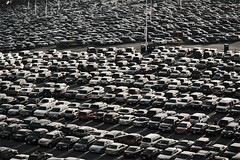
Tomorrow, Friday, is International Talk-Like-a-Pirate Day. I know what I'm doing for that. I'm going to Piratz Tavern in Silver Spring. Driving there, of course, as there is no feasible evening transit access from Laurel to Silver Spring. Saturday, I'll drive from Laurel to Silver Spring to pick up some kids and then to our game in South Germantown (bonus: carpooling). Sunday, I will be driving to FedEx Field to tailgate the Redskins game. I usually drive out of necessity, but this weekend there will be some gratuitous driving, and I really want to prove to myself that I can get to and from work by myself without a car, if it came down to it.
Here are the dilemmas...
My Job: On a military base surrounded by limited access highways (MD 32 and the B-W Parkway). This means that it actually illegal for me to walk to work. I could bike, but my office lacks bike racks. (Of course, I also have that little problem of not owning a bike... not much reason to own one where I live).
My House: one block off of Route 1 in Laurel, near a bus route. Unfortunately, the bus only goes up and down Route 1. My drive to work is 6 and a half miles, and frankly, much closer than anyone else I know at my work.
For me to get to work without driving, I would have to take a bus to Greenbelt, take the Green Line to Fort Totten, switch to the Red Line, take that to Union Station, then switch to the MARC Penn Line. Take the MARC to Odenton, where I get off and wait for a shuttle. This shuttle takes me to the front gate, where I then walk a quarter of a mile to my building. I might be able to transfer busses and pick up the Penn Line at New Carrollton, but I'm not that savvy with the bus routes in PG.
Obviously, I've never even attempted this. It is a highly inefficient means of getting around. It's 47 miles and four separate modes of transportation. The first leg alone of this grueling commute (bus to Greenbelt Metro) would be 8 miles. So instead I drive my six and a half miles to Fort Meade and pray that I can find a spot somewhere in the 900 acres of parking.
Why should you care? I'm sure very few of my readers venture into the wasteland that is Central Maryland on a daily basis. Perhaps some places are just meant to be designed for drivers. What do you care about a few federal employees that drive to work every day.
You should care because I work for the largest employer in the State of Maryland. Over 30,000 people drive to where I work day. The only transit access is a 40-person shuttle that runs three times in the morning and three times in the evening from the MARC station at Odenton, and a 24 person bus that runs from a surrounding community twice (very) early in the morning and twice in the afternoon. The 900 acres of paved surface parking drain into the Patuxent River watershed, which includes several protected wetlands down stream, and ultimately empties into the Chesapeake Bay. Oh, and by the way, this is your Federal Government using your tax dollars for maintaining this deleterious parking system and the highways needed to support job centers like this.
I love my job, and I don't want to quit. I've been exploring options to perhaps work at a satellite location that is Metro-friendly after I move. I buy cars that get good gas mileage, and when I can, I carpool. I raise hell every chance I get trying to promote better transit access to Fort Meade.
It is job centers like this that drive seemingly useless freeways like MD 32, MD 100, and MD 200 aka the Intercounty Connector. It is job centers like these that force the federal government to bleed talented young professionals who can barely live off otherwise decent salaries. I am a GS-11 and over 20% of my monthly take home salary is automatically devoted to my car payment, insurance, gas, and maintenance. I know scores of young professionals that have taken a contractor job that practically doubles their salary and allows them to live and work somewhere that does not require car ownership. It is job centers like this that create traffic, traffic accidents, and exurban sprawl that eat away our region's farms and wildlife areas.
And think of how much worse the Base Realignment and Closure will make this when it brings 5,700 more jobs to Fort Meade.
So as I am writing this, I've decided what I am going to do for car-free day on Monday. I'm going to to sleep in my office for two nights. And once again, I will put out an open letter demanding transit access.
I work there. I get incensed every day wasting money on gas while driving around hunting for a parking space. But every citizen of Maryland and the DC region ought to be irate over the wastefulness and downright lack of foresight in the complete lack of sustainable urban planning at the largest job center in Maryland. If anyone has any other suggestions for me (that are at least as unlikely to get me fired as this stunt) please let me know. Otherwise, I'm looking forward to a protest where all I have to do is sleep.
Subscribe to:
Posts (Atom)

 Posts
Posts


