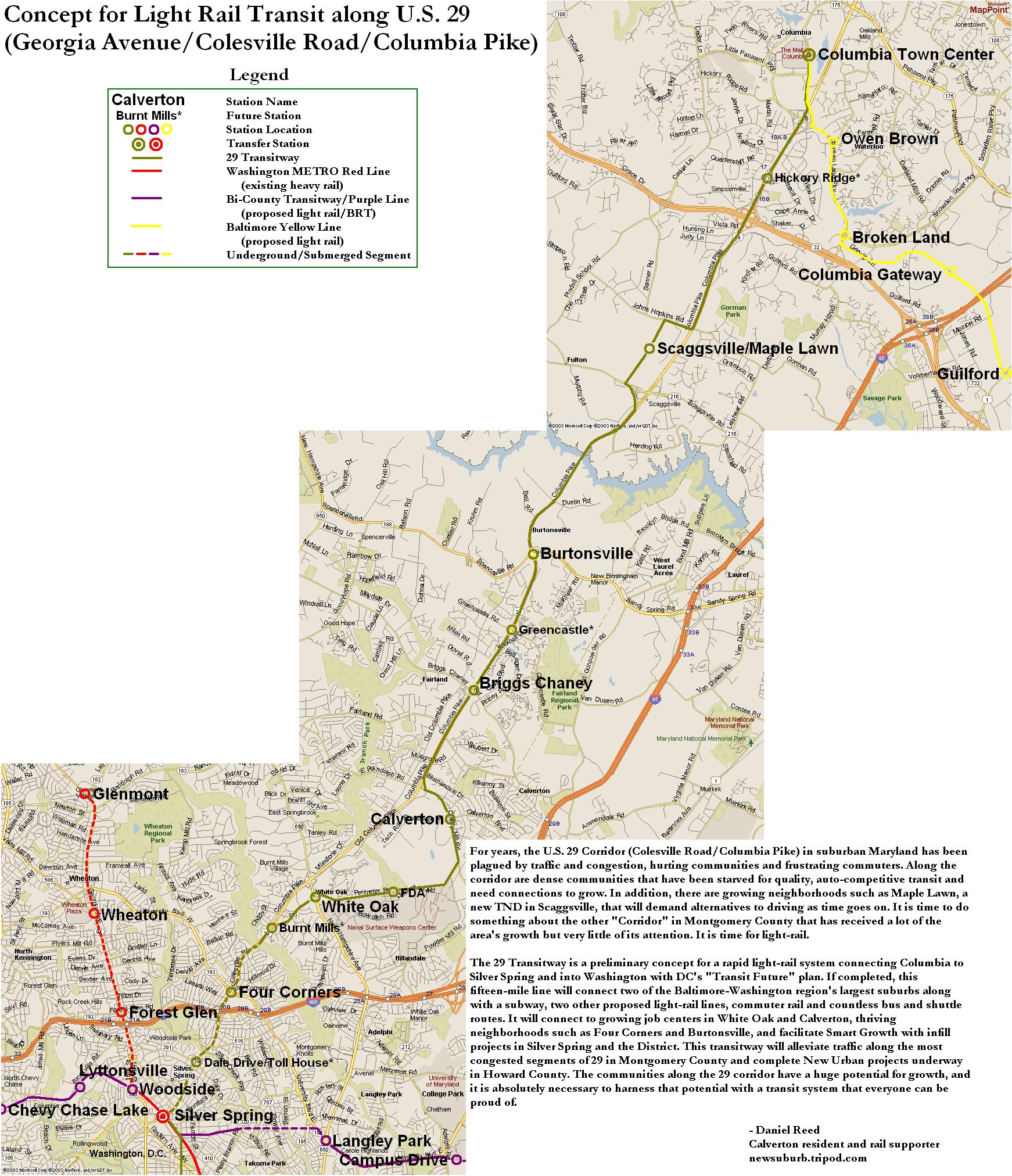
GGW's breakfast links yesterday had a troubling article at the bottom. The Central Maryland Transit Alliance wants to prioritize extending Baltimore's Yellow Line light rail to Columbia over extending the Green Line subway to White Marsh. I can't even begin to express how dumb of an idea this is.
The Green Line extension will hit developed areas in a large city with a burgeoning centralized train system in place. This is smart. The Yellow Line extension will connect Columbia to downtown Baltimore on a very long, very circuitous route that by-passes Fort Meade, the largest employment center in the state of Maryland.
Baltimore City needs transit connections. It needs an expanded system. It needs a centralized system. A Yellow Line extension would bolster businesses in Columbia and Towson. These are decentralized locations. A Green Line extension would bolster more centralized business districts like the Belair Road and Harford Road corridors. These are centralized areas. Baltimore has been decentralizing for fifty years, and it's not working.
From Columbia, the Yellow Line would take 42 minutes to get to BWI Airport, and then another 27 to get to downtown Baltimore. An hour and nine minutes to get from Columbia to Baltimore. The northern section of the Yellow Line is actually a good idea, connecting several colleges along a main thoroughfare through the city proper. But the southern portion is as circuitous and useless as the current plan for the CCT in Gaithersburg.
CMTA, if you want light rail connecting Columbia to the city, why not push for the US-29 light rail project that was once promised to run from Silver Spring to Columbia? A direct route to the city, not a circuitous one, that hits several established communities along the way is what Central Maryland Transit Alliance ought to be seeking. I don't know how long Dan Reed's alignment (linked above) would take to get from Columbia to downtown DC, but I bet it's faster than 69 minutes.
And if Maryland does decide to run light rail further away from Baltimore, can you at least make some effort to hit the 50,000+ job center at Fort Meade before it is completely choking the region with traffic? I bet you a rail right-of-way that a lot of those employees live in Columbia.
Showing posts with label Fort Meade. Show all posts
Showing posts with label Fort Meade. Show all posts
Friday, September 4, 2009

Tuesday, January 27, 2009
Greater Greater Risk to Life and Limb
Tonight I attended a a get together with several of the other writers at Greater Greater Washington, which I really enjoyed. It was my first experience meeting urban planning bloggers face to face, and a lot of thought provoking conversation ensued. Greater Greater Washington has been a great forum, and meeting the other writers it is easy to understand why. I look forward to seeing them again at the 1 Year Anniversary at RFD next week.
The downside to this meeting tonight was that it was in Penn Quarter. No, I have nothing against Penn Quarter (other than the ground-map of the World at the Navy Memorial that has a very outdated rendition of the Aral Sea), but it is quite an ordeal to get down there from Fort Meade in sleet.
On the way home from Greenbelt Metro Station at around 10 pm, I had to call 911 to report a very bad accident 7 car accident on Route 1 that looked like it had just occurred. I think a southbound snow plow side swiped a northbound minivan and a chain reaction ensued. I slowed down, made sure everyone was alright, and called 911 to report it.
Another mile or so up the road (just north of Contee Road), I got a good scare when driving up a hill I saw a Ford Explorer facing sideways and sliding right towards me. I stopped and waited for impact, but fortunately the SUV hit one of the few curbs on that stretch of Rt. 1 and came to a stop. Thank goodness.
Of course, all I could think as that truck was careening towards me was "I can't have anything happen to my car". I wouldn't be able to get to work, or anywhere else for that matter.Car culture has left me putting my property ahead of my health. But hey, I can get to work with a broken arm. I can't get to work without a car. It's too bad, because even trains slowed by the weather would be safer (and probably faster) than driving in this horrible weather.
Fortunately, That was not a problem. But tomorrow when all the tens of thousands of employees of Fort Meade drive to work, how many of them will risk a car accident? For us, we don't have any other choice. For the most part, we don't have any other way to get to work.
The downside to this meeting tonight was that it was in Penn Quarter. No, I have nothing against Penn Quarter (other than the ground-map of the World at the Navy Memorial that has a very outdated rendition of the Aral Sea), but it is quite an ordeal to get down there from Fort Meade in sleet.
On the way home from Greenbelt Metro Station at around 10 pm, I had to call 911 to report a very bad accident 7 car accident on Route 1 that looked like it had just occurred. I think a southbound snow plow side swiped a northbound minivan and a chain reaction ensued. I slowed down, made sure everyone was alright, and called 911 to report it.
Another mile or so up the road (just north of Contee Road), I got a good scare when driving up a hill I saw a Ford Explorer facing sideways and sliding right towards me. I stopped and waited for impact, but fortunately the SUV hit one of the few curbs on that stretch of Rt. 1 and came to a stop. Thank goodness.
Of course, all I could think as that truck was careening towards me was "I can't have anything happen to my car". I wouldn't be able to get to work, or anywhere else for that matter.Car culture has left me putting my property ahead of my health. But hey, I can get to work with a broken arm. I can't get to work without a car. It's too bad, because even trains slowed by the weather would be safer (and probably faster) than driving in this horrible weather.
Fortunately, That was not a problem. But tomorrow when all the tens of thousands of employees of Fort Meade drive to work, how many of them will risk a car accident? For us, we don't have any other choice. For the most part, we don't have any other way to get to work.
Tuesday, December 30, 2008
Car Oriented
I chose to live close to my work at Fort Meade thinking I would drive less. I live close to the base on which I work, and since there's bubkes for transit options to the base, I figure it is best to shorten my commute. It will save money. I'll drive less.
But instead I drive more, since I can't go anywhere from my Laurel neighborhood without driving... not even the grocery store two blocks away, as no sane person would attempt to cross Route 1 while carrying something. And considering that I'm a single 29 year old with an active social life, I like to venture out of Laurel as often as possible. I have a part-time night job in Bethesda, volunteer with a youth program in Silver Spring, I have a ton of friends that live in places like Capitol Hill, Rosslyn, and Dupont, my familiy lives mostly in Silver Spring, and I like to attend sporting events in DC and Landover. All of those locations have one distinct advantage over Laurel: Metro stations.
The buses on Route 1 is painfully slow even during off-peak hours. It doesn't run past 8pm, which is generally when I get off work, and is less reliable on the weekends. Greenbelt and Cheverly Metro stations are where I usually hop on the Metro if I'm going into DC or Virginia, but even those are 15 minute drives in light traffic.
I won't shy away from the fact that I enjoy a good glass of scotch or two from time to time, but I have to plan carefully if I want to go meet friends in Bethesda, Old Town, or H Street for a couple of drinks. Fact is, 100% of drunk drivers are driving at the time. I wonder how many DUI's Metro has prevented over the years.
I try to combine trips as often as possible, but walking anywhere from my house is laborious. There are no sidewalks in my neighborhood. Route 1, where every road in my neighborhood empties, has few sidewalks on my stretch and even fewer crosswalks. Most retail near me is hidden behind a sea of paking lots, including the moribund Laurel Mall, where I only shop when I am absolutely desperate (although here's a great secret: the Macy's there is always fully stocked because no one shops there).
For someone who hates paperwork as much as I do, driving is a nightmare. There is insurance, an expensive necessary evil to legally drive in most of the US. If you live anywhere near a city, the price goes up significantly. MVA (which is Marylandese for DMV) registration, tags, and drivers license are relatively cheap, but minor oversights are costly. Should insurance, tags, license, or registration lapse, there are heavy penalties. Then there is the occaisional parking ticket (I have had plenty at work when parking was particularly bad and I chanced it in a reserve space) and if you're really not paying attention, speed camera ($50 for 36 mph on Minnesota Avenue at 3 a.m. last month... I'm not complaining about speed cameras, but ouch).
The real cost of my car oriented lifestyle is huge. I make a decent living on a federal salary. I'm certainly not loaded, but I make a decent wage by most standards. My car is a modest American sedan that gets 30 mpg that I purchased used on a 5 year loan. My car payment, insurance, scheduled maintenance, and gas (to and from work ONLY, assuming $2/gal) eats up over 20% of my take home salary, which includes my federal salary, my VA disability, and my night job. I don't care how much anyone makes. 20% of any living wage is ludicrous. And that 20% doesn't include emergency repairs (like a new set of tires that wasn't covered by my insurance, $600), tickets, MVA fees, or gas to get anywhere besides work. And to add insult to injury, my tax dollars are now going to bail out the automakers. I already gave them my money when I purchased my car. Rest assured that when I purchase another one, it will not be a GM, Ford, or Chrysler.
That's 20% I can't spend on improving my house. If it comes down to it, an emergency repair on my car takes precedence over one for my house, because I can't get to work without my car. The irrational prioritization I am forced to uphold for my automobile is absurd, but it is a simple fact that most Americans take in stride. Supposedly offering the freedom of mobility, many Americans are in my position, and I consider myself a slave to my car.
Why did I take this in stride most of my life? I was raised in a car-oriented suburb in Silver Spring, a quarter mile from a Beltway exit. The only thing I could walk to from my house without a very long trek involving significant distance along a six lane highway was the community swimming pool, which of course was only open three months a year. I attended high school four miles from my house at a private school with no bus service. I would take Metrobus home from school often, however the school has since relocated far away from the a Metro station and I would not have that option today.
Furthermore, as Rob at Extraordinary Observations points out, previous generations (i.e., the parents who raised us) venerate automobiles. Cars were status symbols and not necessary evils. Where our parents dreamt of moving out to the suburbs, today's young adults are flocking back to the cities. To the Cold War generation, riding transit could be compared to people today who use Walkmans instead of iPods... it spurned progress while at the same time it was a sign of weakness. He also points out that young adults enter the work force from college with enormous debt, which most of our parents did not face. Six figure debt at age 23 is not uncommon in our society, as medical costs and especially college tuition increase have greatly outpaced income increases.
After high school I attended Montgomery College in Rockville, to which I drove, and worked at a store in Cleveland Park, to which I took Metro when feasible. After college, I joined the Army. I have repeatedly stated that it is nearly impossible to get by in the US Army without an automobile, an overpowering irony for the service that prides itself on "beating feet". So when I purchased my house five years ago, I thought I was doing the responsible thing living close to work. And perhaps, to a degree, I was. But living far from transit has cost me a great deal, even if I can't take transit to work.
Don't get me wrong, I love driving. I find it cathartic to be on an open road. For liesure, I used to drive out to northwestern Montgomery County and take in the sights. I always offer to drive on road trips. I love that I can hop in the car on a whim and go just about anywhere in America I choose. But there is a distinct difference between chosing to drive and being wholly dependent on an automobile. There is a difference between driving for leisure and driving because you are forced to drive.
Currently, the extra money that goes into driving is ironically prohibiting me from improving my location by moving somewhere more transit accessible. I probably will never give up driving, but I am committed to driving less. More importantly, I will continue to remind myself and those around me how expensive it can be when you lead a car-oriented lifestyle.
But instead I drive more, since I can't go anywhere from my Laurel neighborhood without driving... not even the grocery store two blocks away, as no sane person would attempt to cross Route 1 while carrying something. And considering that I'm a single 29 year old with an active social life, I like to venture out of Laurel as often as possible. I have a part-time night job in Bethesda, volunteer with a youth program in Silver Spring, I have a ton of friends that live in places like Capitol Hill, Rosslyn, and Dupont, my familiy lives mostly in Silver Spring, and I like to attend sporting events in DC and Landover. All of those locations have one distinct advantage over Laurel: Metro stations.
The buses on Route 1 is painfully slow even during off-peak hours. It doesn't run past 8pm, which is generally when I get off work, and is less reliable on the weekends. Greenbelt and Cheverly Metro stations are where I usually hop on the Metro if I'm going into DC or Virginia, but even those are 15 minute drives in light traffic.
I won't shy away from the fact that I enjoy a good glass of scotch or two from time to time, but I have to plan carefully if I want to go meet friends in Bethesda, Old Town, or H Street for a couple of drinks. Fact is, 100% of drunk drivers are driving at the time. I wonder how many DUI's Metro has prevented over the years.
I try to combine trips as often as possible, but walking anywhere from my house is laborious. There are no sidewalks in my neighborhood. Route 1, where every road in my neighborhood empties, has few sidewalks on my stretch and even fewer crosswalks. Most retail near me is hidden behind a sea of paking lots, including the moribund Laurel Mall, where I only shop when I am absolutely desperate (although here's a great secret: the Macy's there is always fully stocked because no one shops there).
For someone who hates paperwork as much as I do, driving is a nightmare. There is insurance, an expensive necessary evil to legally drive in most of the US. If you live anywhere near a city, the price goes up significantly. MVA (which is Marylandese for DMV) registration, tags, and drivers license are relatively cheap, but minor oversights are costly. Should insurance, tags, license, or registration lapse, there are heavy penalties. Then there is the occaisional parking ticket (I have had plenty at work when parking was particularly bad and I chanced it in a reserve space) and if you're really not paying attention, speed camera ($50 for 36 mph on Minnesota Avenue at 3 a.m. last month... I'm not complaining about speed cameras, but ouch).
The real cost of my car oriented lifestyle is huge. I make a decent living on a federal salary. I'm certainly not loaded, but I make a decent wage by most standards. My car is a modest American sedan that gets 30 mpg that I purchased used on a 5 year loan. My car payment, insurance, scheduled maintenance, and gas (to and from work ONLY, assuming $2/gal) eats up over 20% of my take home salary, which includes my federal salary, my VA disability, and my night job. I don't care how much anyone makes. 20% of any living wage is ludicrous. And that 20% doesn't include emergency repairs (like a new set of tires that wasn't covered by my insurance, $600), tickets, MVA fees, or gas to get anywhere besides work. And to add insult to injury, my tax dollars are now going to bail out the automakers. I already gave them my money when I purchased my car. Rest assured that when I purchase another one, it will not be a GM, Ford, or Chrysler.
That's 20% I can't spend on improving my house. If it comes down to it, an emergency repair on my car takes precedence over one for my house, because I can't get to work without my car. The irrational prioritization I am forced to uphold for my automobile is absurd, but it is a simple fact that most Americans take in stride. Supposedly offering the freedom of mobility, many Americans are in my position, and I consider myself a slave to my car.
Why did I take this in stride most of my life? I was raised in a car-oriented suburb in Silver Spring, a quarter mile from a Beltway exit. The only thing I could walk to from my house without a very long trek involving significant distance along a six lane highway was the community swimming pool, which of course was only open three months a year. I attended high school four miles from my house at a private school with no bus service. I would take Metrobus home from school often, however the school has since relocated far away from the a Metro station and I would not have that option today.
Furthermore, as Rob at Extraordinary Observations points out, previous generations (i.e., the parents who raised us) venerate automobiles. Cars were status symbols and not necessary evils. Where our parents dreamt of moving out to the suburbs, today's young adults are flocking back to the cities. To the Cold War generation, riding transit could be compared to people today who use Walkmans instead of iPods... it spurned progress while at the same time it was a sign of weakness. He also points out that young adults enter the work force from college with enormous debt, which most of our parents did not face. Six figure debt at age 23 is not uncommon in our society, as medical costs and especially college tuition increase have greatly outpaced income increases.
After high school I attended Montgomery College in Rockville, to which I drove, and worked at a store in Cleveland Park, to which I took Metro when feasible. After college, I joined the Army. I have repeatedly stated that it is nearly impossible to get by in the US Army without an automobile, an overpowering irony for the service that prides itself on "beating feet". So when I purchased my house five years ago, I thought I was doing the responsible thing living close to work. And perhaps, to a degree, I was. But living far from transit has cost me a great deal, even if I can't take transit to work.
Don't get me wrong, I love driving. I find it cathartic to be on an open road. For liesure, I used to drive out to northwestern Montgomery County and take in the sights. I always offer to drive on road trips. I love that I can hop in the car on a whim and go just about anywhere in America I choose. But there is a distinct difference between chosing to drive and being wholly dependent on an automobile. There is a difference between driving for leisure and driving because you are forced to drive.
Currently, the extra money that goes into driving is ironically prohibiting me from improving my location by moving somewhere more transit accessible. I probably will never give up driving, but I am committed to driving less. More importantly, I will continue to remind myself and those around me how expensive it can be when you lead a car-oriented lifestyle.
Tuesday, November 11, 2008
Thank Your Veterans by Lobbying for Better Bases
Today is Veteran's Day, and I encourage all of you to thank your veterans for serving. We live in an area rich with military tradition, and it is important to remember the millions of men and women who have served our country either voluntarily or as conscripts. They fought wars so we wouldn't have to fight them on our own soil, and they continue to serve selflessly today. No matter what your opinions on the current wars may be, I believe we should all be thankful for the soldiers we have willing to fight them.
I'll also take this opportunity to encourage lobbying the Federal Government and the Department of Defense for more economical use of their lands. As I have mentioned in the past, some of America's most deleterious use of land happens in and around military bases. Particularly in our region, places like Andrews AFB, Bolling AFB, Fort Meade, Fort Belvoir, Quantico MCB, NAS Anacostia, and of course the Pentagon have some of the most uneconomical, pollution-causing land use policies.
As I continue my fight from the inside to improve transit, pedestrian, and environmental policies on Fort Meade, I ask anyone who works at any of the other military bases to fight for them at their locations. When bases are set up in suburban-style sprawl, a great deal of the cost associated with that is passed on to the taxpayers: utilities, fuel for civil service vehicles, land acquisition, parking lots, road widening, traffic, and pollution, to name a few. The best thing we can do for our veterans is to give them better living and training facilities, help them not need to own a car, and clean up their natural environment by demanding better planning for military bases.
***
In other news, I would like to let everyone know that I am now writing semi-regularly for GreaterGreaterWashington, and a couple of my recent posts have been cross-posted there. Since I'm sure I have very few readers that don't read GGW, I'm sure you already knew that. But in case you've never read GGW, I highly recommend it as a source for information, links, and analysis about urban planning and local issues for the DC metropolitan area, and I'm grateful to be a part of it.
I'll also take this opportunity to encourage lobbying the Federal Government and the Department of Defense for more economical use of their lands. As I have mentioned in the past, some of America's most deleterious use of land happens in and around military bases. Particularly in our region, places like Andrews AFB, Bolling AFB, Fort Meade, Fort Belvoir, Quantico MCB, NAS Anacostia, and of course the Pentagon have some of the most uneconomical, pollution-causing land use policies.
As I continue my fight from the inside to improve transit, pedestrian, and environmental policies on Fort Meade, I ask anyone who works at any of the other military bases to fight for them at their locations. When bases are set up in suburban-style sprawl, a great deal of the cost associated with that is passed on to the taxpayers: utilities, fuel for civil service vehicles, land acquisition, parking lots, road widening, traffic, and pollution, to name a few. The best thing we can do for our veterans is to give them better living and training facilities, help them not need to own a car, and clean up their natural environment by demanding better planning for military bases.
***
In other news, I would like to let everyone know that I am now writing semi-regularly for GreaterGreaterWashington, and a couple of my recent posts have been cross-posted there. Since I'm sure I have very few readers that don't read GGW, I'm sure you already knew that. But in case you've never read GGW, I highly recommend it as a source for information, links, and analysis about urban planning and local issues for the DC metropolitan area, and I'm grateful to be a part of it.
Friday, October 31, 2008
cArmy Base: Fort Meade
Military bases dot the landscape all around the Capital region. This is a unique presence, as many cities in America are largely defined by the one or two military bases near their boundaries, cities like Fayetteville, NC; Pensacola, FL; Kileen, TX; Norfolk, VA; and even San Diego, CA. Washington, DC, however, is home to the entire Federal Government, so the fact of a few military bases is pocket change in comparison. among the more prominent is a WWI-era base halfway between DC and Baltimore called Fort George G. Meade.
Nestled at the northeast corner of the junction of the Baltimore-Washington Parkway and MD-32, Fort Meade is by far the largest single job center in the state of Maryland and, after Downtown and Tysons Corner, the third largest in the metro area, and this does not account for National Business Park, a huge complex of government contractor buildings right across the B-W Parkway. Fort Meade is home to tens of thousands of military personnel from all five branches, plus retirees. It houses several major Army units, including the Defense Information School, Defense Courier Service, and the US Army Field Band. The Environmental Protection Agency has a large facility, and let's not forget about the National Security Agency, which housed over 30,000 jobs according to James Bamford's 2000 book Body of Secrets. No doubt that number has increased in recent years. Additionally, 5,700 jobs are being relocated to Fort Meade in the Base Relocation and Closure.
The continued growth of the base is of great concern, considering the institutional problems within the defense department when it comes to planning policy. The Pentagon, for example, sits atop two lines of Metro, yet it still has the largest surface parking lot in Arlington County. Fort Meade's total surface parking rivals (if not overtakes) FedEx Field's. This is particularly alarming considering the surface parking's negative effects on storm water runoff into the adjacent Patuxent Research Refuge (to the point where the NSA has an entire section devoted to it on its website). But the base's planning priority? Two 18 hole golf courses to "maintain soldiers' quality of life".
Surely with all these jobs, thousands of residents, and an explosion of growth in the near future, there must be some kind of transit node on the base, right? Not really.
The base is served by a single bus, a 24-seater that runs only twice in the morning and twice in the evening and serves only portions of the city of Laurel to the NSA's main gate. Various agencies on the base offer shuttles that run a few times a day from the Odenton and Savage MARC stations, which are two and five miles from the NSA main gate, respectively, and each three miles from the nearest regular base gate. It is literally illegal to walk any of those routes, as they are largely along MD-32, a freeway of interstate standards. Even servicemen living on base are likely to commute by car, as the base is so spread out that it is a long walk from any of the housing to any of the jobs on post, including almost all of the shopping and recreation amenities.
The first thing I did when I got stationed at Fort Meade? Buy a car. Sure, I wanted a car to go home and visit my family regularly. But I would not have been able to attend my morning physical training without a car. And this was when I lived in the battalion barracks!
So what do you care about a base 20 miles outside of DC?
Consider that a traffic nightmare reaching the base would have a major impact on transportation between Baltimore and Washington. The economic impacts of the resulting disconnect between the two cities could be drastic. Ryan Avent considered the positive impacts that a high speed rail between DC and Baltimore would provide. clogging the highways between the two cities would likely have the opposite effect.
I have often considered Fort Meade an ideal place for the Baltimore and Washington rail systems to meet. I know many detractors consider it wasteful to run the system all the way out to Fort Meade. But smaller jobs centers in Chantilly and Reston, similarly unserved by transit currently will be getting Silver Line service within a decade. And transportation implications in northwestern Fairfax County do not affect passage between two major cities. Other bases involved in the BRAC, such as Andrews AFB, Bolling AFB, Fort Belvoir, and Bethesda Naval Medical Center, have all had plenty of proposals thrown around to improve transit access to the bases (in some cases, like Bolling and Bethesda Naval, increasing existing transit efficiency). Fort Meade has not, despite the unique opportunity of potentially being able to serve the base by two major cities' transit systems. To alleviate traffic at enormous (50,000+) job centers, connector shuttles from commuter rails (i.e. a necessary modal shift) just won't do the trick. Perhaps for a Metro station, the NSA could donate some of it's 900+ acres of parking.
But today, long before ground will ever be broken on any kind of rail connections, wouldn't it at LEAST be appropriate for Fort Meade to receive some sort of express bus service from Greenbelt Metro? Perhaps more regular service from towns like Columbia, Laurel, Odenton and Annapolis? A bus system for the base itself so that a young GI doesn't have to waste his first few paychecks on a new car?
It blows my mind that 18 year old privates are not allowed to drink alcohol, but they are expected to be mature enough to finance, purchase, insure, and properly operate their own heavy machinery, which they may legally store on base free of charge. Shame on Army bases across the country, but particularly Fort Meade, which has the resources nearby to outgrow ridiculous and deleterious planning policies. For a service known for moving on foot, the Army's bases certainly don't embrace any mode of transportation beyond the car.
Nestled at the northeast corner of the junction of the Baltimore-Washington Parkway and MD-32, Fort Meade is by far the largest single job center in the state of Maryland and, after Downtown and Tysons Corner, the third largest in the metro area, and this does not account for National Business Park, a huge complex of government contractor buildings right across the B-W Parkway. Fort Meade is home to tens of thousands of military personnel from all five branches, plus retirees. It houses several major Army units, including the Defense Information School, Defense Courier Service, and the US Army Field Band. The Environmental Protection Agency has a large facility, and let's not forget about the National Security Agency, which housed over 30,000 jobs according to James Bamford's 2000 book Body of Secrets. No doubt that number has increased in recent years. Additionally, 5,700 jobs are being relocated to Fort Meade in the Base Relocation and Closure.
The continued growth of the base is of great concern, considering the institutional problems within the defense department when it comes to planning policy. The Pentagon, for example, sits atop two lines of Metro, yet it still has the largest surface parking lot in Arlington County. Fort Meade's total surface parking rivals (if not overtakes) FedEx Field's. This is particularly alarming considering the surface parking's negative effects on storm water runoff into the adjacent Patuxent Research Refuge (to the point where the NSA has an entire section devoted to it on its website). But the base's planning priority? Two 18 hole golf courses to "maintain soldiers' quality of life".
Surely with all these jobs, thousands of residents, and an explosion of growth in the near future, there must be some kind of transit node on the base, right? Not really.
The base is served by a single bus, a 24-seater that runs only twice in the morning and twice in the evening and serves only portions of the city of Laurel to the NSA's main gate. Various agencies on the base offer shuttles that run a few times a day from the Odenton and Savage MARC stations, which are two and five miles from the NSA main gate, respectively, and each three miles from the nearest regular base gate. It is literally illegal to walk any of those routes, as they are largely along MD-32, a freeway of interstate standards. Even servicemen living on base are likely to commute by car, as the base is so spread out that it is a long walk from any of the housing to any of the jobs on post, including almost all of the shopping and recreation amenities.
The first thing I did when I got stationed at Fort Meade? Buy a car. Sure, I wanted a car to go home and visit my family regularly. But I would not have been able to attend my morning physical training without a car. And this was when I lived in the battalion barracks!
So what do you care about a base 20 miles outside of DC?
Consider that a traffic nightmare reaching the base would have a major impact on transportation between Baltimore and Washington. The economic impacts of the resulting disconnect between the two cities could be drastic. Ryan Avent considered the positive impacts that a high speed rail between DC and Baltimore would provide. clogging the highways between the two cities would likely have the opposite effect.
I have often considered Fort Meade an ideal place for the Baltimore and Washington rail systems to meet. I know many detractors consider it wasteful to run the system all the way out to Fort Meade. But smaller jobs centers in Chantilly and Reston, similarly unserved by transit currently will be getting Silver Line service within a decade. And transportation implications in northwestern Fairfax County do not affect passage between two major cities. Other bases involved in the BRAC, such as Andrews AFB, Bolling AFB, Fort Belvoir, and Bethesda Naval Medical Center, have all had plenty of proposals thrown around to improve transit access to the bases (in some cases, like Bolling and Bethesda Naval, increasing existing transit efficiency). Fort Meade has not, despite the unique opportunity of potentially being able to serve the base by two major cities' transit systems. To alleviate traffic at enormous (50,000+) job centers, connector shuttles from commuter rails (i.e. a necessary modal shift) just won't do the trick. Perhaps for a Metro station, the NSA could donate some of it's 900+ acres of parking.
But today, long before ground will ever be broken on any kind of rail connections, wouldn't it at LEAST be appropriate for Fort Meade to receive some sort of express bus service from Greenbelt Metro? Perhaps more regular service from towns like Columbia, Laurel, Odenton and Annapolis? A bus system for the base itself so that a young GI doesn't have to waste his first few paychecks on a new car?
It blows my mind that 18 year old privates are not allowed to drink alcohol, but they are expected to be mature enough to finance, purchase, insure, and properly operate their own heavy machinery, which they may legally store on base free of charge. Shame on Army bases across the country, but particularly Fort Meade, which has the resources nearby to outgrow ridiculous and deleterious planning policies. For a service known for moving on foot, the Army's bases certainly don't embrace any mode of transportation beyond the car.
Tuesday, September 30, 2008
BRAC =/= Community Building
Today I was talking to a good friend of mine at work about Takoma Park. She is a relative newcomer to the area, moving up here from the South just over a year ago. She works with me at Fort Meade, lives in Annapolis, and goes to church in Takoma Park. She was considering moving closer in to the city, but wasn't too fond of Takoma Park, her only experience with it being the two mile drive down University Boulevard from the Beltway to her church on Carroll Avenue.
This, of course, is right by where I grew up. So naturally, I had to chime in and offer to take her on a tour of a town much more pleasant than the snippets that she has experienced over the last sixteen months.
I could sing Takoma Park's praises for hours. It's a very pleasant streetcar suburb. It's very friendly, clean, and safe. It houses a very diverse spectrum of people. And it's close to everything. Frankly, I was perturbed that this hadn't been exposed to her previously. Why was this? I can attest that she is highly intelligent. But when she moved up here for her job at Fort Meade, my guess is that the hiring office pointed her toward the drab car-oriented apartment complexes of Central Maryland so that she could be (relatively) close to work. To her credit, she moved to Annapolis and not Columbia or Odenton, but nonetheless, after a year of suburban isolation, she wants to move closer to one of the cities.
She chose the DC area because that is where her church is, in Takoma Park. But a word she threw around often during our conversation was "community". Not just church community, but community as a place to live. Her apartment complex, though safe and quiet, offers no such sense of community.
I explained to her my philosophy on choosing an apartment complex (I've only once ever lived in one, and would never do it again now that I own a house, but I love offering my unwarranted advice). If you can enter an apartment building from a sidewalk along a street and you don't have to walk across a surface parking lot, it is more likely to be better than other apartment buildings in the area.
-Apartments with street entrances generally make better use of the land on which they lie, leaving fewer dark corners for crime to breed.
-They encourage pedestrian activity, which adds eyes on the street, detering criminal activity.
-People walking around are more likely to interact every day, and thus less likely to behave poorly towards each other (as I've found the anonymous neighbor might tend to do).
-Pedestrian activity also implies less dependence (real or perceived) on the automobile.
-Less automobile dependence ipso facto means less money spent on the automobile, which in turn implies a larger disposable income, raising their socio-economic status
-People of higher socio-economic status demand a higher standard of amenities and are less likely to tolerate crime or unsanitary conditions in and around the building.
Again, the above is just my own little method of choosing a decent apartment, and it is entirely unscientific. But I use the example of down town Silver Spring: The apartment buildings on East-West Highway between Georgia Avenue and Colesville Road are far superior than those just a quarter mile away in the Summit Hills complex (Slummit Thrills, as my college buddies who lived there call it) at East-West and 16th Street. Better urbanism makes a more palatable place to live. Thing is, we're seeing that transformation to urbanism in Silver Spring and Takoma Park... not so much in Anne Arundel and Howard Counties.
It got me to think about where I live. I work at Fort Meade, which I've stated before is absolutely horrible for the region as a whole. I live in Laurel, because it is close to work. My father, who also worked at Fort Meade, chose a much longer commute, coming from Silver Spring... because it was near my parents' church, good schools, a community. And he moved there in the car-happy early '70s. And now, I find myself driving to Silver Spring at least four times a week to partake in that community (my church, the football team I coach, my family, many of my friends). And drive I must, because Laurel doesn't have convenient transit for me to bus or train it to Silver Spring.
So now you have me driving 13 miles round trip to and from work every day, plus 25+ miles round trip to Silver Spring several times a week. Then there's my friend who drive about 41 miles round trip every day for work, plus another 62 miles round trip every Sunday for church. If we could commute to work via transit, chances are we'd both live near a transit hub, set our roots there, and that would eliminate 300+ miles driving a week right there. Richard Layman points out the dangers of sending thousands more jobs to military. If there are going to be thousands of new jobs sent out here with the BRAC, perhaps there should be an initiative to encourage these folks settle in an area-- a community-- that minimizes their impact on the highways (and their wallets) with the commute.
After the BRAC takes full effect, Fort Meade will have over 50,000 jobs on it, and thousands more around it. And Fort Meade doesn't have a single transit station. It's a ticking time bomb.
This, of course, is right by where I grew up. So naturally, I had to chime in and offer to take her on a tour of a town much more pleasant than the snippets that she has experienced over the last sixteen months.
I could sing Takoma Park's praises for hours. It's a very pleasant streetcar suburb. It's very friendly, clean, and safe. It houses a very diverse spectrum of people. And it's close to everything. Frankly, I was perturbed that this hadn't been exposed to her previously. Why was this? I can attest that she is highly intelligent. But when she moved up here for her job at Fort Meade, my guess is that the hiring office pointed her toward the drab car-oriented apartment complexes of Central Maryland so that she could be (relatively) close to work. To her credit, she moved to Annapolis and not Columbia or Odenton, but nonetheless, after a year of suburban isolation, she wants to move closer to one of the cities.
She chose the DC area because that is where her church is, in Takoma Park. But a word she threw around often during our conversation was "community". Not just church community, but community as a place to live. Her apartment complex, though safe and quiet, offers no such sense of community.
I explained to her my philosophy on choosing an apartment complex (I've only once ever lived in one, and would never do it again now that I own a house, but I love offering my unwarranted advice). If you can enter an apartment building from a sidewalk along a street and you don't have to walk across a surface parking lot, it is more likely to be better than other apartment buildings in the area.
-Apartments with street entrances generally make better use of the land on which they lie, leaving fewer dark corners for crime to breed.
-They encourage pedestrian activity, which adds eyes on the street, detering criminal activity.
-People walking around are more likely to interact every day, and thus less likely to behave poorly towards each other (as I've found the anonymous neighbor might tend to do).
-Pedestrian activity also implies less dependence (real or perceived) on the automobile.
-Less automobile dependence ipso facto means less money spent on the automobile, which in turn implies a larger disposable income, raising their socio-economic status
-People of higher socio-economic status demand a higher standard of amenities and are less likely to tolerate crime or unsanitary conditions in and around the building.
Again, the above is just my own little method of choosing a decent apartment, and it is entirely unscientific. But I use the example of down town Silver Spring: The apartment buildings on East-West Highway between Georgia Avenue and Colesville Road are far superior than those just a quarter mile away in the Summit Hills complex (Slummit Thrills, as my college buddies who lived there call it) at East-West and 16th Street. Better urbanism makes a more palatable place to live. Thing is, we're seeing that transformation to urbanism in Silver Spring and Takoma Park... not so much in Anne Arundel and Howard Counties.
It got me to think about where I live. I work at Fort Meade, which I've stated before is absolutely horrible for the region as a whole. I live in Laurel, because it is close to work. My father, who also worked at Fort Meade, chose a much longer commute, coming from Silver Spring... because it was near my parents' church, good schools, a community. And he moved there in the car-happy early '70s. And now, I find myself driving to Silver Spring at least four times a week to partake in that community (my church, the football team I coach, my family, many of my friends). And drive I must, because Laurel doesn't have convenient transit for me to bus or train it to Silver Spring.
So now you have me driving 13 miles round trip to and from work every day, plus 25+ miles round trip to Silver Spring several times a week. Then there's my friend who drive about 41 miles round trip every day for work, plus another 62 miles round trip every Sunday for church. If we could commute to work via transit, chances are we'd both live near a transit hub, set our roots there, and that would eliminate 300+ miles driving a week right there. Richard Layman points out the dangers of sending thousands more jobs to military. If there are going to be thousands of new jobs sent out here with the BRAC, perhaps there should be an initiative to encourage these folks settle in an area-- a community-- that minimizes their impact on the highways (and their wallets) with the commute.
After the BRAC takes full effect, Fort Meade will have over 50,000 jobs on it, and thousands more around it. And Fort Meade doesn't have a single transit station. It's a ticking time bomb.
Thursday, September 18, 2008
Car Free Day: I'll Sleep On It
Monday, September 22nd is National Car Free Day. And I want to participate. But I am at a loss.
Tomorrow, Friday, is International Talk-Like-a-Pirate Day. I know what I'm doing for that. I'm going to Piratz Tavern in Silver Spring. Driving there, of course, as there is no feasible evening transit access from Laurel to Silver Spring. Saturday, I'll drive from Laurel to Silver Spring to pick up some kids and then to our game in South Germantown (bonus: carpooling). Sunday, I will be driving to FedEx Field to tailgate the Redskins game. I usually drive out of necessity, but this weekend there will be some gratuitous driving, and I really want to prove to myself that I can get to and from work by myself without a car, if it came down to it.
Here are the dilemmas...
My Job: On a military base surrounded by limited access highways (MD 32 and the B-W Parkway). This means that it actually illegal for me to walk to work. I could bike, but my office lacks bike racks. (Of course, I also have that little problem of not owning a bike... not much reason to own one where I live).
My House: one block off of Route 1 in Laurel, near a bus route. Unfortunately, the bus only goes up and down Route 1. My drive to work is 6 and a half miles, and frankly, much closer than anyone else I know at my work.
For me to get to work without driving, I would have to take a bus to Greenbelt, take the Green Line to Fort Totten, switch to the Red Line, take that to Union Station, then switch to the MARC Penn Line. Take the MARC to Odenton, where I get off and wait for a shuttle. This shuttle takes me to the front gate, where I then walk a quarter of a mile to my building. I might be able to transfer busses and pick up the Penn Line at New Carrollton, but I'm not that savvy with the bus routes in PG.
Obviously, I've never even attempted this. It is a highly inefficient means of getting around. It's 47 miles and four separate modes of transportation. The first leg alone of this grueling commute (bus to Greenbelt Metro) would be 8 miles. So instead I drive my six and a half miles to Fort Meade and pray that I can find a spot somewhere in the 900 acres of parking.
Why should you care? I'm sure very few of my readers venture into the wasteland that is Central Maryland on a daily basis. Perhaps some places are just meant to be designed for drivers. What do you care about a few federal employees that drive to work every day.
You should care because I work for the largest employer in the State of Maryland. Over 30,000 people drive to where I work day. The only transit access is a 40-person shuttle that runs three times in the morning and three times in the evening from the MARC station at Odenton, and a 24 person bus that runs from a surrounding community twice (very) early in the morning and twice in the afternoon. The 900 acres of paved surface parking drain into the Patuxent River watershed, which includes several protected wetlands down stream, and ultimately empties into the Chesapeake Bay. Oh, and by the way, this is your Federal Government using your tax dollars for maintaining this deleterious parking system and the highways needed to support job centers like this.
I love my job, and I don't want to quit. I've been exploring options to perhaps work at a satellite location that is Metro-friendly after I move. I buy cars that get good gas mileage, and when I can, I carpool. I raise hell every chance I get trying to promote better transit access to Fort Meade.
It is job centers like this that drive seemingly useless freeways like MD 32, MD 100, and MD 200 aka the Intercounty Connector. It is job centers like these that force the federal government to bleed talented young professionals who can barely live off otherwise decent salaries. I am a GS-11 and over 20% of my monthly take home salary is automatically devoted to my car payment, insurance, gas, and maintenance. I know scores of young professionals that have taken a contractor job that practically doubles their salary and allows them to live and work somewhere that does not require car ownership. It is job centers like this that create traffic, traffic accidents, and exurban sprawl that eat away our region's farms and wildlife areas.
And think of how much worse the Base Realignment and Closure will make this when it brings 5,700 more jobs to Fort Meade.
So as I am writing this, I've decided what I am going to do for car-free day on Monday. I'm going to to sleep in my office for two nights. And once again, I will put out an open letter demanding transit access.
I work there. I get incensed every day wasting money on gas while driving around hunting for a parking space. But every citizen of Maryland and the DC region ought to be irate over the wastefulness and downright lack of foresight in the complete lack of sustainable urban planning at the largest job center in Maryland. If anyone has any other suggestions for me (that are at least as unlikely to get me fired as this stunt) please let me know. Otherwise, I'm looking forward to a protest where all I have to do is sleep.
Tomorrow, Friday, is International Talk-Like-a-Pirate Day. I know what I'm doing for that. I'm going to Piratz Tavern in Silver Spring. Driving there, of course, as there is no feasible evening transit access from Laurel to Silver Spring. Saturday, I'll drive from Laurel to Silver Spring to pick up some kids and then to our game in South Germantown (bonus: carpooling). Sunday, I will be driving to FedEx Field to tailgate the Redskins game. I usually drive out of necessity, but this weekend there will be some gratuitous driving, and I really want to prove to myself that I can get to and from work by myself without a car, if it came down to it.
Here are the dilemmas...
My Job: On a military base surrounded by limited access highways (MD 32 and the B-W Parkway). This means that it actually illegal for me to walk to work. I could bike, but my office lacks bike racks. (Of course, I also have that little problem of not owning a bike... not much reason to own one where I live).
My House: one block off of Route 1 in Laurel, near a bus route. Unfortunately, the bus only goes up and down Route 1. My drive to work is 6 and a half miles, and frankly, much closer than anyone else I know at my work.
For me to get to work without driving, I would have to take a bus to Greenbelt, take the Green Line to Fort Totten, switch to the Red Line, take that to Union Station, then switch to the MARC Penn Line. Take the MARC to Odenton, where I get off and wait for a shuttle. This shuttle takes me to the front gate, where I then walk a quarter of a mile to my building. I might be able to transfer busses and pick up the Penn Line at New Carrollton, but I'm not that savvy with the bus routes in PG.
Obviously, I've never even attempted this. It is a highly inefficient means of getting around. It's 47 miles and four separate modes of transportation. The first leg alone of this grueling commute (bus to Greenbelt Metro) would be 8 miles. So instead I drive my six and a half miles to Fort Meade and pray that I can find a spot somewhere in the 900 acres of parking.
Why should you care? I'm sure very few of my readers venture into the wasteland that is Central Maryland on a daily basis. Perhaps some places are just meant to be designed for drivers. What do you care about a few federal employees that drive to work every day.
You should care because I work for the largest employer in the State of Maryland. Over 30,000 people drive to where I work day. The only transit access is a 40-person shuttle that runs three times in the morning and three times in the evening from the MARC station at Odenton, and a 24 person bus that runs from a surrounding community twice (very) early in the morning and twice in the afternoon. The 900 acres of paved surface parking drain into the Patuxent River watershed, which includes several protected wetlands down stream, and ultimately empties into the Chesapeake Bay. Oh, and by the way, this is your Federal Government using your tax dollars for maintaining this deleterious parking system and the highways needed to support job centers like this.
I love my job, and I don't want to quit. I've been exploring options to perhaps work at a satellite location that is Metro-friendly after I move. I buy cars that get good gas mileage, and when I can, I carpool. I raise hell every chance I get trying to promote better transit access to Fort Meade.
It is job centers like this that drive seemingly useless freeways like MD 32, MD 100, and MD 200 aka the Intercounty Connector. It is job centers like these that force the federal government to bleed talented young professionals who can barely live off otherwise decent salaries. I am a GS-11 and over 20% of my monthly take home salary is automatically devoted to my car payment, insurance, gas, and maintenance. I know scores of young professionals that have taken a contractor job that practically doubles their salary and allows them to live and work somewhere that does not require car ownership. It is job centers like this that create traffic, traffic accidents, and exurban sprawl that eat away our region's farms and wildlife areas.
And think of how much worse the Base Realignment and Closure will make this when it brings 5,700 more jobs to Fort Meade.
So as I am writing this, I've decided what I am going to do for car-free day on Monday. I'm going to to sleep in my office for two nights. And once again, I will put out an open letter demanding transit access.
I work there. I get incensed every day wasting money on gas while driving around hunting for a parking space. But every citizen of Maryland and the DC region ought to be irate over the wastefulness and downright lack of foresight in the complete lack of sustainable urban planning at the largest job center in Maryland. If anyone has any other suggestions for me (that are at least as unlikely to get me fired as this stunt) please let me know. Otherwise, I'm looking forward to a protest where all I have to do is sleep.
Tuesday, July 22, 2008
BRAC: A Transit Nightmare
So there's this Base Realignment and Closure (BRAC) thing going on, moving tons of jobs to bases that can't possibly handle the increased population, and it's going on all over our area. What's affected? Fort Meade, Fort Belvoir, Quantico, and Andrews AFB, for starters, are all juuuust far enough outside the city that they have no Metro connection and absolutely disgraceful transit options. Then there's Bethesda Naval Medical Center, which has its very own Red Line stop but chokes off the MD 355 corridor creating perennial traffic issues. Though fiscally I imagine it makes plenty of sense to consolidate military jobs, it's going to take a lot of growing pains for this gigantic realignment, which was initially announced in September of 2005.
Having served four years in the United States Army, I can assure all of you that I find most military bases damn near impossible to get to and get around without a car. Absolutely horrible. Why do think so many bases are surrounded by car dealerships? Every soldier needs a car. And every base at which I've been stationed, sergeants and petty officers warn their troops about getting ripped off by said car salesmen. I was once in a battalion where I was required to attend a briefing specific to this matter!
Let's start with getting TO the base. Fort Meade, which houses the National Security Agency, is getting approximately 5,000 new jobs. there are two MARC stations that "serve" Fort Meade, Odenton and Savage. In practice, both are miles from a base entrance, and there is virtually zero pedestrian access. There are shuttles that operate from the MARC stations, but this system is far more time consuming than driving and I don't believe that it encourages ridership much at all. If there is any kind of bus service, I didn't hear about it the four years I was stationed there. I know that Corridor Transit offers a bus to the NSA twice in the morning and twice in the evening. Yeah, that ought to handle the 30,000+ commuters there. I can't speak to Andrews, Quantico, or Belvoir, but I imagine the problems are similar to some degree of those at Fort Meade. But instead of bringing transit to these areas, the big lobby is to bring the Purple Line to Bethesda Medical Center even though it would better serve Bethesda's central business district. Priorities!
Next let's talk getting AROUND these bases. So great, a bus/train/shuttle dumps you off at the main gate to Fort Meade. You are likely miles from your office. Military bases, in my experience, exercise little to no land use economy whatsoever. For a military service that prides "beating feet" I did an awful lot of driving around Fort Meade when I was stationed there. The only thing centrally located on that base is the golf course! Wasted land and few sidewalks between buildings, much of it nowhere near the main entrance. No regular base shuttles. It was not uncommon for me to make 20+ car trips a day while I was stationed there.
Working for the Department of Defense at most facilities demands that you own a car. For me, the cost of owning a car (car payment + insurance + maintenance + gas to and from work only) is 20% of my take home salary. And I'm not exactly driving a Lexus.
Which is why I was not surprised when someone in my office confided in me that his electricity had been shut off because he had recently spent a great deal of money on some car troubles. He literally had to choose between getting to work and powering his home. And this is a GS-11 with a very modest mortgage who lives less than 5 miles from Fort Meade. The DoD doesn't fathom any other method of commuting besides the automobile. This is evident by looking at the amount of parking at the Pentagon, which has its own Metro Station served by two lines.
I have a couple ideas. Extend the Yellow Line to Fort Belvoir. Extend the Green Line from Branch Avenue to Andrews AFB, or perhaps the Purple Line. Bring Metro up from Greenbelt to BWI with a stop at Fort Meade or the NSA. How about programs that encourage people moving to BRAC jobs to purchazse houses near transit lines that lead to their jobs? Developing the bases so that they can sustain a level of walkability from the main gates to the job centers? Imagine how fewer cars at checkpoints could be a good thing for bases. Hell, I even think military bases are good places to experiment with PRT to get people from transit to and around job centers on post. At this point, anything is better than the meager road widenings that have been announced.
Having served four years in the United States Army, I can assure all of you that I find most military bases damn near impossible to get to and get around without a car. Absolutely horrible. Why do think so many bases are surrounded by car dealerships? Every soldier needs a car. And every base at which I've been stationed, sergeants and petty officers warn their troops about getting ripped off by said car salesmen. I was once in a battalion where I was required to attend a briefing specific to this matter!
Let's start with getting TO the base. Fort Meade, which houses the National Security Agency, is getting approximately 5,000 new jobs. there are two MARC stations that "serve" Fort Meade, Odenton and Savage. In practice, both are miles from a base entrance, and there is virtually zero pedestrian access. There are shuttles that operate from the MARC stations, but this system is far more time consuming than driving and I don't believe that it encourages ridership much at all. If there is any kind of bus service, I didn't hear about it the four years I was stationed there. I know that Corridor Transit offers a bus to the NSA twice in the morning and twice in the evening. Yeah, that ought to handle the 30,000+ commuters there. I can't speak to Andrews, Quantico, or Belvoir, but I imagine the problems are similar to some degree of those at Fort Meade. But instead of bringing transit to these areas, the big lobby is to bring the Purple Line to Bethesda Medical Center even though it would better serve Bethesda's central business district. Priorities!
Next let's talk getting AROUND these bases. So great, a bus/train/shuttle dumps you off at the main gate to Fort Meade. You are likely miles from your office. Military bases, in my experience, exercise little to no land use economy whatsoever. For a military service that prides "beating feet" I did an awful lot of driving around Fort Meade when I was stationed there. The only thing centrally located on that base is the golf course! Wasted land and few sidewalks between buildings, much of it nowhere near the main entrance. No regular base shuttles. It was not uncommon for me to make 20+ car trips a day while I was stationed there.
Working for the Department of Defense at most facilities demands that you own a car. For me, the cost of owning a car (car payment + insurance + maintenance + gas to and from work only) is 20% of my take home salary. And I'm not exactly driving a Lexus.
Which is why I was not surprised when someone in my office confided in me that his electricity had been shut off because he had recently spent a great deal of money on some car troubles. He literally had to choose between getting to work and powering his home. And this is a GS-11 with a very modest mortgage who lives less than 5 miles from Fort Meade. The DoD doesn't fathom any other method of commuting besides the automobile. This is evident by looking at the amount of parking at the Pentagon, which has its own Metro Station served by two lines.
I have a couple ideas. Extend the Yellow Line to Fort Belvoir. Extend the Green Line from Branch Avenue to Andrews AFB, or perhaps the Purple Line. Bring Metro up from Greenbelt to BWI with a stop at Fort Meade or the NSA. How about programs that encourage people moving to BRAC jobs to purchazse houses near transit lines that lead to their jobs? Developing the bases so that they can sustain a level of walkability from the main gates to the job centers? Imagine how fewer cars at checkpoints could be a good thing for bases. Hell, I even think military bases are good places to experiment with PRT to get people from transit to and around job centers on post. At this point, anything is better than the meager road widenings that have been announced.
Subscribe to:
Posts (Atom)

 Posts
Posts