
I'm very fortunately to have my entire family nearby for the holidays. Our family has deep roots here, and my brothers and sisters have all stayed pretty close to the DC area. But they are all spread out over suburban Maryland, and they have a diverse set of problems they face getting around.
This year, we celebrated Thanksgiving with my sister and brother-in-law at their house in the Silver Spring enclave of Spencerville, a semi-rural area just west of Burtonsville in northeast Montgomery County. My brother-in-law tries to stay involved in planning issues in his area, such as the revitalization of Burtonsville, so we have plenty to talk about at these family gatherings. But this time he struck me with a problem I'd never really considered: during rush hour, he can't get out of his neighborhood.
There are two main roads cutting east to west across the area, MD-198 and Briggs Chaney Road. They are both two-lane highways with few traffic lights and horrible congestion problems. I consider them two of the primary reasons for the justification of the ICC. Along the section between New Hampshire Avenue and Old Columbia Pike, 198 has no traffic lights, a speed limit of (I'm pretty sure) 45, and virtually no pedestrian facilities. Briggs Chaney Road has a few traffic lights, but it is not much better. When these roads experience rush hour traffic, it is virtually impossible to make a right turn on to 198 from a neighborhood street, and don't even think about a left turn.
So what do they do in the exurbs when they face problems like this? Well, my brother-in-law has been attending meetings discussing the widening of 198 between New Hampshire and Old Columbia, which he agrees will be a not-so-smart idea. The state is building a freeway through the area, why the heck should the people of Spencerville have to widen their roads? Wouldn't this option encourage people to use the "rural" roads from which the ICC is supposed to be removing traffic?
He then went on to tell me about another solution, one that I rather liked: traffic circles. These have been a success a few miles away on Fairland Road. They don't induce more traffic like a widening would, and access to and from the neighborhoods would be greatly improved. It would slow traffic down, too, which would discourage using these once-country roads as short cuts between Rockville and US 29. At the very least, a traffic signal or stop sign at a few intersections would do the trick.
I don't believe this is an isolated problem. Rapidly-suburbanizing Bowie, Upper Marlboro, and Clinton all have similar road construction to the Spencerville area. Unfortunately, Prince George's County has an affinity for wider roads at the expense of smart development. Loudon County already has plenty of traffic woes, I'm sure inability to egress a neighborhood is among them in some areas. Same with Prince William. I'll bet even parts of Fairfax have some issue with this.
The fact is, our outer suburbs already utilize a disproportionate amount of government coffers with the cost of running utilities, road construction and maintenance, school busing, postal delivery, and other services that good urbanism here is just as important as it is down town. Otherwise, we face the expensive prospect of concentric rings of highways serving more of the environmentally unfriendly spread-out suburban landscape.
I hope my brother-in-law helps win the fight against road widening, and I hope he and his neighbors are successful in pushing for a smarter way to get out of their neighborhoods during rush hour. But most of all, I hope Spencerville sets a good example for Bowie, Upper Marlboro, Dale City, Ashburn, and the rest of DC's exurbs.
Friday, November 28, 2008


Tuesday, November 18, 2008
Casual Observation
If you're taking the freeway that runs between the Douglass and Sousa Bridges, it's the Anacostia Freeway. But if you keep driving north, people will refer to what ultimately becomes the Baltimore Washington Parkway as simply "295". In Bethesda, it's Wisconsin Avenue, then it becomes Rockville Pike, but further north nobody calls it Hungerford Drive or Frederick Road... simply "355".
This has always bugged me. It seems that the further away from good urbanism you get, the more major roads are called by their route number instead of their name. I have often thought of this strange fact to be a symptom of bad urbanism. Close in freeways and arterials have common street names by which they are referred, like the Southeast Freeway, New York Avenue, Shirley Highway, and the Beltway. But sprawl areas tend to latch on to the rural custom of referring to just the route, like 198, 28, or 97, referring to the Maryland routes. But this even happens with routes that came with the sprawl, and weren't there when the areas were rural, like I-97, MD-100, and VA-28, which on large portions aren't even given another name.
Why do I think about crazy things like this? I live off of Route 1 (which fits this pattern for the most part). Even I never say "Baltimore Avenue". I have even incorrectly referred to it as Baltimore Boulevard when trying to remember the actual street name!
I wonder if encouraging colloquial street names might have a positive impact on good urbanism? If "East-West Highway" were renamed, say, Hyatt Avenue (i.e. after the founder of Hyattsville) perhaps it would have a psychological effect on what sort of growth developers would push there. East-West Highway sounds like a great place for a Wal-Mart and an office park, whereas Hyatt Avenue sounds more like sidewalk cafes and brick walk-ups. Okay, that's pushing it a bit, but I'm just trying to think outside the box here.
Traditionally, urban streets have odonyms like "Avenue" and "Street". Should we promote these in our inner suburbs over "Highway" and "Road"? I think it has the potential to add to sense of place. Anyone have thoughts on how we ought to name our streets?
This has always bugged me. It seems that the further away from good urbanism you get, the more major roads are called by their route number instead of their name. I have often thought of this strange fact to be a symptom of bad urbanism. Close in freeways and arterials have common street names by which they are referred, like the Southeast Freeway, New York Avenue, Shirley Highway, and the Beltway. But sprawl areas tend to latch on to the rural custom of referring to just the route, like 198, 28, or 97, referring to the Maryland routes. But this even happens with routes that came with the sprawl, and weren't there when the areas were rural, like I-97, MD-100, and VA-28, which on large portions aren't even given another name.
Why do I think about crazy things like this? I live off of Route 1 (which fits this pattern for the most part). Even I never say "Baltimore Avenue". I have even incorrectly referred to it as Baltimore Boulevard when trying to remember the actual street name!
I wonder if encouraging colloquial street names might have a positive impact on good urbanism? If "East-West Highway" were renamed, say, Hyatt Avenue (i.e. after the founder of Hyattsville) perhaps it would have a psychological effect on what sort of growth developers would push there. East-West Highway sounds like a great place for a Wal-Mart and an office park, whereas Hyatt Avenue sounds more like sidewalk cafes and brick walk-ups. Okay, that's pushing it a bit, but I'm just trying to think outside the box here.
Traditionally, urban streets have odonyms like "Avenue" and "Street". Should we promote these in our inner suburbs over "Highway" and "Road"? I think it has the potential to add to sense of place. Anyone have thoughts on how we ought to name our streets?
I Thought Crime Took Transit?
Last month, the ridiculous argument that transit brings crime into the innocent little suburbs was revisited in response to this article in Freakonomics. More recently, Just Up the Pike followed a shooting that occurred on a Silver Spring bus recently, prompting more discussion on the possibility that mass transit has an effect on crime.
I eventually had to defend this argument to a good friend of mine who happens to be a Baltimore City police officer. His anecdotal claim: the subway in Baltimore has done absolutely nothing to positively impact the safety of the surrounding areas, and if anything has made them worse.
I argue that it has more to do with the bad urbanism for which the Baltimore Metro is now notorious. I believe even bad transit can positively impact crime rates in many cases, if for no other reason than by potentially lowering the cost of living. But perhaps the fact of the presence of transit has no impact on crime whatsoever, perhaps the onus lies entirely on the good urbanism that ought to come with transit. Maybe large, spread out parking lots are what really draw crime. Many transit stations have those, and it's bad urbanism. I certainly feel much safer getting off at Gallery Place late at night versus Greenbelt for that reason.
Recently, some federal employees at Fort Meade received an email alert cautioning them to stay away from Arundel Mills Mall after dark. Think about that: stay away from the largest shopping center in Central Maryland while the holiday shopping rush looms upon us. Why? Inside Charm City points toward this Baltimore Sun article that tells of a woman and her young child being robbed at gunpoint in the parking lot. Most disturbing is the fact that police believe that this crime is unrelated to two other robberies that took place around the giant oasis of auto-oriented commerce near the MD-100 interchange with the Baltimore-Washington Parkway. I did some further pecking and found another Sun article published just Thursday. There have been five robberies in the Arundel Mills parking lot in just the last month. Concerns over the robberies were echoed on MyFoxDC.
Urbanism doesn't get much worse than at Arundel Mills:
View Larger Map
But in most of the robberies reported there, did the criminals hop on the light rail back to Baltimore city? No, they hopped into a car and then disappeared into traffic. But no one ever says "That new highway is going to bring more crime!"
I eventually had to defend this argument to a good friend of mine who happens to be a Baltimore City police officer. His anecdotal claim: the subway in Baltimore has done absolutely nothing to positively impact the safety of the surrounding areas, and if anything has made them worse.
I argue that it has more to do with the bad urbanism for which the Baltimore Metro is now notorious. I believe even bad transit can positively impact crime rates in many cases, if for no other reason than by potentially lowering the cost of living. But perhaps the fact of the presence of transit has no impact on crime whatsoever, perhaps the onus lies entirely on the good urbanism that ought to come with transit. Maybe large, spread out parking lots are what really draw crime. Many transit stations have those, and it's bad urbanism. I certainly feel much safer getting off at Gallery Place late at night versus Greenbelt for that reason.
Recently, some federal employees at Fort Meade received an email alert cautioning them to stay away from Arundel Mills Mall after dark. Think about that: stay away from the largest shopping center in Central Maryland while the holiday shopping rush looms upon us. Why? Inside Charm City points toward this Baltimore Sun article that tells of a woman and her young child being robbed at gunpoint in the parking lot. Most disturbing is the fact that police believe that this crime is unrelated to two other robberies that took place around the giant oasis of auto-oriented commerce near the MD-100 interchange with the Baltimore-Washington Parkway. I did some further pecking and found another Sun article published just Thursday. There have been five robberies in the Arundel Mills parking lot in just the last month. Concerns over the robberies were echoed on MyFoxDC.
Urbanism doesn't get much worse than at Arundel Mills:
View Larger Map
But in most of the robberies reported there, did the criminals hop on the light rail back to Baltimore city? No, they hopped into a car and then disappeared into traffic. But no one ever says "That new highway is going to bring more crime!"
Tuesday, November 11, 2008
Thank Your Veterans by Lobbying for Better Bases
Today is Veteran's Day, and I encourage all of you to thank your veterans for serving. We live in an area rich with military tradition, and it is important to remember the millions of men and women who have served our country either voluntarily or as conscripts. They fought wars so we wouldn't have to fight them on our own soil, and they continue to serve selflessly today. No matter what your opinions on the current wars may be, I believe we should all be thankful for the soldiers we have willing to fight them.
I'll also take this opportunity to encourage lobbying the Federal Government and the Department of Defense for more economical use of their lands. As I have mentioned in the past, some of America's most deleterious use of land happens in and around military bases. Particularly in our region, places like Andrews AFB, Bolling AFB, Fort Meade, Fort Belvoir, Quantico MCB, NAS Anacostia, and of course the Pentagon have some of the most uneconomical, pollution-causing land use policies.
As I continue my fight from the inside to improve transit, pedestrian, and environmental policies on Fort Meade, I ask anyone who works at any of the other military bases to fight for them at their locations. When bases are set up in suburban-style sprawl, a great deal of the cost associated with that is passed on to the taxpayers: utilities, fuel for civil service vehicles, land acquisition, parking lots, road widening, traffic, and pollution, to name a few. The best thing we can do for our veterans is to give them better living and training facilities, help them not need to own a car, and clean up their natural environment by demanding better planning for military bases.
***
In other news, I would like to let everyone know that I am now writing semi-regularly for GreaterGreaterWashington, and a couple of my recent posts have been cross-posted there. Since I'm sure I have very few readers that don't read GGW, I'm sure you already knew that. But in case you've never read GGW, I highly recommend it as a source for information, links, and analysis about urban planning and local issues for the DC metropolitan area, and I'm grateful to be a part of it.
I'll also take this opportunity to encourage lobbying the Federal Government and the Department of Defense for more economical use of their lands. As I have mentioned in the past, some of America's most deleterious use of land happens in and around military bases. Particularly in our region, places like Andrews AFB, Bolling AFB, Fort Meade, Fort Belvoir, Quantico MCB, NAS Anacostia, and of course the Pentagon have some of the most uneconomical, pollution-causing land use policies.
As I continue my fight from the inside to improve transit, pedestrian, and environmental policies on Fort Meade, I ask anyone who works at any of the other military bases to fight for them at their locations. When bases are set up in suburban-style sprawl, a great deal of the cost associated with that is passed on to the taxpayers: utilities, fuel for civil service vehicles, land acquisition, parking lots, road widening, traffic, and pollution, to name a few. The best thing we can do for our veterans is to give them better living and training facilities, help them not need to own a car, and clean up their natural environment by demanding better planning for military bases.
***
In other news, I would like to let everyone know that I am now writing semi-regularly for GreaterGreaterWashington, and a couple of my recent posts have been cross-posted there. Since I'm sure I have very few readers that don't read GGW, I'm sure you already knew that. But in case you've never read GGW, I highly recommend it as a source for information, links, and analysis about urban planning and local issues for the DC metropolitan area, and I'm grateful to be a part of it.
Thursday, November 6, 2008
Rumination: 14th Street
I am not a political voice. I am a 29 year old Irish-Sicilian-American mid-level federal employee with just an associates degree. I have no political background other than growing up just outside the DC line. But I feel compelled to share my experiences on election day.
Politically, I liked both candidates. I am sorry John McCain will never get to be the president. I wish he had been 8 years ago, he would have been a much better president through 9/11. And as a war vet who served in Afghanistan and Iraq, I think he would have caught bin Laden and I don't think Iraq would have turned out how it did. But as he gave his very inspirational concession speech, it reinforced to me that now is not his time.
I then watched Barack Obama's victory speech, and for the first time in my adult life, I felt inspired watching a leader of this nation speak. I knew I would have an easy time getting behind whoever won the presidency (after working for W for 7 years, it wouldn't be that difficult to do) but President-Elect Obama's words left me with a sense of pride in serving the country.
But what really inspired me, really got me excited, was the people in the streets at 14th and U.
Growing up, we suburban kids threw around "14th Street" as a metonym for prostitution in DC. From the '68 riots until about 6 years ago, I was very wary about that part of town, which was blighted, crime ridden, and worn down. And for a "white boy" growing up in the suburbs, it represented a horrible racial stereotype, one that many were too ignorant to see past. The scars of the '68 riots were more than abandoned storefronts and crime, there was a psychological scar that was handed down to me and my generation, remnants of a different time where people saw something different and met it with fear and hate.
In 2002, I visited the African American Civil War Memorial for the first time, and I fell in love with the life that the Green Line brought to that part of the city. It was the DC I always wanted to see, the town my parents described to me, not the city that was abandoned and stereotyped from behind picket fences.
Last night, seeing this neighborhood once destroyed by race riots as an area where all types of people gathered to celebrate the election of the United States' first African-American Commander-in-Chief was a beautiful thing. It was a microcosm for the progress that makes this country so special, and it showcased the diversity and vibrancy that ought to be found in the capital of such a great country. I have always been proud to claim DC as the city of my birth, but never as proud as I was last night. It was a good night for DC.
Politically, I liked both candidates. I am sorry John McCain will never get to be the president. I wish he had been 8 years ago, he would have been a much better president through 9/11. And as a war vet who served in Afghanistan and Iraq, I think he would have caught bin Laden and I don't think Iraq would have turned out how it did. But as he gave his very inspirational concession speech, it reinforced to me that now is not his time.
I then watched Barack Obama's victory speech, and for the first time in my adult life, I felt inspired watching a leader of this nation speak. I knew I would have an easy time getting behind whoever won the presidency (after working for W for 7 years, it wouldn't be that difficult to do) but President-Elect Obama's words left me with a sense of pride in serving the country.
But what really inspired me, really got me excited, was the people in the streets at 14th and U.
Growing up, we suburban kids threw around "14th Street" as a metonym for prostitution in DC. From the '68 riots until about 6 years ago, I was very wary about that part of town, which was blighted, crime ridden, and worn down. And for a "white boy" growing up in the suburbs, it represented a horrible racial stereotype, one that many were too ignorant to see past. The scars of the '68 riots were more than abandoned storefronts and crime, there was a psychological scar that was handed down to me and my generation, remnants of a different time where people saw something different and met it with fear and hate.
In 2002, I visited the African American Civil War Memorial for the first time, and I fell in love with the life that the Green Line brought to that part of the city. It was the DC I always wanted to see, the town my parents described to me, not the city that was abandoned and stereotyped from behind picket fences.
Last night, seeing this neighborhood once destroyed by race riots as an area where all types of people gathered to celebrate the election of the United States' first African-American Commander-in-Chief was a beautiful thing. It was a microcosm for the progress that makes this country so special, and it showcased the diversity and vibrancy that ought to be found in the capital of such a great country. I have always been proud to claim DC as the city of my birth, but never as proud as I was last night. It was a good night for DC.
Tuesday, November 4, 2008
Election Updates (Before the Polls Open)
This is the third presidential election I will be enjoying my constitutionally granted right to vote, And I plan to make the most of it. I encourage everyone out there to do the same, on both the local and national levels. A couple of election day-related tidbits I wanted to put out there:
- I said gas would bottom out on election day. The Exxon at Rt. 1 and Cherry Lane is at $2.13, and it's $2.09 at the BP down the road if you get a car wash. It didn't drop below $2 around here as far as I can tell, but apparently it has in other parts of the country.
-Good news for Barack fans: In the Redskins last 17 pre-presidential election games, the incumbent party shares the same fate as the Redskins. In other words, if the Redskins win, the party in office wins. If the Redskins lose, the party in office loses. The Redskins lost to the Steelers on Monday Night Football, so your forecast is full of Hope with a chance of Change.
-If you live in DC, GreaterGreaterWashington has some helpful posts on local candidates which I find relatively objective and very informative.
-Virginia is a swing state this year, so get out and vote, Old Dominion!
-I don't generally spout off political views in this forum, but I encourage everyone to vote for candidates who will ultimately give more of a voice to the residents of the District of Columbia.
Hope everyone has a fulfilling day at the ballots. I'm hoping for a smooth democratic process and looking forward to an end to campaign ads.

- I said gas would bottom out on election day. The Exxon at Rt. 1 and Cherry Lane is at $2.13, and it's $2.09 at the BP down the road if you get a car wash. It didn't drop below $2 around here as far as I can tell, but apparently it has in other parts of the country.
-Good news for Barack fans: In the Redskins last 17 pre-presidential election games, the incumbent party shares the same fate as the Redskins. In other words, if the Redskins win, the party in office wins. If the Redskins lose, the party in office loses. The Redskins lost to the Steelers on Monday Night Football, so your forecast is full of Hope with a chance of Change.
-If you live in DC, GreaterGreaterWashington has some helpful posts on local candidates which I find relatively objective and very informative.
-Virginia is a swing state this year, so get out and vote, Old Dominion!
-I don't generally spout off political views in this forum, but I encourage everyone to vote for candidates who will ultimately give more of a voice to the residents of the District of Columbia.
Hope everyone has a fulfilling day at the ballots. I'm hoping for a smooth democratic process and looking forward to an end to campaign ads.
Monday, November 3, 2008
Are You Ready For Some Metro
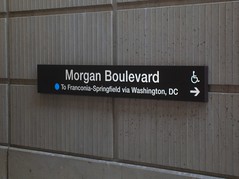 Monday Night Football, the NFL's major prime time network(-cum-basic-cable) broadcast has come to FedEx Field once again. Even more exciting than the normal hyperbole of MNF game is the fact that the 6-2 Redskins are playing the 5-2 Pittsburgh Steelers, a game that lots of people are actually going to care about for a change. Redskins Nation is buzzing.
If you commute on the eastern half of the Beltway, however, your afternoon drive will probably be much slower, as FedEx Field opens the lots four hours before the 9 pm kickoff and tailgaters will likely be jamming exits 15, 16, and 17 during the evening rush, as happens for every weeknight home game at FedEx Field. But Metro is pulling their weight, just like they did for the last Monday Night game at FedEx, the 2006 season opener. The system will be staying open until 1 a.m., with additional personnel at Morgan Boulevard and Largo stations.
Considering that FedEx Field opened in 1997 but Morgan Boulevard and Largo stations did not open until 2004, Metro use during mega-events at the stadium does not make headlines like Nationals Park did when it opened atop a Green Line station this spring. People took notice that Nationals games were not choking the Metro system, even when Nationals games were getting high attendance at the beginning of the season (interest naturally waned by the middle of their dismal 59-102 season).
Of course, FedEx Field has over twice the capacity of Nationals Park. Then again, FedEx Field is suburban, fed by highways, and surrounded by acres of surface parking. Where Navy Yard station is a block from Nats Park, FedEx Field lies almost a mile from Morgan Boulevard. Even if one were to envision a future Purple Line station at FedEx Field, it wouldn't be much closer, and would likely augment rather than replace Morgan Boulevard as the primary stop for the venue. In any event, an awful lot of people would have to give up driving before Metro started to have major issues on game day, even when games impacted the weekday rush hour. For now, the Blue Line is a viable alternative to driving. I'll take walking a four fifths of a mile for free from the Metro over walking two fifths of a mile from a $30 parking space. And it never hurts to take a car off the Beltway, while you're at it.
Friday, October 31, 2008
cArmy Base: Fort Meade
Military bases dot the landscape all around the Capital region. This is a unique presence, as many cities in America are largely defined by the one or two military bases near their boundaries, cities like Fayetteville, NC; Pensacola, FL; Kileen, TX; Norfolk, VA; and even San Diego, CA. Washington, DC, however, is home to the entire Federal Government, so the fact of a few military bases is pocket change in comparison. among the more prominent is a WWI-era base halfway between DC and Baltimore called Fort George G. Meade.
Nestled at the northeast corner of the junction of the Baltimore-Washington Parkway and MD-32, Fort Meade is by far the largest single job center in the state of Maryland and, after Downtown and Tysons Corner, the third largest in the metro area, and this does not account for National Business Park, a huge complex of government contractor buildings right across the B-W Parkway. Fort Meade is home to tens of thousands of military personnel from all five branches, plus retirees. It houses several major Army units, including the Defense Information School, Defense Courier Service, and the US Army Field Band. The Environmental Protection Agency has a large facility, and let's not forget about the National Security Agency, which housed over 30,000 jobs according to James Bamford's 2000 book Body of Secrets. No doubt that number has increased in recent years. Additionally, 5,700 jobs are being relocated to Fort Meade in the Base Relocation and Closure.
The continued growth of the base is of great concern, considering the institutional problems within the defense department when it comes to planning policy. The Pentagon, for example, sits atop two lines of Metro, yet it still has the largest surface parking lot in Arlington County. Fort Meade's total surface parking rivals (if not overtakes) FedEx Field's. This is particularly alarming considering the surface parking's negative effects on storm water runoff into the adjacent Patuxent Research Refuge (to the point where the NSA has an entire section devoted to it on its website). But the base's planning priority? Two 18 hole golf courses to "maintain soldiers' quality of life".
Surely with all these jobs, thousands of residents, and an explosion of growth in the near future, there must be some kind of transit node on the base, right? Not really.
The base is served by a single bus, a 24-seater that runs only twice in the morning and twice in the evening and serves only portions of the city of Laurel to the NSA's main gate. Various agencies on the base offer shuttles that run a few times a day from the Odenton and Savage MARC stations, which are two and five miles from the NSA main gate, respectively, and each three miles from the nearest regular base gate. It is literally illegal to walk any of those routes, as they are largely along MD-32, a freeway of interstate standards. Even servicemen living on base are likely to commute by car, as the base is so spread out that it is a long walk from any of the housing to any of the jobs on post, including almost all of the shopping and recreation amenities.
The first thing I did when I got stationed at Fort Meade? Buy a car. Sure, I wanted a car to go home and visit my family regularly. But I would not have been able to attend my morning physical training without a car. And this was when I lived in the battalion barracks!
So what do you care about a base 20 miles outside of DC?
Consider that a traffic nightmare reaching the base would have a major impact on transportation between Baltimore and Washington. The economic impacts of the resulting disconnect between the two cities could be drastic. Ryan Avent considered the positive impacts that a high speed rail between DC and Baltimore would provide. clogging the highways between the two cities would likely have the opposite effect.
I have often considered Fort Meade an ideal place for the Baltimore and Washington rail systems to meet. I know many detractors consider it wasteful to run the system all the way out to Fort Meade. But smaller jobs centers in Chantilly and Reston, similarly unserved by transit currently will be getting Silver Line service within a decade. And transportation implications in northwestern Fairfax County do not affect passage between two major cities. Other bases involved in the BRAC, such as Andrews AFB, Bolling AFB, Fort Belvoir, and Bethesda Naval Medical Center, have all had plenty of proposals thrown around to improve transit access to the bases (in some cases, like Bolling and Bethesda Naval, increasing existing transit efficiency). Fort Meade has not, despite the unique opportunity of potentially being able to serve the base by two major cities' transit systems. To alleviate traffic at enormous (50,000+) job centers, connector shuttles from commuter rails (i.e. a necessary modal shift) just won't do the trick. Perhaps for a Metro station, the NSA could donate some of it's 900+ acres of parking.
But today, long before ground will ever be broken on any kind of rail connections, wouldn't it at LEAST be appropriate for Fort Meade to receive some sort of express bus service from Greenbelt Metro? Perhaps more regular service from towns like Columbia, Laurel, Odenton and Annapolis? A bus system for the base itself so that a young GI doesn't have to waste his first few paychecks on a new car?
It blows my mind that 18 year old privates are not allowed to drink alcohol, but they are expected to be mature enough to finance, purchase, insure, and properly operate their own heavy machinery, which they may legally store on base free of charge. Shame on Army bases across the country, but particularly Fort Meade, which has the resources nearby to outgrow ridiculous and deleterious planning policies. For a service known for moving on foot, the Army's bases certainly don't embrace any mode of transportation beyond the car.
Nestled at the northeast corner of the junction of the Baltimore-Washington Parkway and MD-32, Fort Meade is by far the largest single job center in the state of Maryland and, after Downtown and Tysons Corner, the third largest in the metro area, and this does not account for National Business Park, a huge complex of government contractor buildings right across the B-W Parkway. Fort Meade is home to tens of thousands of military personnel from all five branches, plus retirees. It houses several major Army units, including the Defense Information School, Defense Courier Service, and the US Army Field Band. The Environmental Protection Agency has a large facility, and let's not forget about the National Security Agency, which housed over 30,000 jobs according to James Bamford's 2000 book Body of Secrets. No doubt that number has increased in recent years. Additionally, 5,700 jobs are being relocated to Fort Meade in the Base Relocation and Closure.
The continued growth of the base is of great concern, considering the institutional problems within the defense department when it comes to planning policy. The Pentagon, for example, sits atop two lines of Metro, yet it still has the largest surface parking lot in Arlington County. Fort Meade's total surface parking rivals (if not overtakes) FedEx Field's. This is particularly alarming considering the surface parking's negative effects on storm water runoff into the adjacent Patuxent Research Refuge (to the point where the NSA has an entire section devoted to it on its website). But the base's planning priority? Two 18 hole golf courses to "maintain soldiers' quality of life".
Surely with all these jobs, thousands of residents, and an explosion of growth in the near future, there must be some kind of transit node on the base, right? Not really.
The base is served by a single bus, a 24-seater that runs only twice in the morning and twice in the evening and serves only portions of the city of Laurel to the NSA's main gate. Various agencies on the base offer shuttles that run a few times a day from the Odenton and Savage MARC stations, which are two and five miles from the NSA main gate, respectively, and each three miles from the nearest regular base gate. It is literally illegal to walk any of those routes, as they are largely along MD-32, a freeway of interstate standards. Even servicemen living on base are likely to commute by car, as the base is so spread out that it is a long walk from any of the housing to any of the jobs on post, including almost all of the shopping and recreation amenities.
The first thing I did when I got stationed at Fort Meade? Buy a car. Sure, I wanted a car to go home and visit my family regularly. But I would not have been able to attend my morning physical training without a car. And this was when I lived in the battalion barracks!
So what do you care about a base 20 miles outside of DC?
Consider that a traffic nightmare reaching the base would have a major impact on transportation between Baltimore and Washington. The economic impacts of the resulting disconnect between the two cities could be drastic. Ryan Avent considered the positive impacts that a high speed rail between DC and Baltimore would provide. clogging the highways between the two cities would likely have the opposite effect.
I have often considered Fort Meade an ideal place for the Baltimore and Washington rail systems to meet. I know many detractors consider it wasteful to run the system all the way out to Fort Meade. But smaller jobs centers in Chantilly and Reston, similarly unserved by transit currently will be getting Silver Line service within a decade. And transportation implications in northwestern Fairfax County do not affect passage between two major cities. Other bases involved in the BRAC, such as Andrews AFB, Bolling AFB, Fort Belvoir, and Bethesda Naval Medical Center, have all had plenty of proposals thrown around to improve transit access to the bases (in some cases, like Bolling and Bethesda Naval, increasing existing transit efficiency). Fort Meade has not, despite the unique opportunity of potentially being able to serve the base by two major cities' transit systems. To alleviate traffic at enormous (50,000+) job centers, connector shuttles from commuter rails (i.e. a necessary modal shift) just won't do the trick. Perhaps for a Metro station, the NSA could donate some of it's 900+ acres of parking.
But today, long before ground will ever be broken on any kind of rail connections, wouldn't it at LEAST be appropriate for Fort Meade to receive some sort of express bus service from Greenbelt Metro? Perhaps more regular service from towns like Columbia, Laurel, Odenton and Annapolis? A bus system for the base itself so that a young GI doesn't have to waste his first few paychecks on a new car?
It blows my mind that 18 year old privates are not allowed to drink alcohol, but they are expected to be mature enough to finance, purchase, insure, and properly operate their own heavy machinery, which they may legally store on base free of charge. Shame on Army bases across the country, but particularly Fort Meade, which has the resources nearby to outgrow ridiculous and deleterious planning policies. For a service known for moving on foot, the Army's bases certainly don't embrace any mode of transportation beyond the car.
Thursday, October 30, 2008
Home Sweet Home...
I bought my home in November 2003, at the very beginning of the housing bubble. I consider myself lucky. I had considered moving out and renting for a little while when I got out of the Army in 2005, and I wish I had. My house today is worth less than half what it was worth in when I got out of the Army. Thankfully, still slightly more than I paid for it.
I count my blessings that I wasn't one of the poor souls who got wrangled into a sub-prime mortgage. Considering that I was a naive 23 year old Army specialist when I purchased my house, I very well could have fallen for that. So I'm not on the streets, and I am not totally broke. I count my lucky stars for that.
But now I find myself in a different type of bad situation: one where I want to relocate, but I can't. Sure, it's an excellent time to buy. But even the most motivated seller would have a difficult time selling an old starter home behind the strip malls of Route 1. Tonight I realized just how stuck I really am, and I've all but abandoned my goal of moving by next summer, unless I hit the Powerball or find a much, much more lucrative career field.
I bought this house because of my job on Fort Meade (I'm a civilian now, I was in the Army then). I wasn't thinking that I would be here for a particularly long time, and I was hoping to relocate somewhere more convenient to Metro once I got established in my civilian position. Of course, with the minimal transit capacity on Fort Meade, living near Metro would do me little good, though I might be able to take MARC to work once in a while if I'm in a pinch. The 3 mile shuttle ride from the MARC station to my building is long, infrequent, and inconvenient, and doesn't mesh with my later work schedule, but there are days where anything is better than spending half an hour looking for parking in a lot comparable in size to the lot at FedEx Field for a space that is likely to be virtually inaccessible when I get out of work at 9pm and several of the access gates are long closed.
The parking situation alone leaves me bewildered at people who oppose having Metro come out to Fort Meade, where there are 50,000 jobs plus several thousand more across the B-W Parkway (mostly government contractors, not unlike parts of Tyson's Corner). This massive job center has virtually zero direct transit access (very few shuttles from Savage and Odenton MARC stations), and literally thousands of acres of Fort Meade have been converted to parking lots in order to maintain growth.
Alas, I'm a slave to my car, which soaks up so much of my income that I can't afford to invest the money into the house that I would like in order to sell. Not the worst problem in the world, but just another way the bad economy is hurting an average joe.

I count my blessings that I wasn't one of the poor souls who got wrangled into a sub-prime mortgage. Considering that I was a naive 23 year old Army specialist when I purchased my house, I very well could have fallen for that. So I'm not on the streets, and I am not totally broke. I count my lucky stars for that.
But now I find myself in a different type of bad situation: one where I want to relocate, but I can't. Sure, it's an excellent time to buy. But even the most motivated seller would have a difficult time selling an old starter home behind the strip malls of Route 1. Tonight I realized just how stuck I really am, and I've all but abandoned my goal of moving by next summer, unless I hit the Powerball or find a much, much more lucrative career field.
I bought this house because of my job on Fort Meade (I'm a civilian now, I was in the Army then). I wasn't thinking that I would be here for a particularly long time, and I was hoping to relocate somewhere more convenient to Metro once I got established in my civilian position. Of course, with the minimal transit capacity on Fort Meade, living near Metro would do me little good, though I might be able to take MARC to work once in a while if I'm in a pinch. The 3 mile shuttle ride from the MARC station to my building is long, infrequent, and inconvenient, and doesn't mesh with my later work schedule, but there are days where anything is better than spending half an hour looking for parking in a lot comparable in size to the lot at FedEx Field for a space that is likely to be virtually inaccessible when I get out of work at 9pm and several of the access gates are long closed.
The parking situation alone leaves me bewildered at people who oppose having Metro come out to Fort Meade, where there are 50,000 jobs plus several thousand more across the B-W Parkway (mostly government contractors, not unlike parts of Tyson's Corner). This massive job center has virtually zero direct transit access (very few shuttles from Savage and Odenton MARC stations), and literally thousands of acres of Fort Meade have been converted to parking lots in order to maintain growth.
Alas, I'm a slave to my car, which soaks up so much of my income that I can't afford to invest the money into the house that I would like in order to sell. Not the worst problem in the world, but just another way the bad economy is hurting an average joe.
Tuesday, October 28, 2008
Stupid Growth: The CCC
When the Arc and the Dove landed on the shores of the lower Potomac in 1634, Southern Maryland was as pristine as it had ever been. Beautiful estuaries, diverse flora and fauna,
and verdant landscapes have always highlighted the area, and they no doubt helped contribute to the success of the first European colony in Maryland.
Most recently, parts of Charles, Calvert, and Saint Mary's County have come to look more like the off-the-highway towns I came to know in the remote parts of the Midwest back in my Army days. Car culture, big boxes, and inefficient land use has taken its toll in places like Waldorf and Dunkirk, and the effects are spreading. Vital wetlands in the Potomac and Patuxent watersheds are bearing the brunt of the ecological damage.
And now a new highway is moving forward.
The Charles County Connector. Consider it the baby brother of the ICC. And thanks to the big brother, you're not likely to hear anything about it. I myself have had a difficult time finding up-to-date information on this highway, but I managed to dig up an old National Environmental Policy Act report (warning: PDF).
 I first heard of this freeway through a colleague of mine who is a member of the Maryland Ornithological Society. The group is of course concerned about the outright destruction the vital wetlands of the Mattawoman Creek as well as increasing impervious surfaces that will feed polluted water into the wetlands, home to scores of species of Maryland birds. These concerns are shared directly by the Mattawoman Watershed Society, who is urging people to write the governor in opposition of the plan. In all, the four-mile, $60m highway would require the destruction of 74 acres of forest and 7.5 acres of wetland. Much of the surrounding area is slated for development upon completion of the new road.
Tim Wheeler at the Baltimore Sun's Bay and Environment blog points out that this deleterious construction would be carried out under the guise of the Maryland Smart Growth initiatives. This to me is incredibly bizarre and most frustrating. Obviously, keeping development in the northern portion of Charles County makes sense for a number of reasons. It is closer to DC, there are larger towns (Waldorf, LaPlata) that are already somewhat developed, and there are ample road and utility connections already present. But smart growth by definition would dictate that development would take place in and around those towns, not in brand new developments around them. Smart growth implies LESS use of the automobile, quite contrary to the notion of constructing a highway.
Granted I have only skimmed the NEPA report, but nowhere have I seen any plans for sidewalks, trails, or transit along the highway. Of course, If they are there, they may get canceled for "environmental impact" reasons like the ironic fate of the ICC bike trail.
For those that argue that they need the highway to alleviate traffic in the area, consider the following analogy: building highways to alleviate traffic is like scratching poison Ivy to get rid of the irritation. It will be better for a short while, but ultimately you are only spreading the problem. Perhaps before Charles County partitions and destroys its most valuable resource, denser construction and transit around Waldorf ought to be considered. That's real smart growth. And if they do, perhaps Southern Maryland will keep a bit more of its idyllic charm from getting eaten up by cul-de-sacs and parking lots. And perhaps my friend from work will be able to spot a common snipe on the Mattawoman for years to come.
and verdant landscapes have always highlighted the area, and they no doubt helped contribute to the success of the first European colony in Maryland.
Most recently, parts of Charles, Calvert, and Saint Mary's County have come to look more like the off-the-highway towns I came to know in the remote parts of the Midwest back in my Army days. Car culture, big boxes, and inefficient land use has taken its toll in places like Waldorf and Dunkirk, and the effects are spreading. Vital wetlands in the Potomac and Patuxent watersheds are bearing the brunt of the ecological damage.
And now a new highway is moving forward.
The Charles County Connector. Consider it the baby brother of the ICC. And thanks to the big brother, you're not likely to hear anything about it. I myself have had a difficult time finding up-to-date information on this highway, but I managed to dig up an old National Environmental Policy Act report (warning: PDF).
 I first heard of this freeway through a colleague of mine who is a member of the Maryland Ornithological Society. The group is of course concerned about the outright destruction the vital wetlands of the Mattawoman Creek as well as increasing impervious surfaces that will feed polluted water into the wetlands, home to scores of species of Maryland birds. These concerns are shared directly by the Mattawoman Watershed Society, who is urging people to write the governor in opposition of the plan. In all, the four-mile, $60m highway would require the destruction of 74 acres of forest and 7.5 acres of wetland. Much of the surrounding area is slated for development upon completion of the new road.
Tim Wheeler at the Baltimore Sun's Bay and Environment blog points out that this deleterious construction would be carried out under the guise of the Maryland Smart Growth initiatives. This to me is incredibly bizarre and most frustrating. Obviously, keeping development in the northern portion of Charles County makes sense for a number of reasons. It is closer to DC, there are larger towns (Waldorf, LaPlata) that are already somewhat developed, and there are ample road and utility connections already present. But smart growth by definition would dictate that development would take place in and around those towns, not in brand new developments around them. Smart growth implies LESS use of the automobile, quite contrary to the notion of constructing a highway.
Granted I have only skimmed the NEPA report, but nowhere have I seen any plans for sidewalks, trails, or transit along the highway. Of course, If they are there, they may get canceled for "environmental impact" reasons like the ironic fate of the ICC bike trail.
For those that argue that they need the highway to alleviate traffic in the area, consider the following analogy: building highways to alleviate traffic is like scratching poison Ivy to get rid of the irritation. It will be better for a short while, but ultimately you are only spreading the problem. Perhaps before Charles County partitions and destroys its most valuable resource, denser construction and transit around Waldorf ought to be considered. That's real smart growth. And if they do, perhaps Southern Maryland will keep a bit more of its idyllic charm from getting eaten up by cul-de-sacs and parking lots. And perhaps my friend from work will be able to spot a common snipe on the Mattawoman for years to come.
Subscribe to:
Posts (Atom)

 Posts
Posts


